We help the world since 2012

How to Select the Right High Voltage DC-DC Converter
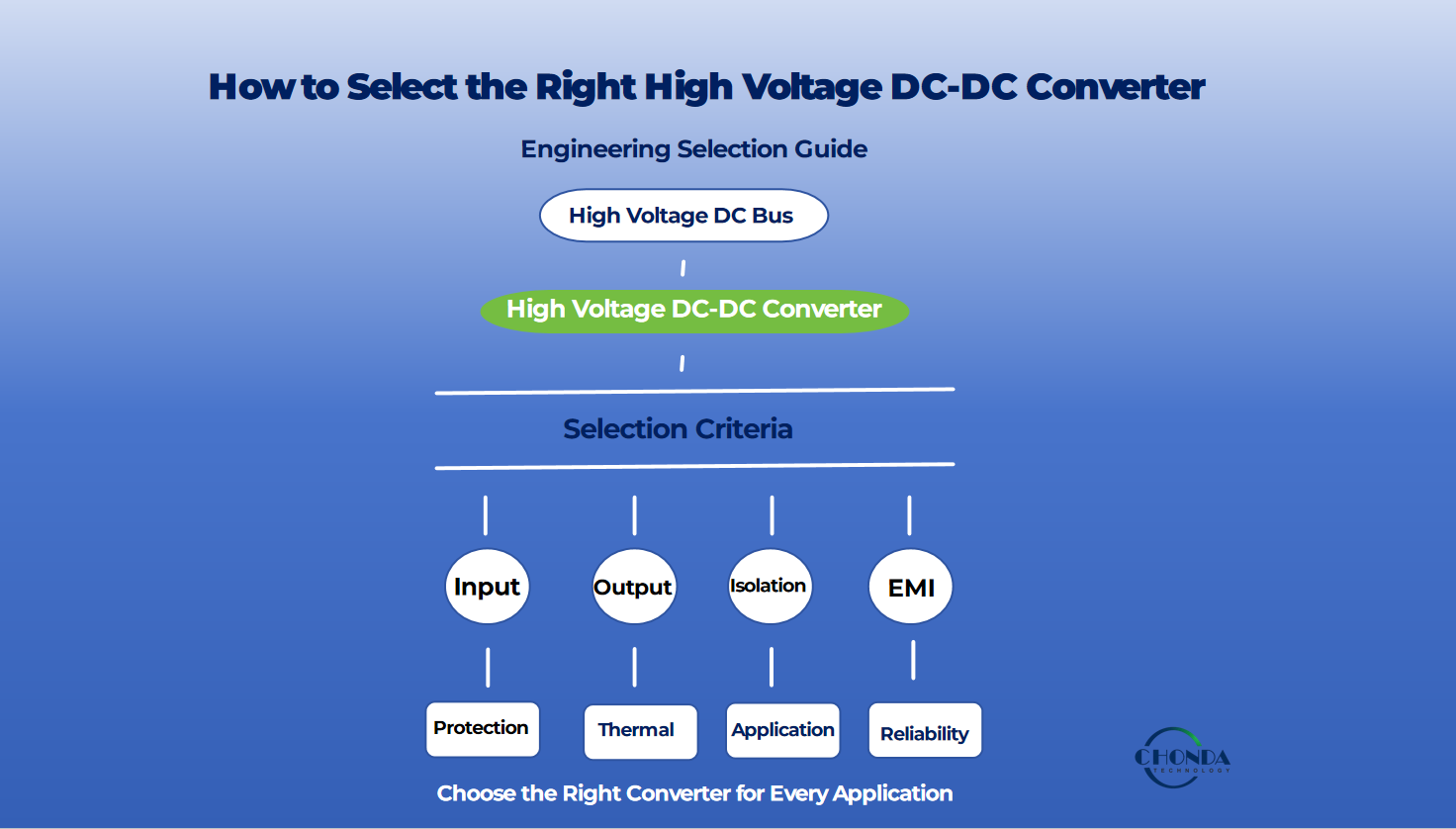
Selecting the right high voltage DC-DC converter is one of the most important decisions when designing modern high-voltage power systems. Although many engineers initially compare only input voltage, output voltage, and output power, successful converter selection requires a much broader evaluation that includes electrical isolation, electromagnetic compatibility (EMI), thermal performance, protection functions, long-term reliability, and application-specific operating conditions.
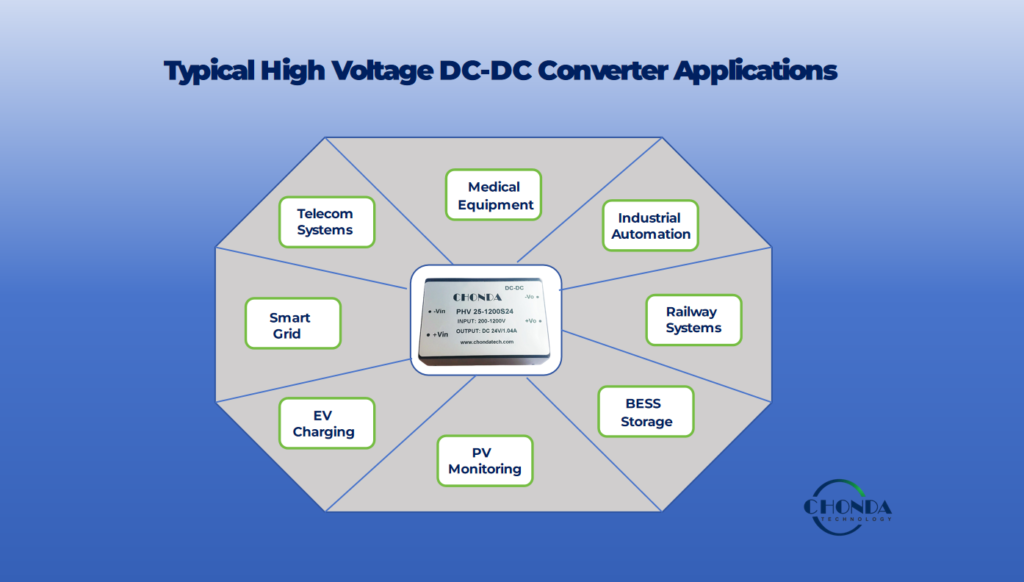
High voltage DC-DC converters are widely used in battery energy storage systems (BESS), photovoltaic monitoring equipment, industrial automation, railway electronics, EV charging infrastructure, medical equipment, smart grid systems, and telecommunication networks. Each application places different demands on the auxiliary power supply, meaning that a converter suitable for one industry may not be the best choice for another.
This guide explains a practical engineering workflow for selecting the right high voltage DC-DC converter. Instead of focusing on product specifications alone, we will examine the key design considerations that influence long-term system reliability while linking to detailed technical articles covering isolation, EMI, thermal management, protection features, and industry-specific applications.
Why Selecting the Right High Voltage DC-DC Converter Matters
Many engineers begin the selection process by comparing only the input voltage, output voltage, and output power of a DC-DC converter. While these specifications are important, they represent only a small part of the overall design decision.
In real-world applications, the auxiliary power supply directly influences system reliability, electrical safety, electromagnetic compatibility, thermal performance, maintenance requirements, and even the overall product lifetime. Choosing the wrong converter may lead to unstable operation, certification failures, excessive heat generation, or unexpected field failures long after the equipment has been deployed.
Selecting the right high voltage DC-DC converter means understanding not only the electrical specifications, but also how the converter will operate within the complete system.
Why Can’t Engineers Select a Converter Based Only on Voltage?
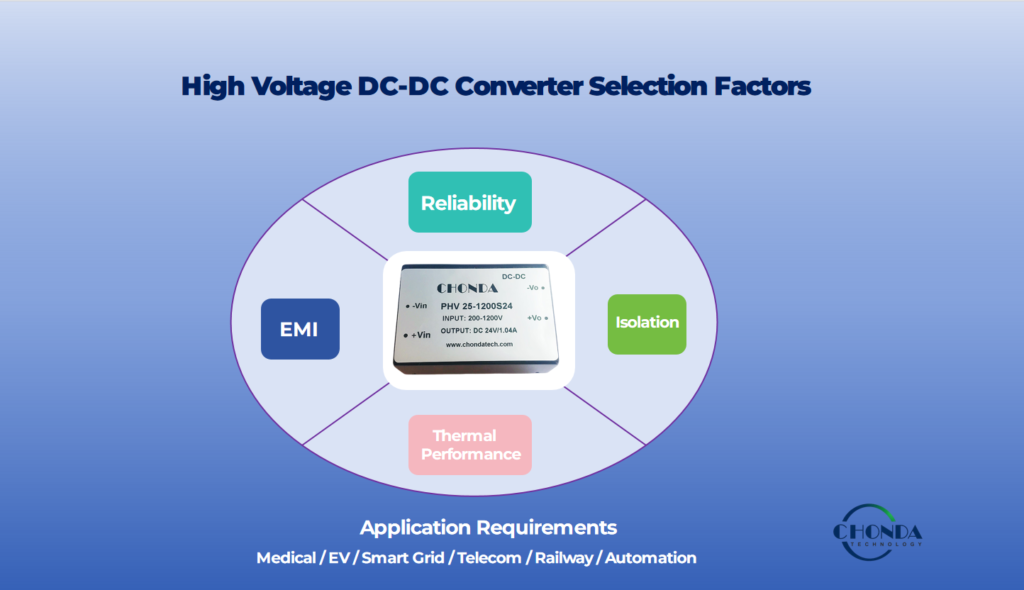
Two converters may share identical input and output voltage ratings while delivering completely different system performance.
For example, one converter may provide:
- Reinforced electrical isolation
- Low EMI characteristics
- High conversion efficiency
- Wide operating temperature capability
- Long-term industrial reliability
while another may simply satisfy the voltage requirements without meeting the environmental or regulatory demands of the application.
As a result, voltage specifications alone cannot determine whether a converter is suitable for a particular project.
Why Does Converter Selection Affect Overall System Reliability?
The auxiliary power supply operates continuously throughout the lifetime of the equipment.
If the converter experiences excessive electrical noise, unstable output regulation, poor thermal performance, or insufficient protection, these issues can affect the operation of controllers, communication interfaces, monitoring circuits, sensors, and other critical electronics.
A carefully selected converter helps improve:
- Long-term operational stability
- System uptime
- Maintenance intervals
- Product lifetime
- Overall equipment reliability
For industrial and infrastructure equipment expected to operate 24 hours a day, converter reliability is often just as important as the primary system design.
Why Is Application Context Important?
Different industries place very different requirements on auxiliary power supplies.
For example:
| Application | Primary Design Consideration |
|---|---|
| Medical Equipment | Patient safety, reinforced isolation, low leakage current |
| EV Charging Systems | Wide input voltage, high efficiency, outdoor reliability |
| Smart Grid Systems | Continuous operation, electrical isolation, long service life |
| Telecommunication Systems | Low EMI, communication stability, 24/7 operation |
| Railway Electronics | Vibration resistance, temperature tolerance, reliability |
| Industrial Automation | Fast response, compact size, industrial EMC |
Understanding the operating environment allows engineers to choose a converter that supports both electrical performance and long-term system reliability instead of selecting based only on electrical ratings.
Step 1 — Define the Input Voltage Range
Selecting the correct input voltage range is the first step when choosing a high voltage DC-DC converter. The converter must operate reliably across the entire DC bus voltage rather than only the nominal system voltage.
Many engineers mistakenly select a converter based on the normal operating voltage without considering startup conditions, battery charging status, regenerative energy, or voltage fluctuations. This often leads to unstable operation or unexpected system failures.
Instead of asking “What is my nominal voltage?”, the better question is:
“What is the minimum and maximum voltage my DC bus can reach during real operation?”
Only after defining the actual operating range can an appropriate converter be selected.
Why Is Input Voltage Range So Important?
The input voltage directly determines whether the converter can maintain stable regulation under all operating conditions.
If the DC bus voltage exceeds the converter’s specified range, the converter may:
- Shut down unexpectedly
- Trigger over-voltage protection
- Reduce output stability
- Experience accelerated component aging
Conversely, if the input voltage falls below the minimum operating threshold, the auxiliary electronics may lose power, affecting controllers, communication modules, and monitoring systems.
A correctly selected input range ensures reliable auxiliary power throughout the entire operating cycle.
Typical High Voltage Input Ranges
Different industries operate with different DC bus voltages.
Typical examples include:
| Typical DC Bus | Recommended Converter Range | Typical Applications |
|---|---|---|
| 200–800 VDC | 200–800 VDC | Industrial automation, energy storage |
| 200–1200 VDC | 200–1200 VDC | Smart grid, EV charging, railway systems |
| Up to 1500 VDC | Custom solutions | Utility-scale PV systems and specialized high-voltage equipment |
Selecting a converter with sufficient voltage margin helps improve long-term reliability while reducing the risk of unexpected shutdowns during abnormal operating conditions.
Should You Choose a Wider Input Range?
Not always.
A wider input range increases application flexibility, but it should match the actual system requirements rather than being selected simply because “more is better.”
Engineers should balance:
- Actual operating voltage
- System safety margin
- Converter efficiency
- Project cost
- Long-term reliability
Choosing an appropriate operating range is often more beneficial than selecting the widest available specification.
📚 Continue Reading
If you would like to learn more about the key parameters that influence high voltage DC-DC converter selection, continue reading:
→ DC-DC Converter Selection Guide: Key Parameters for High Voltage Applications
Step 2 — Select the Required Output Voltage and Power
After determining the required input voltage range, the next step is selecting the appropriate output voltage and power rating.
The auxiliary power supply must provide stable power for every low-voltage subsystem within the equipment. Although many systems appear similar from the outside, their auxiliary power requirements can differ significantly depending on the number of electronic modules, communication interfaces, processors, sensors, and control circuits.
Choosing an output voltage simply because it is commonly used is not always the best engineering decision. Instead, engineers should evaluate the actual load requirements of the complete system.
Which Output Voltage Should You Choose?
Different applications commonly require different auxiliary supply voltages.
Typical output voltages include:
| Output Voltage | Typical Applications |
|---|---|
| 12 VDC | Embedded controllers, sensors, industrial electronics |
| 24 VDC | Industrial automation, telecommunication, railway systems, smart grid equipment |
| 48 VDC | Communication systems, networking equipment, distributed power architectures |
Among these options, 24 VDC remains one of the most widely adopted auxiliary voltages because it offers an excellent balance between transmission efficiency, wiring simplicity, and compatibility with industrial control equipment.
How Much Output Power Is Required?
Output power should be calculated based on the total auxiliary load rather than individual components.
Typical auxiliary loads may include:
- Industrial controllers
- PLC modules
- Communication gateways
- Optical transceivers
- Monitoring systems
- Protection relays
- Human-machine interfaces (HMIs)
- Cooling fans
- Sensor interfaces
When estimating converter capacity, engineers should always include sufficient design margin to accommodate startup current, future expansion, and continuous long-term operation.
Why Is Power Margin Important?
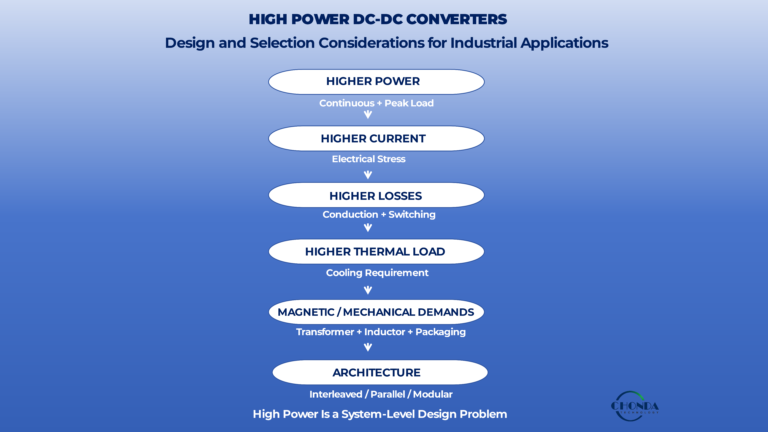
Selecting a converter that operates continuously near its maximum rated output may reduce efficiency and increase thermal stress.
Maintaining reasonable operating headroom helps improve:
- Conversion efficiency
- Thermal performance
- Long-term reliability
- Component lifetime
- Overall system stability
Rather than selecting the smallest converter capable of supporting the load, engineers typically choose a converter with appropriate reserve capacity to ensure reliable operation under varying environmental conditions.
📚 Continue Reading
To better understand the key electrical parameters involved in converter selection, continue with:
→ DC-DC Converter Selection Guide: Key Parameters for High Voltage Applications
Step 3 — Determine the Required Isolation Level
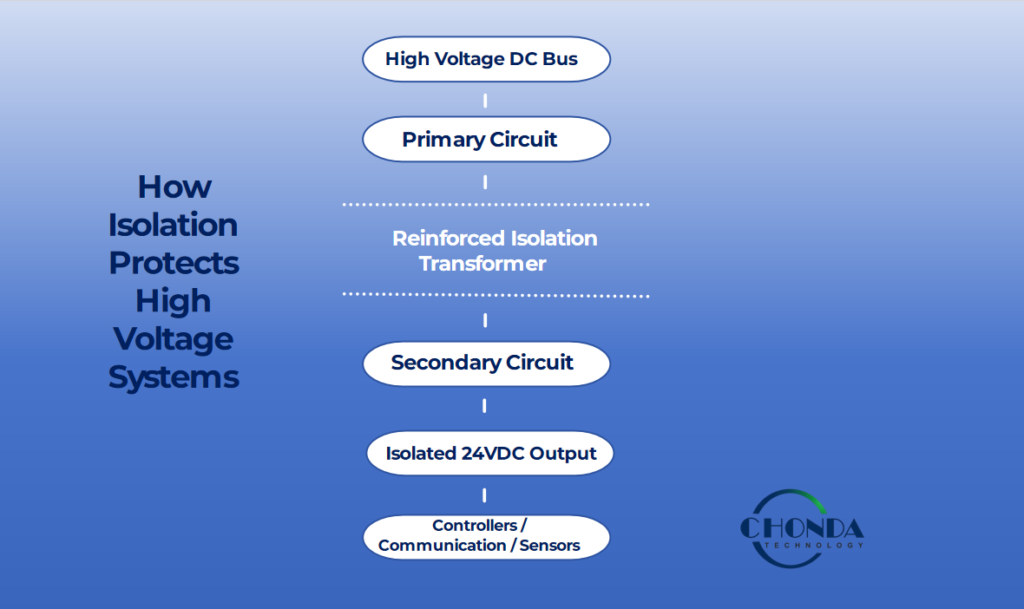
Electrical isolation is one of the most important considerations when selecting a high voltage DC-DC converter.
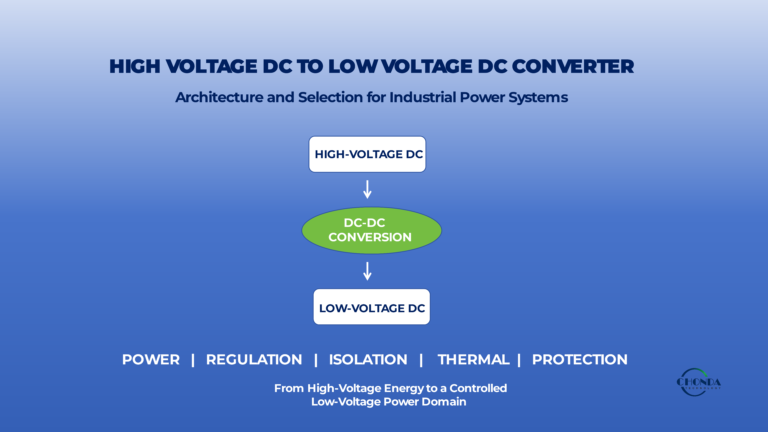
Isolation protects low-voltage control electronics from hazardous high-voltage DC buses while preventing unwanted electrical interference from propagating throughout the system.
The required isolation level depends on the application rather than simply the converter itself. Industrial automation, medical equipment, railway systems, telecommunication infrastructure, EV charging systems, and smart grid applications all have different isolation requirements based on safety regulations and operating environments.
Why Is Isolation Necessary?
Without adequate isolation, high-voltage transients or ground potential differences may reach sensitive electronic circuits.
Proper isolation helps to:
- Protect operators and maintenance personnel
- Prevent damage to low-voltage electronics
- Reduce ground loop interference
- Improve signal integrity
- Increase overall system reliability
For many industrial and infrastructure applications, electrical isolation is both a safety requirement and a performance requirement.
Common Isolation Voltage Levels
The required isolation voltage varies depending on industry standards and system design.
Typical values include:
| Isolation Rating | Typical Applications |
|---|---|
| 1500 VAC | Industrial automation, telecommunication, smart grid |
| 3000 VAC | Railway equipment, energy storage, EV charging |
| 5000 VAC | Medical devices and applications requiring reinforced isolation |
Higher isolation ratings provide greater protection against electrical stress but should be selected according to actual system requirements rather than specification alone.
Isolation Is More Than a Voltage Rating
Many engineers focus only on the isolation voltage printed in the datasheet.
However, reliable isolation also depends on factors such as:
- Transformer design
- Creepage distance
- Clearance distance
- PCB layout
- Insulation materials
- Long-term aging performance
A converter with well-designed isolation provides stable protection throughout its service life, even in harsh industrial environments.
How to Choose the Right Isolation Level
When selecting an isolation rating, engineers should evaluate:
- Maximum system voltage
- Applicable safety standards
- Operating environment
- Expected surge conditions
- Long-term reliability requirements
Rather than selecting the highest available specification, the best practice is to choose an isolation level that satisfies both regulatory requirements and practical operating conditions.
📚 Continue Reading
To learn more about isolation design and reinforced isolation principles, continue with:
→ High Voltage DC-DC Converter Isolation Design: Principles and Applications
→ Medical Isolation Power Supply
Step 4 — Evaluate EMI Performance
Electromagnetic interference (EMI) is often overlooked during converter selection until unexpected communication problems or EMC certification failures occur.
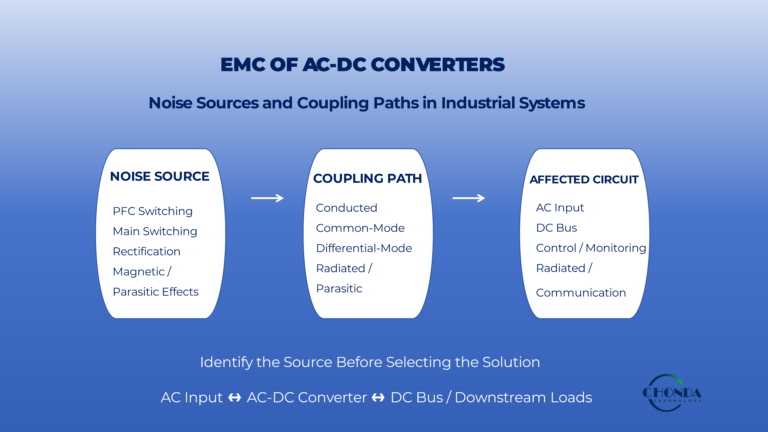
High voltage DC-DC converters are switching power supplies that naturally generate high-frequency electrical noise. If EMI is not properly controlled, it can affect nearby electronic circuits, communication interfaces, measurement accuracy, and overall system stability.
Selecting a converter with optimized EMI performance helps reduce system integration risks while simplifying EMC compliance during product development.
Why Does EMI Matter?
Switching converters continuously generate high-frequency voltage and current transitions.
Without proper EMI control, these switching signals may couple into nearby circuits through conduction or radiation, causing problems such as:
- Communication errors
- Sensor instability
- Increased measurement noise
- False triggering of digital circuits
- Reduced overall system reliability
In complex electronic systems, EMI affects far more than the power supply itself.
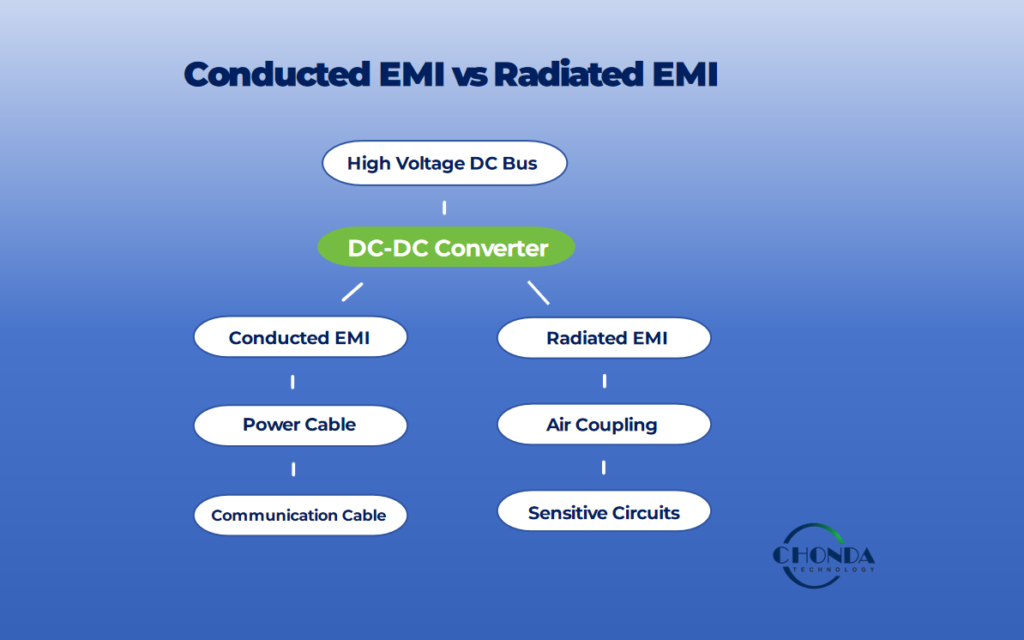
Conducted EMI vs Radiated EMI
When evaluating converter performance, engineers should understand the difference between two major types of electromagnetic interference.
| EMI Type | Description | Typical Impact |
|---|---|---|
| Conducted EMI | Electrical noise transmitted through power lines and cables | Power instability, communication interference |
| Radiated EMI | Electromagnetic energy emitted into surrounding space | Wireless interference, EMC certification failures |
Both forms should be considered during converter selection, especially in systems containing sensitive communication or measurement electronics.
Applications That Require Low EMI
Low EMI performance is especially important in applications such as:
- Medical equipment
- Telecommunication systems
- Smart grid controllers
- Industrial automation
- Precision measurement equipment
- Optical communication systems
In these environments, maintaining clean auxiliary power helps ensure stable communication, accurate data acquisition, and reliable long-term operation.
How to Evaluate EMI Performance
Instead of looking only at converter efficiency, engineers should also review:
- EMI test reports
- Input and output filtering design
- PCB layout recommendations
- Shielding strategy
- Compliance with applicable EMC standards
A converter designed with low EMI characteristics can significantly reduce development time by minimizing system-level troubleshooting and simplifying EMC certification.
📚 Continue Reading
For a more detailed discussion of EMI optimization techniques, continue with:
→ High Voltage DC-DC Converter EMI Design Considerations
→ Low EMI DC-DC Converter for Medical Equipment
Step 5 — Verify Protection Features
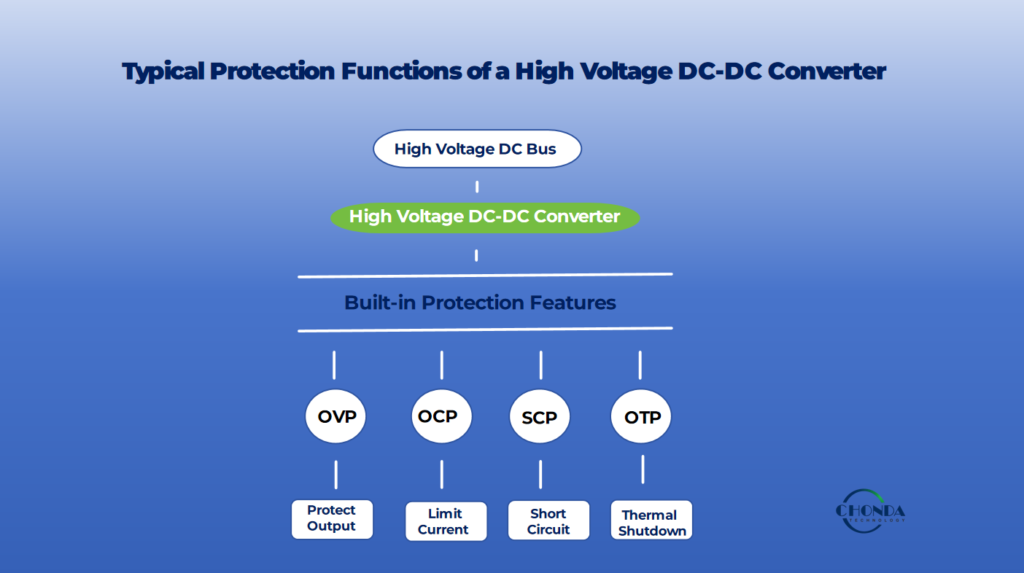
Electrical protection is one of the most important factors when selecting a high voltage DC-DC converter. Even when a power system is carefully designed, unexpected electrical faults can still occur during startup, maintenance, abnormal loading, or environmental disturbances.
A reliable converter should not only provide stable output power but also protect itself and the downstream electronics against abnormal operating conditions. Proper protection mechanisms reduce maintenance costs, extend equipment lifetime, and improve overall system reliability.
When comparing different high voltage DC-DC converters, engineers should verify that the required protection functions are available rather than assuming all products offer the same level of protection.
Over-Voltage Protection (OVP)
Over-Voltage Protection (OVP) prevents the output voltage from exceeding its specified operating range.
Unexpected voltage spikes may damage controllers, communication modules, sensors, industrial processors, or other sensitive electronic circuits powered by the converter.
These abnormal conditions may occur because of:
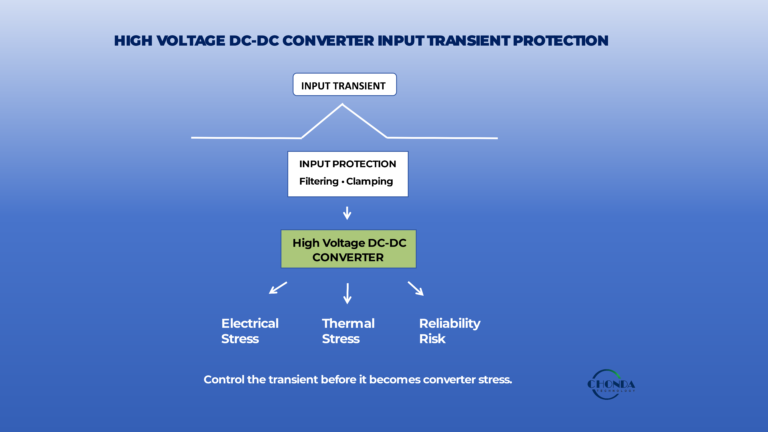
- Input voltage transients
- Load switching
- Internal component failures
- High-voltage DC bus fluctuations
A converter equipped with OVP continuously monitors the output voltage and automatically limits or shuts down the output when unsafe voltage levels are detected.
This protection helps prevent permanent damage to downstream electronics while improving the long-term stability of the entire power system.
Over-Current Protection (OCP)
Over-Current Protection (OCP) prevents excessive output current caused by overload conditions.
Temporary overloads may occur during equipment startup or when additional auxiliary loads are connected to the system.
Typical causes include:
- Controller startup surge
- Communication equipment initialization
- Fan motor startup current
- Unexpected load increases
Without current limiting, excessive current may overheat switching components, reduce converter efficiency, or permanently damage power devices.
A properly designed OCP function limits the output current or temporarily shuts down the converter until normal operating conditions are restored.
This greatly improves system robustness while protecting both the converter and connected equipment.
Short-Circuit Protection (SCP)
Short-Circuit Protection (SCP) protects the converter when the output is accidentally shorted.
Short circuits are among the most common faults encountered during:
- Equipment installation
- Field maintenance
- Wiring mistakes
- Connector failures
- Unexpected hardware faults
Instead of allowing uncontrolled current to flow, SCP immediately interrupts or limits the output current until the fault has been removed.
Fast protection response helps prevent catastrophic damage to:
- Power MOSFETs
- Isolation transformers
- PCB traces
- Connected electronic modules
For industrial and telecommunication equipment operating continuously in the field, reliable short-circuit protection significantly improves overall system reliability.
Over-Temperature Protection (OTP)
High ambient temperatures or insufficient cooling may increase the internal temperature of the converter during continuous operation.
Applications such as:
- Telecommunication cabinets
- Industrial control systems
- Outdoor communication equipment
- Smart grid installations
- EV charging systems
often operate under elevated temperatures for extended periods.
Over-Temperature Protection (OTP) continuously monitors the converter’s internal temperature. When the operating temperature exceeds the safe limit, the converter automatically reduces output power or shuts down to prevent thermal damage.
Once the temperature returns to the normal operating range, many converters automatically recover without requiring manual intervention.
Effective thermal protection extends converter lifetime while maintaining stable long-term operation in demanding environments.
Why Protection Features Matter During Converter Selection
When engineers compare high voltage DC-DC converters, output voltage and input range are often considered first. However, protection features are equally important because they directly affect long-term reliability.
A converter with comprehensive protection mechanisms can:
- Improve system safety
- Reduce maintenance costs
- Minimize unexpected downtime
- Protect expensive communication and industrial equipment
- Extend overall equipment lifetime
For mission-critical applications, selecting a converter with complete electrical protection is often more valuable than simply choosing the highest power rating.
📚 Continue Reading
To learn more about converter protection mechanisms and how they improve long-term system reliability, continue reading:
➡ High Voltage DC-DC Converter Protection Features
H2
Step 6 — Evaluate Thermal Performance
Thermal performance plays a critical role in the long-term reliability of a high voltage DC-DC converter. During operation, every power converter generates heat as part of the energy conversion process. If this heat cannot be effectively managed, internal component temperatures will continue to rise, reducing efficiency, accelerating component aging, and shortening product lifetime.
When selecting a high voltage DC-DC converter, engineers should evaluate not only the electrical specifications but also how efficiently the converter manages thermal energy under real operating conditions.
Why Does Conversion Efficiency Matter?
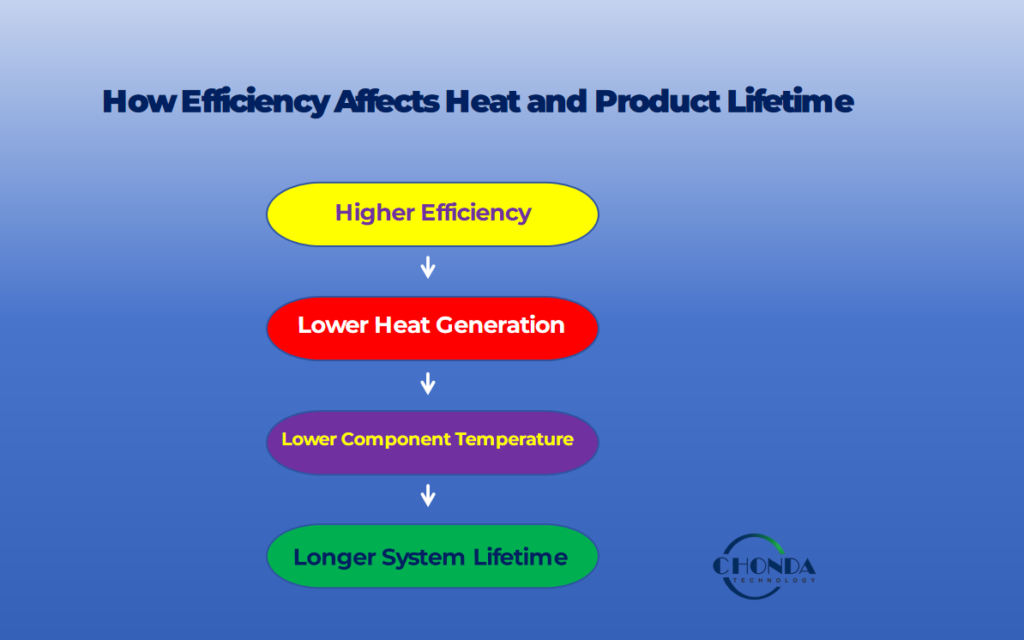
Conversion efficiency directly influences the amount of heat generated inside the converter.
A higher-efficiency converter converts more electrical energy into useful output power while producing less waste heat.
For example:
- A 95% efficient converter generates significantly less heat than a 90% efficient converter operating under the same load.
- Reduced heat generation lowers thermal stress on internal components and improves overall system stability.
High efficiency is particularly valuable in systems operating continuously, where even small efficiency improvements can reduce long-term operating temperatures.
Why Is Heat Management Important?
Excessive heat affects more than just the converter itself.
As internal temperatures increase, engineers may experience:
- Reduced output stability
- Lower conversion efficiency
- Increased component stress
- Faster aging of electronic components
- Higher risk of unexpected failures
In enclosed cabinets, outdoor installations, or high-power industrial equipment, thermal management becomes an essential part of overall system design.
Selecting a converter that operates efficiently under elevated temperatures helps maintain stable auxiliary power throughout the equipment’s service life.
How Does Thermal Performance Influence Product Lifetime?
Electronic components naturally age over time, and elevated operating temperatures accelerate this process.
Long-term exposure to excessive heat may reduce the lifetime of:
- Electrolytic capacitors
- Power semiconductors
- Magnetic components
- Insulation materials
A converter with good thermal performance operates at lower internal temperatures, reducing thermal stress and improving long-term reliability.
For industrial infrastructure expected to operate continuously for many years, thermal performance is often closely linked to maintenance costs and equipment availability.
What Should Engineers Evaluate?
When comparing high voltage DC-DC converters, engineers should review:
- Conversion efficiency
- Operating temperature range
- Maximum case temperature
- Cooling requirements
- Recommended installation conditions
- Long-term reliability under continuous operation
Rather than focusing on peak performance alone, it is important to evaluate how the converter performs during sustained operation in the actual application environment.
📚 Continue Reading
To learn more about thermal management techniques and heat dissipation strategies, continue reading:
➡ High Voltage DC-DC Converter Thermal Management
Step 7 — Match the Converter to Your Application
Selecting the right high voltage DC-DC converter is not only about electrical specifications. Different industries have different design priorities, environmental conditions, regulatory requirements, and reliability expectations.
For example, a converter used in a medical monitoring device focuses on patient safety and isolation, while one used in an EV charging station must withstand high power density and demanding outdoor environments.
After confirming the key selection parameters discussed in the previous steps, the final stage is choosing the converter that best matches your specific application.
The following application guides provide more detailed recommendations for common high-voltage DC-DC converter deployment scenarios.
Medical Equipment
Medical equipment requires reliable isolated auxiliary power for sensitive electronic circuits such as patient monitors, ECG systems, imaging equipment, and laboratory instruments.
When selecting a converter for medical applications, engineers should pay particular attention to isolation performance, low EMI, long-term reliability, and compliance with medical safety standards.
📚 Continue Reading
➡ High Voltage DC-DC Converter for Medical Equipment
Industrial Automation
Industrial automation systems often operate continuously in electrically noisy environments. Controllers, PLCs, sensors, and industrial communication modules all require stable auxiliary power with excellent reliability.
Converters designed for industrial automation should offer wide input voltage ranges, reinforced isolation, and robust protection features.
📚 Continue Reading
➡ High Voltage DC-DC Converter for Industrial Automation
Railway Systems
Railway applications demand exceptional reliability because equipment must continue operating under vibration, temperature variation, and long service cycles.
High voltage DC-DC converters are widely used to provide isolated auxiliary power for railway control systems, onboard electronics, and signaling equipment.
📚 Continue Reading
➡ High Voltage DC-DC Converter for Railway Systems
Battery Energy Storage Systems (BESS)
Battery energy storage systems require isolated auxiliary power for battery management systems (BMS), monitoring controllers, communication modules, and protection electronics.
Wide input voltage capability and high reliability are essential for long-term energy storage operation.
📚 Continue Reading
➡ High Voltage DC-DC Converter for Battery Energy Storage Systems
PV Monitoring
Photovoltaic string monitoring systems frequently operate from high-voltage DC strings and require isolated low-voltage auxiliary power for data acquisition, communication, and monitoring electronics.
Wide input voltage range and stable isolation are critical for reliable solar monitoring systems.
📚 Continue Reading
➡ High Voltage DC-DC Converter for PV Monitoring
EV Charging Systems
EV charging equipment requires reliable isolated auxiliary power for control electronics, communication interfaces, human-machine interfaces, and protection systems.
Converters used in EV chargers should provide high efficiency, reinforced isolation, and stable operation under demanding load conditions.
📚 Continue Reading
➡ High Voltage DC-DC Converter for EV Charging Systems
H3
Smart Grid Applications
Smart grid equipment depends on isolated auxiliary power for intelligent monitoring, data collection, communication gateways, and power management controllers.
Reliable DC-DC converters help improve grid stability while supporting long-term unattended operation.
📚 Continue Reading
➡ High Voltage DC-DC Converter for Smart Grid Applications
Telecommunication Systems
Telecommunication infrastructure requires stable auxiliary power for controllers, optical communication modules, network switches, cooling systems, and remote monitoring equipment.
High voltage DC-DC converters with low EMI and high reliability help maintain continuous network availability.
📚 Continue Reading
➡ High Voltage DC-DC Converter for Telecommunication Systems
CHONDA High Voltage DC-DC Converter Solutions
Every industry has different power architectures, environmental conditions, EMC requirements, and reliability expectations. Selecting the right high voltage DC-DC converter requires understanding the specific application rather than relying on a single universal solution.
CHONDA offers a comprehensive portfolio of high voltage isolated DC-DC converter modules covering a wide range of industrial and mission-critical applications. Our product portfolio includes the PHV25 Series and PHV50 Series, supporting 100–1000VDC, 200–1200VDC, and custom high-voltage input ranges with isolated 12V, 24V, and 48V outputs.
In addition to our standard product series, CHONDA also provides OEM and custom high voltage DC-DC converter development services. Our engineering team supports application-specific requirements including input voltage customization, output configuration, isolation level optimization, low EMI design, protection features, thermal management, and mechanical integration.
Whether the system operates inside a hospital, railway cabinet, photovoltaic monitoring system, energy storage platform, communication base station, or industrial automation equipment, CHONDA can provide reliable auxiliary power solutions designed for long-term system stability. Explore our complete High Voltage DC-DC Converter Product Series to find the solution that best fits your application requirements.
Medical Equipment
Medical devices require low EMI, reinforced isolation, and stable auxiliary power to protect sensitive electronic circuits and maintain patient safety.
Typical applications include patient monitoring systems, diagnostic equipment, laboratory devices, and medical communication modules.
👉 Continue Reading:
High Voltage DC-DC Converter for Medical Equipment (P32)
Industrial Automation
Industrial automation equipment often operates in electrically noisy environments with continuous duty cycles.
High voltage DC-DC converters provide isolated auxiliary power for PLCs, industrial controllers, robotic systems, sensors, and embedded control electronics.
👉 Continue Reading:
High Voltage DC-DC Converter for Industrial Automation
Railway Systems
Railway power systems require high isolation voltage, excellent vibration resistance, and reliable operation across wide temperature ranges.
Typical applications include onboard electronics, signaling equipment, monitoring units, and auxiliary control systems.
👉 Continue Reading:
High Voltage DC-DC Converter for Railway Systems
Battery Energy Storage Systems (BESS)
Battery Energy Storage Systems require isolated auxiliary power for battery monitoring, protection circuits, communication modules, and energy management systems.
Reliable power conversion helps maintain stable operation throughout the complete energy storage platform.
👉 Continue Reading:
High Voltage DC-DC Converter for Battery Energy Storage Systems
PV Monitoring Systems
Photovoltaic monitoring equipment typically operates directly from high-voltage DC strings.
High voltage DC-DC converters generate isolated low-voltage power for monitoring controllers, communication modules, and data acquisition systems.
👉 Continue Reading:
High Voltage DC-DC Converter for PV Monitoring
EV Charging Systems
Modern EV charging stations integrate numerous low-voltage electronic subsystems that require reliable isolated auxiliary power.
Typical powered circuits include charging controllers, communication interfaces, display systems, cooling control, and safety monitoring.
👉 Continue Reading:
High Voltage DC-DC Converter for EV Charging Systems
Smart Grid Applications
Smart grid equipment requires reliable auxiliary power for intelligent monitoring, distributed control, remote communication, and grid automation.
Stable isolated power contributes to long-term system availability and network reliability.
👉 Continue Reading:
High Voltage DC-DC Converter for Smart Grid Applications
Telecommunication Systems
Modern telecommunication infrastructure depends on isolated auxiliary power for controllers, optical communication modules, routers, switches, cooling systems, and remote monitoring devices.
Low EMI performance and high reliability are essential for continuous network operation.
👉 Continue Reading:
High Voltage DC-DC Converter for Telecommunication Systems
Frequently Asked Questions (FAQs)
Q1. What input voltage should I choose for a high voltage DC-DC converter?
The input voltage range should match your actual DC bus rather than selecting the widest specification available. A converter operating close to its typical working range usually delivers better efficiency, lower thermal stress, and improved long-term reliability. Engineers should always verify the minimum, nominal, and maximum operating voltages of the complete system before selecting the converter.
Q2. How much isolation voltage do I need?
The required isolation voltage depends on the application’s safety requirements, system architecture, and applicable industry standards. Industrial automation, medical equipment, railway systems, and energy storage applications often require reinforced electrical isolation to protect sensitive electronics and personnel. Always evaluate both functional isolation and safety isolation requirements during system design.
Q3. Should I choose a 24V or 48V output?
The output voltage should match the auxiliary power requirements of the downstream electronics. Most industrial controllers, communication modules, PLCs, sensors, and monitoring systems commonly use isolated 24VDC power, while many telecommunication and networking applications may also require 48VDC. Selecting the correct output voltage helps simplify system integration and improve overall efficiency.
Q4. How can I reduce EMI in a high voltage DC-DC converter?
Reducing EMI requires a combination of converter design, PCB layout, grounding strategy, shielding, filtering, and proper component selection. Choosing a converter with optimized low EMI performance can significantly reduce both conducted and radiated emissions while improving EMC compliance and overall system stability.
Q5. How do I determine the required power rating?
The converter should provide sufficient output power for both normal operation and temporary peak loads. Engineers should calculate the total auxiliary power consumption of all connected devices and include an appropriate design margin to improve long-term reliability and thermal performance. Oversizing excessively is usually unnecessary, while undersizing may reduce converter lifetime.
Q6. Should I use a custom DC-DC converter?
A standard converter is often suitable for common industrial applications. However, custom solutions become valuable when projects require unique input voltage ranges, special output configurations, reinforced isolation, enhanced protection, extremely low EMI, or mechanical constraints. Working with an experienced engineering team can reduce development time while improving overall system compatibility.
Conclusion
Selecting the right high voltage DC-DC converter involves much more than comparing voltage and power specifications. Engineers should evaluate input voltage range, isolation requirements, EMI performance, protection features, thermal management, long-term reliability, and application-specific operating conditions before making a final decision.
For applications such as industrial automation, medical equipment, railway systems, battery energy storage, photovoltaic monitoring, EV charging, smart grids, and telecommunication infrastructure, choosing the appropriate converter can significantly improve system stability, simplify EMC compliance, and reduce long-term maintenance costs.
CHONDA provides a wide range of isolated high voltage DC-DC converter solutions with wide input voltage ranges, low EMI design, reinforced isolation, and engineering customization services to support demanding industrial applications.
If you need assistance selecting the most suitable converter for your project, our engineering team is ready to help.
Related Articles
📘 Converter Fundamentals
- What Is a High Voltage DC-DC Converter?
- DC-DC Converter Selection Guide: Key Parameters for High Voltage Applications
- High Voltage DC-DC Converter Module Selection Guide for Industrial Applications
⚙️ Engineering Design
- High Voltage DC-DC Converter Isolation Design
- High Voltage DC-DC Converter EMI Design Considerations
- High Voltage DC-DC Converter Thermal Management
- High Voltage DC-DC Converter Protection Features
🏭 Industry Applications
- High Voltage DC-DC Converter for PV Monitoring
- High Voltage DC-DC Converter for Industrial Automation
- High Voltage DC-DC Converter for Railway Systems
- High Voltage DC-DC Converter for Medical Equipment
- High Voltage DC-DC Converter for Telecommunication Systems
- High Voltage DC-DC Converter for Battery Energy Storage Systems
- High Voltage DC-DC Converter for EV Charging Systems
- High Voltage DC-DC Converter for Smart Grid Applications