We help the world since 2012

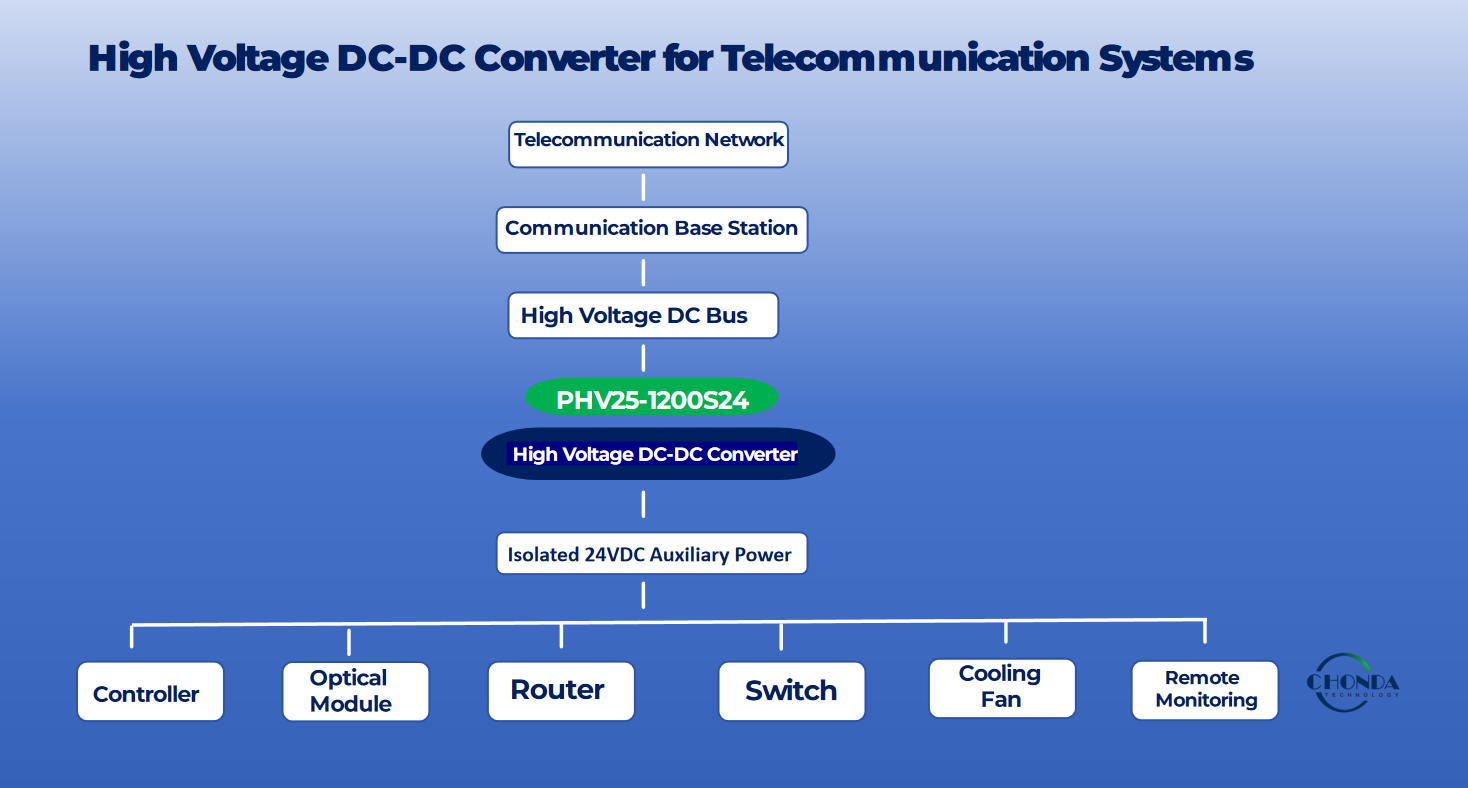
High Voltage DC-DC Converter for Telecommunication Systems
Modern telecommunication infrastructure relies on stable auxiliary power to keep communication equipment operating continuously under demanding environmental conditions. From 5G base stations and optical transmission systems to industrial communication cabinets and network switches, low-voltage control electronics require isolated power that remains stable even when the primary DC bus experiences voltage fluctuations.
High voltage DC-DC converters play a critical role by converting the high-voltage DC bus into isolated auxiliary power for communication controllers, monitoring circuits, optical modules, cooling systems, and remote management devices. In addition to electrical isolation, telecommunication applications demand high reliability, low electromagnetic interference (EMI), wide input voltage capability, and long service life to minimize maintenance and ensure uninterrupted network availability.
This article explains why high voltage DC-DC converters are essential in telecommunication systems, discusses the key engineering requirements for auxiliary power design, and demonstrates how isolated DC-DC converters help improve system reliability in modern communication infrastructure.
1. Why Auxiliary Power Is Critical in Telecommunication Systems
Modern telecommunication systems contain far more than high-power communication equipment. Although the primary high-voltage DC bus supplies the main power stage, numerous low-voltage electronic subsystems are responsible for communication, monitoring, protection, and system management.
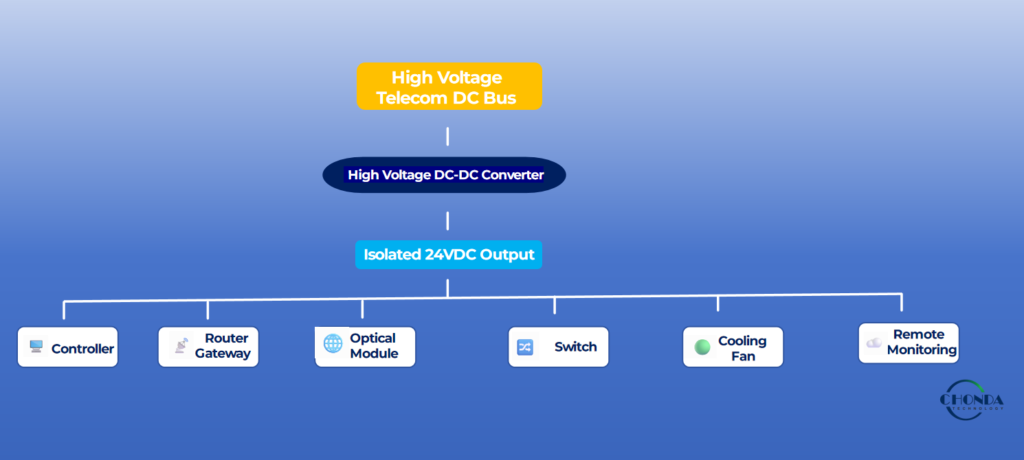
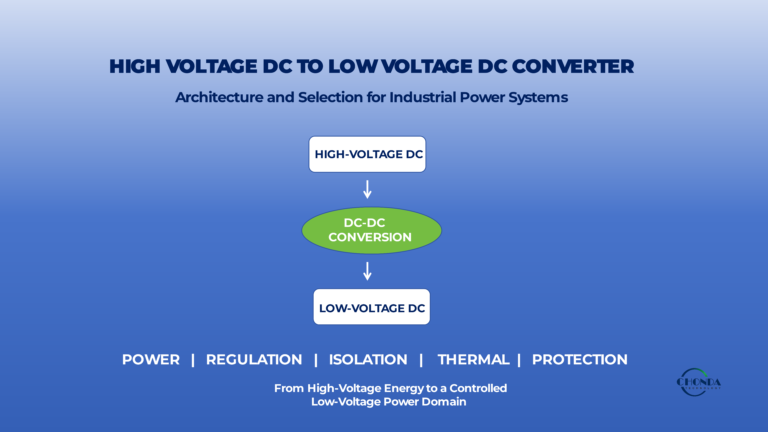
These electronic subsystems cannot operate directly from the high-voltage DC bus. Instead, they require stable, isolated auxiliary power supplied by a high voltage DC-DC converter.
Without a reliable auxiliary power supply, even a fully functional communication power system may fail to start, lose network connectivity, or become unable to perform monitoring and protection functions.
1.1. Supplying Critical Control Electronics
Telecommunication equipment relies on embedded controllers to manage startup, fault detection, power sequencing, and communication between different system modules.
Typical auxiliary-powered electronics include:
- Main control boards
- Embedded MCU systems
- Digital signal processors (DSP)
- FPGA control circuits
- Remote management controllers
Stable auxiliary power ensures these control systems continue operating even during changing load conditions.
1.2. Supporting Communication and Network Interfaces
Modern communication infrastructure depends heavily on continuous data exchange.
Auxiliary power supplies commonly support:
- Ethernet communication modules
- Optical transceivers
- Fiber communication interfaces
- CAN bus controllers
- RS485 communication modules
- Remote monitoring systems
A stable isolated power source helps maintain reliable network communication while minimizing electrical interference.
1.3. Powering Monitoring and Protection Functions
Telecommunication systems continuously monitor equipment status to improve reliability and reduce maintenance costs.
Auxiliary power is required for:
- Voltage monitoring
- Current sensing
- Temperature monitoring
- Fan control
- Alarm systems
- Protection circuits
These monitoring functions allow operators to detect faults early and improve overall network availability.
1.4. Maintaining Stable Operation During Continuous Service
Unlike many industrial applications, telecommunication equipment often operates continuously for years with minimal planned downtime.
For this reason, the auxiliary power supply must provide:
- Stable output voltage
- High reliability
- Wide input voltage tolerance
- Low EMI performance
- Long operational lifetime
A well-designed isolated DC-DC converter helps ensure continuous operation while reducing maintenance requirements across communication networks.
2. Why Low EMI DC-DC Converters Improve Telecommunication Reliability
Unlike consumer electronics, telecommunication equipment operates continuously under demanding environmental conditions. Base stations, communication cabinets, and remote network nodes often remain online 24 hours a day, 365 days a year. Even minor electromagnetic interference (EMI) can reduce communication quality, increase error rates, or interrupt critical network functions.
A low EMI DC-DC converter helps maintain stable communication performance by reducing conducted and radiated electrical noise while supplying isolated auxiliary power to sensitive electronic circuits.
2.1. Stable Communication Performance
Modern telecommunication equipment depends on high-speed digital communication between controllers, switches, optical modules, and network processors.
Excessive switching noise may cause:
- Communication packet errors
- Unstable Ethernet links
- Optical module interference
- Data retransmission
- Reduced network reliability
Low EMI power converters help maintain clean power rails, allowing communication interfaces to operate more reliably.
2.2. Improved Signal Integrity
Many communication circuits process low-level digital or optical signals that are highly sensitive to electrical noise.
Low EMI auxiliary power helps improve:
- Clock signal stability
- Signal-to-noise ratio (SNR)
- Data integrity
- Optical transmission performance
This is especially important for fiber communication equipment and high-speed switching systems.
2.3. Easier EMC Certification
Telecommunication equipment must comply with EMC standards before commercial deployment.
A low EMI DC-DC converter reduces unwanted emissions, making it easier for complete communication systems to satisfy regulatory testing requirements.
Typical EMC-related standards include:
- CISPR 32
- EN 55032
- FCC Part 15
- IEC 61000 Series
Selecting a converter with optimized EMI performance can significantly reduce system-level compliance risks.
2.4. Higher System Availability
Communication networks are expected to provide uninterrupted service.
Reducing electrical interference helps decrease unexpected equipment resets, communication failures, and maintenance events.
A reliable auxiliary power supply contributes directly to:
- Longer equipment lifetime
- Lower maintenance costs
- Improved network uptime
- Higher overall system reliability
3. CHONDA High Voltage DC-DC Converter Solution for Telecommunication Systems
Modern telecommunication equipment requires compact, reliable auxiliary power supplies capable of operating directly from high-voltage DC distribution systems. CHONDA’s PHV Series high voltage DC-DC converters are designed to provide isolated low-voltage power for communication electronics while maintaining excellent electrical performance under continuous operation.
Featuring a wide high-voltage input range, reinforced isolation, low EMI characteristics, and stable long-term performance, the PHV Series is well suited for telecommunication infrastructure where system availability and communication reliability are critical.
3.1. PHV25-1200S24 for Telecommunication Applications
The PHV25-1200S24 is a compact isolated high voltage DC-DC converter designed for communication systems operating from high-voltage DC buses.
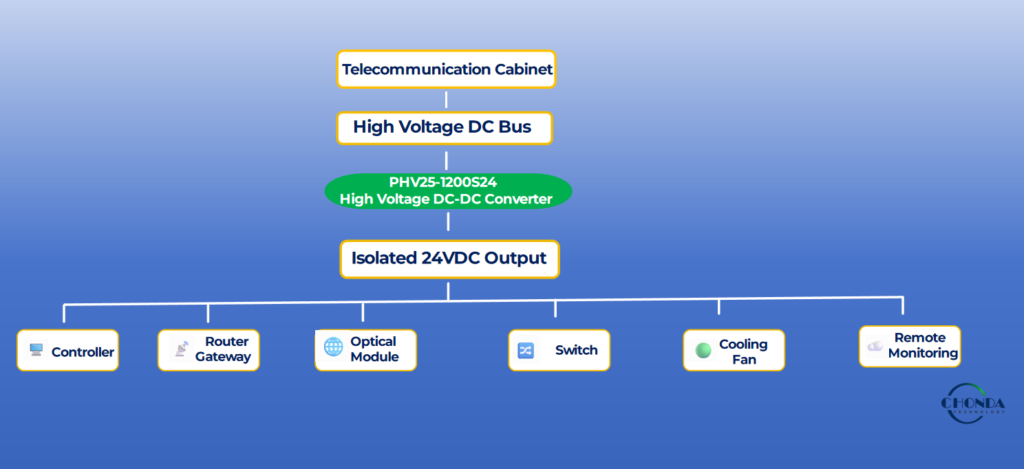
Typical features include:
- Wide input voltage: 200–1200VDC
- Stable 24VDC regulated output
- Reinforced isolation between primary and secondary circuits
- Low EMI design for sensitive communication electronics
- High efficiency with low standby power consumption
- Compact encapsulated package for easy integration
- Designed for continuous 24/7 industrial operation
The converter can supply isolated auxiliary power for communication controllers, optical modules, industrial Ethernet devices, switching equipment, monitoring systems, and protection electronics inside telecommunication cabinets.
3.2. Typical Telecommunication Applications
PHV Series high voltage DC-DC converters are suitable for a wide variety of communication infrastructure, including:
- 5G and LTE base stations
- Optical fiber transmission equipment
- Telecommunication power cabinets
- Network switches and routers
- Industrial communication gateways
- Remote communication terminals
- Smart communication nodes
- Microwave communication systems
- Edge computing communication equipment
These applications require reliable isolated auxiliary power capable of operating continuously in demanding outdoor or industrial environments.
3.3. Custom High Voltage DC-DC Converter Solutions
Different communication platforms often require customized auxiliary power specifications.
CHONDA provides OEM and custom design services, including:
- Custom input voltage ranges
- Multiple output voltages (12V, 15V, 24V, 48V)
- Higher output power options
- Enhanced isolation voltage
- Low ripple and ultra-low EMI optimization
- Extended operating temperature versions
- Customized protection functions
- Application-specific mechanical packaging
For projects requiring customized auxiliary power architecture, please visit our OEM customization for high voltage DC-DC converters page to discuss your application with our engineering team.
4. How to Select the Right High Voltage DC-DC Converter for Telecommunication Systems
Selecting a high voltage DC-DC converter for telecommunication equipment involves more than simply matching the input and output voltage. Communication systems often operate continuously for years under demanding environmental conditions, making long-term reliability, electrical isolation, and electromagnetic compatibility equally important.
When evaluating an auxiliary power solution for telecommunication applications, engineers should consider the following factors.
4.1. Confirm the High Voltage Input Range
Different communication infrastructures use different DC distribution architectures. Before selecting a converter, verify that the input voltage range covers the highest and lowest operating voltages expected in the system.
Typical communication power systems may require:
- 200–800VDC
- 300–1000VDC
- 200–1200VDC
Selecting a converter with sufficient voltage margin improves long-term operating stability and simplifies future platform upgrades.
4.2. Choose the Appropriate Output Voltage
Auxiliary electronics inside communication equipment often require regulated low-voltage power rails.
Common output voltages include:
- 12VDC
- 15VDC
- 24VDC
- 48VDC
The required output voltage depends on the controller architecture, communication interfaces, cooling systems, and monitoring electronics used in the cabinet.
4.3. Verify Isolation Requirements
Electrical isolation protects low-voltage communication electronics from the high-voltage DC distribution bus.
When comparing products, engineers should evaluate:
- Isolation voltage rating
- Reinforced isolation design
- Long-term insulation reliability
- Safety certification requirements
Adequate isolation improves both equipment protection and communication stability.
4.4. Evaluate EMI Performance
Telecommunication equipment contains high-speed digital interfaces that are highly sensitive to electrical noise.
When selecting a converter, consider:
- Conducted EMI performance
- Radiated EMI characteristics
- PCB layout recommendations
- EMC certification support
Choosing a converter with optimized EMI performance can significantly reduce system integration time and improve first-pass EMC testing success.
4.5. Consider Long-Term Reliability
Communication infrastructure is expected to remain online continuously, often in outdoor or industrial environments.
Important reliability considerations include:
- Continuous 24/7 operation
- Wide operating temperature range
- High conversion efficiency
- Stable output under varying load conditions
- Proven industrial application experience
A reliable auxiliary power supply contributes directly to lower maintenance costs and higher network availability.
4.6. Determine Whether Customization Is Required
Many communication platforms have unique electrical or mechanical requirements that cannot always be satisfied by standard power modules.
Typical customization options include:
- Custom input voltage ranges
- Multiple output voltages
- Increased output power
- Enhanced isolation voltage
- Ultra-low EMI optimization
- Mechanical packaging modifications
- Application-specific protection functions
For communication projects requiring customized auxiliary power solutions, working with an experienced power supply partner can significantly reduce development time while improving overall system reliability.
5. Conclusion
Reliable auxiliary power is essential to the stability and long-term performance of modern telecommunication infrastructure. Although the high-voltage DC bus provides the primary system energy, communication controllers, optical modules, routers, switches, monitoring systems, and cooling devices all depend on a stable, isolated low-voltage power supply to operate correctly.
Selecting the right high voltage DC-DC converter requires more than matching voltage specifications. Engineers should evaluate input voltage range, isolation performance, EMI characteristics, conversion efficiency, operating reliability, and long-term application requirements to ensure dependable system operation throughout the product lifecycle.
CHONDA’s PHV Series high voltage DC-DC converters are designed to deliver isolated auxiliary power for demanding industrial and telecommunication applications. With wide input voltage options, reinforced isolation, compact design, and customization capability, they provide a flexible solution for communication systems requiring reliable high-voltage power conversion.
If your telecommunication project requires a customized high voltage DC-DC converter, our engineering team can assist with input voltage optimization, output configuration, mechanical integration, and application-specific design support.
Contact CHONDA today to discuss your telecommunication power supply requirements.
Related Articles
High Voltage DC-DC Converter Knowledge
- High Voltage DC-DC Converter for Smart Grid Applications
- High Voltage DC-DC Converter for EV Charging Systems
- High Voltage DC-DC Converter for Telecommunication System
- High Voltage DC-DC Modules: Complete Selection Guide
Medical Power Supply
- Medical Isolation Power Supply: Complete Design Guide
- Low EMI DC-DC Converter for Medical Equipment
- How Reinforced Isolation Improves Medical Device Safety
- Choosing the Right DC-DC Converter for Medical Electronics
Customization
- OEM Custom High Voltage DC-DC Converter Solutions
- How to Select the Right High Voltage DC-DC Converter