We help the world since 2012

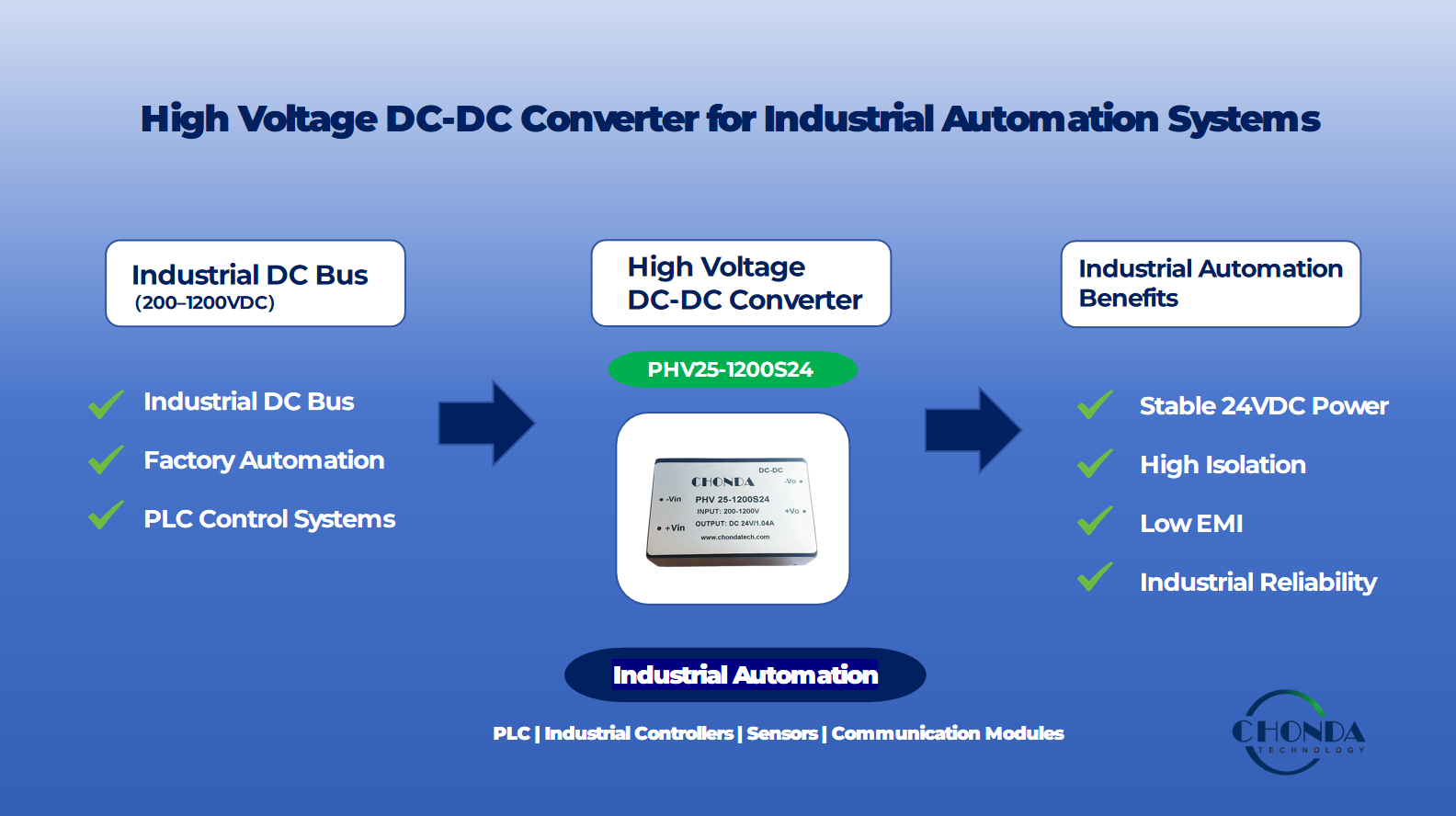
High Voltage DC-DC Converter for Industrial Automation | CHONDA
Industrial automation systems require stable, isolated, and highly reliable power supplies to support controllers, communication modules, sensors, and industrial equipment operating in demanding environments.
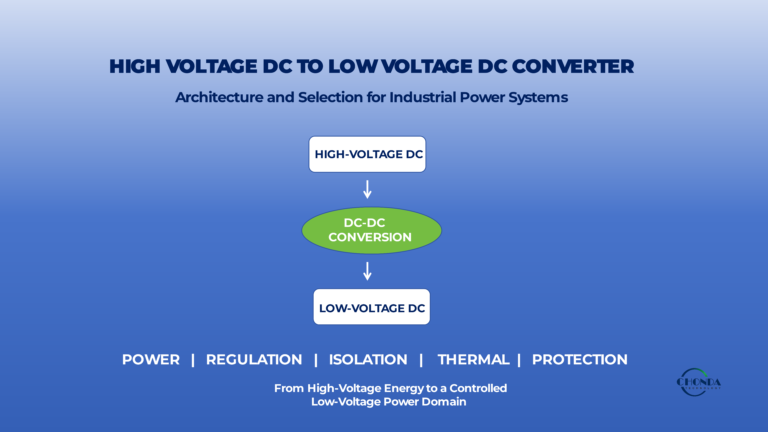
Many industrial control systems utilize high voltage DC bus architectures ranging from 200VDC to 1200VDC, creating the need for efficient high voltage DC-DC converters that can safely provide low voltage auxiliary power for control electronics.
This article explains why high voltage DC-DC converters are essential in industrial automation systems, the key technical requirements engineers should consider, and how CHONDA’s high voltage DC-DC converter solutions help improve industrial system reliability.
1. What Is an Industrial Automation System?
Industrial automation systems use intelligent control devices, sensors, communication networks, and industrial equipment to improve manufacturing efficiency, production quality, and operational safety.
Reliable power distribution is essential because every controller, sensor, and communication module depends on stable auxiliary power for continuous operation.
1.1.PLC Control Systems
Programmable Logic Controllers (PLCs) serve as the central control units in industrial automation systems.
They collect signals from sensors, execute control logic, and coordinate equipment such as motors, robots, conveyors, and production machinery. Stable low-voltage power is essential to ensure continuous PLC operation and prevent unexpected system interruptions.
1.2.Industrial Communication Networks
Modern industrial automation relies on communication protocols such as Modbus, CAN Bus, PROFINET, EtherCAT, and RS485 to exchange data between controllers and field devices.
Reliable communication allows different equipment to operate together efficiently while providing real-time monitoring, diagnostics, and remote control capabilities.
1.3.Sensors and Field Devices
Industrial automation systems use a wide variety of sensors to monitor voltage, current, temperature, pressure, position, and other operating conditions.
These field devices continuously collect operational data and transmit information back to the control system, helping improve process accuracy, equipment protection, and predictive maintenance.
2. Why High Voltage DC-DC Converters Are Required in Industrial Automation Systems
These systems often operate in environments where high voltage DC buses are already available, such as industrial machinery, railway equipment, robotics, and factory automation platforms.
A high voltage DC-DC converter efficiently converts the high voltage DC source into stable low voltage auxiliary power, allowing sensitive control electronics to operate safely and reliably.
2.1.Converting High Voltage DC Bus to Stable Control Power
Many industrial automation systems use a centralized high voltage DC bus to distribute power throughout the equipment.
However, control electronics typically require isolated low voltage outputs such as 24VDC.
A high voltage DC-DC converter bridges this gap by providing efficient power conversion while maintaining electrical isolation between the power stage and control circuits.
2.2.Powering PLCs and Industrial Controllers
Programmable Logic Controllers (PLCs) serve as the central control units in industrial automation systems.
Stable auxiliary power is essential for maintaining continuous operation, preventing unexpected shutdowns, and ensuring reliable communication between different control modules.
High voltage DC-DC converters provide regulated low voltage power that supports long-term controller stability.
2.3.Supplying Industrial Sensors
Modern industrial automation relies on numerous sensors to monitor voltage, current, temperature, pressure, position, and equipment status.
These sensors require clean and stable DC power to maintain measurement accuracy.
Low-noise isolated DC-DC converters help reduce electrical interference that could affect sensor performance.
2.4.Supporting Industrial Communication Networks
Industrial Ethernet, CAN Bus, Modbus, RS485, and other communication networks are widely used in automation systems.
Communication modules are highly sensitive to power quality.
Stable low ripple output and low electromagnetic interference (EMI) improve communication reliability while minimizing data transmission errors.
3. Key Requirements for High Voltage DC-DC Converters in Industrial Automation
Industrial automation equipment often operates continuously under demanding electrical and environmental conditions.
To ensure reliable system performance, the high voltage DC-DC converter must provide stable power conversion, effective electrical isolation, low electromagnetic interference, and long-term operational reliability.
When selecting a converter for industrial automation applications, engineers should pay attention to the following key technical requirements.
3.1.Wide Input Voltage Range
Industrial automation systems may use different high voltage DC bus architectures depending on equipment type and application requirements.
A wide input voltage range allows one converter platform to operate across various DC bus voltages without additional power conditioning circuits.
This flexibility simplifies system design while improving compatibility with different industrial automation platforms.
3.2.High Electrical Isolation
Industrial control electronics must be electrically isolated from high voltage power sources to ensure operator safety and equipment protection.
A high voltage DC-DC converter with proper isolation helps prevent hazardous voltage from reaching PLCs, sensors, communication interfaces, and other sensitive control circuits.
Reliable isolation also improves overall system stability in industrial environments.
3.3.Low EMI Performance
Industrial automation systems contain numerous communication interfaces and precision control devices that are sensitive to electromagnetic interference.
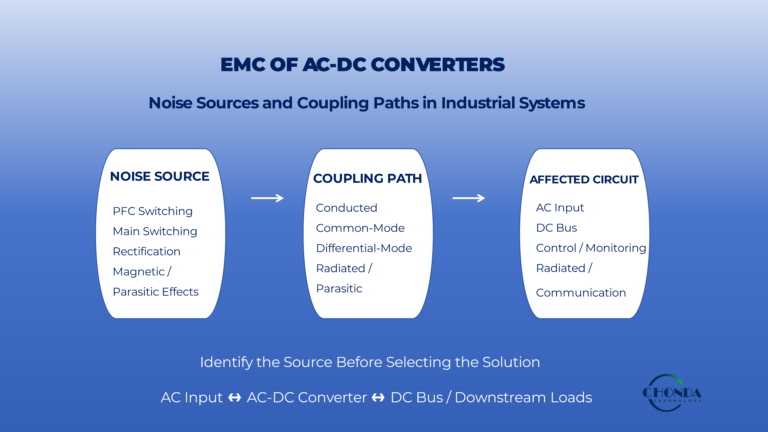
A low-EMI converter minimizes conducted and radiated noise, improving communication stability while reducing the possibility of control errors and unexpected equipment interruptions.
3.4.High Conversion Efficiency
Industrial automation equipment often operates continuously for extended periods.
High conversion efficiency reduces power loss and heat generation, improving overall system efficiency while reducing cooling requirements and operating costs.
Efficient power conversion also contributes to longer service life for both the converter and surrounding equipment.
3.5.Industrial Reliability
Industrial automation systems require stable operation under vibration, temperature variation, humidity, and continuous operating conditions.
A reliable high voltage DC-DC converter should provide robust protection features, wide operating temperature capability, and long-term electrical stability to support continuous industrial production.
4. CHONDA High Voltage DC-DC Converter Solution for Industrial Automation
4.1.PHV25-1200S24 for Industrial Automation
The following diagram illustrates a typical industrial automation power architecture using a high voltage DC-DC converter to supply reliable 24VDC auxiliary power for control electronics.
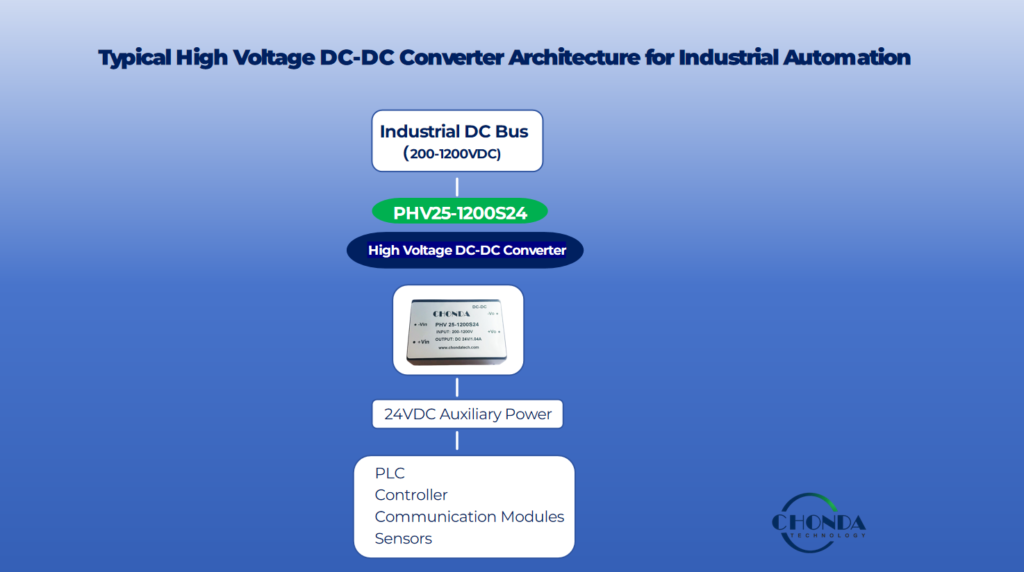
As shown above, the high voltage DC-DC converter converts high-voltage DC bus power into stable isolated 24VDC output for PLCs, industrial controllers, communication modules, and sensors while maintaining electrical isolation and reliable system operation.
For industrial automation applications, CHONDA provides high voltage DC-DC converter solutions that deliver stable auxiliary power for PLCs, industrial controllers, communication modules, and field devices operating from high voltage DC bus systems.
In a typical industrial automation architecture, the converter transforms the high voltage DC input into regulated 24VDC auxiliary power, ensuring reliable operation of low-voltage control electronics while maintaining electrical isolation and system safety.
CHONDA PHV25-1200S24 is specifically designed for industrial environments requiring wide input voltage capability, high electrical isolation, low EMI performance, and long-term operational reliability.
4.2.PHV25-1200S24 Key Features for Industrial Automation
4.2.1.Wide Input Voltage Capability
Supporting an input range of 200–1200VDC, the PHV25-1200S24 can operate across different industrial DC bus architectures, providing excellent flexibility for factory automation, robotics, transportation, and industrial control equipment.
4.2.2.Stable 24VDC Auxiliary Power
The regulated 24VDC output supplies reliable power for PLCs, industrial communication modules, sensors, HMIs, and other automation electronics, ensuring stable control performance even under changing operating conditions.
4.2.3.High Electrical Isolation
Electrical isolation protects low-voltage control electronics from hazardous high-voltage DC buses while improving operator safety and reducing the influence of common-mode noise within industrial systems.
4.2.4.Low EMI Performance
Industrial communication networks require clean power to maintain stable signal transmission.
The PHV25-1200S24 features low conducted and radiated EMI characteristics that help improve communication reliability for Modbus, CAN Bus, RS485, PROFINET, EtherCAT, and other industrial networks.
4.2.5.Integrated Protection and Industrial Reliability
Integrated protection functions, including over-voltage, over-current, short-circuit, and over-temperature protection, help ensure reliable operation in demanding industrial environments.
Designed for continuous industrial use, the PHV25-1200S24 delivers stable long-term performance while reducing maintenance requirements.
For industrial projects requiring customized input voltage ranges, output specifications, mechanical dimensions, or application-specific designs, CHONDA also provides Custom High Voltage DC-DC Converter OEM Solutions to support a wide range of industrial power conversion applications.
5. Conclusion
Selecting a high voltage DC-DC converter for industrial automation systems involves more than matching voltage and power specifications. Engineers should also evaluate electrical isolation, EMI performance, conversion efficiency, integrated protection, and long-term reliability to ensure stable operation in demanding industrial environments.
A properly designed converter provides reliable auxiliary power for PLCs, industrial communication modules, sensors, and control electronics while improving system safety and reducing maintenance requirements.
As industrial automation systems continue to adopt higher DC bus voltages, high voltage DC-DC converters play an increasingly important role in achieving efficient, reliable, and safe industrial power distribution.
Related Articles
How to Select a High Voltage DC-DC Converter Module for Industrial Applications
High Voltage DC-DC Converter EMI Design Considerations