We help the world since 2012

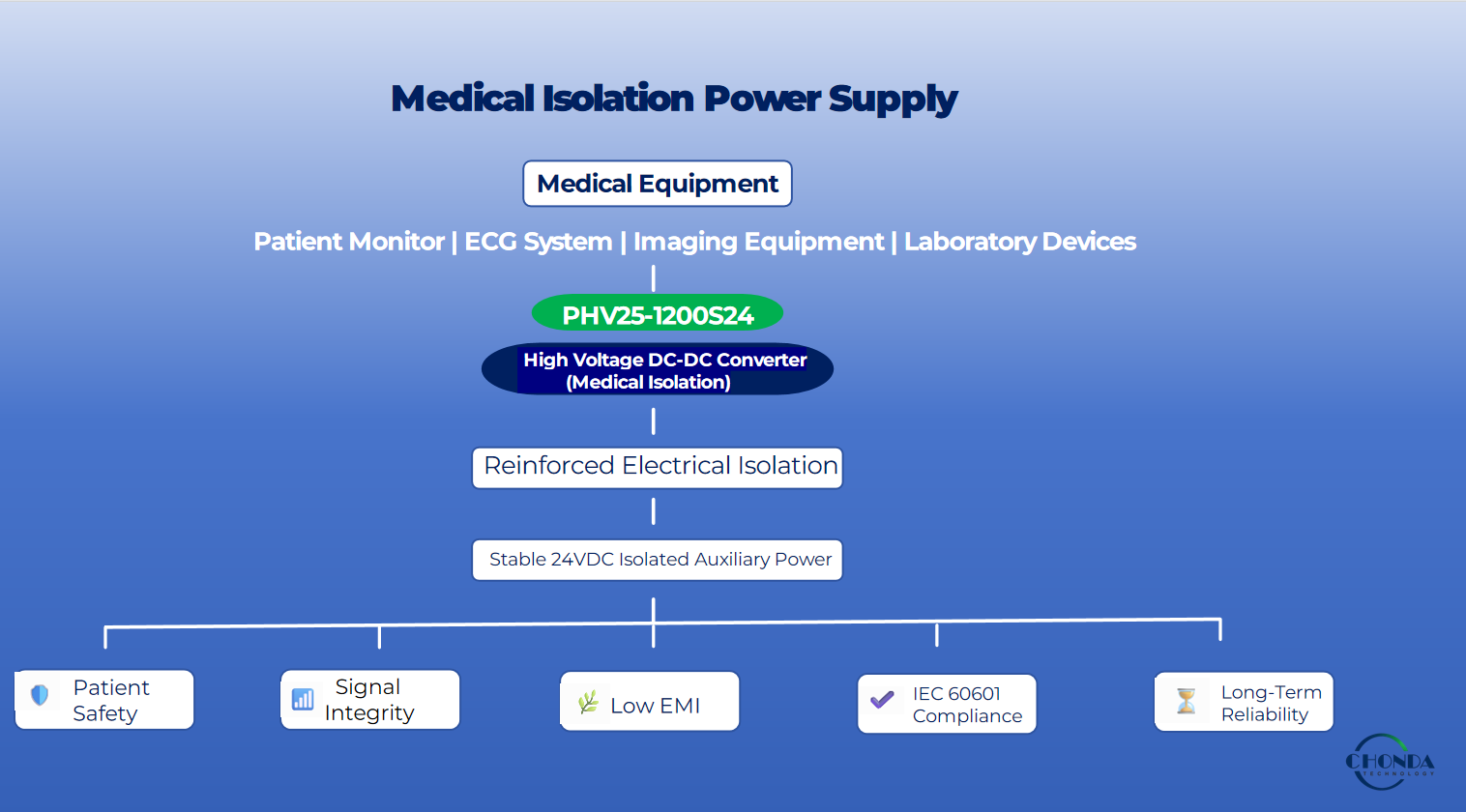
Medical Isolation Power Supply
Medical isolation power supplies play a fundamental role in modern healthcare equipment by providing electrically isolated auxiliary power for sensitive electronic systems. Unlike standard industrial power supplies, medical applications require much higher levels of electrical safety because patients, medical staff, and diagnostic equipment may all be electrically connected during operation.
Proper electrical isolation helps protect low-voltage electronic circuits from disturbances on the primary power bus while reducing leakage current, improving signal integrity, and supporting compliance with medical safety standards such as IEC 60601-1.
This article explains what a medical isolation power supply is, why electrical isolation is essential in medical equipment, how isolated high voltage DC-DC converters support medical auxiliary power systems, and the key engineering considerations when selecting reliable medical isolation solutions.
1. What Is a Medical Isolation Power Supply?
A medical isolation power supply is a power conversion system designed to deliver electrically isolated DC power for medical electronic equipment. Its primary function is to separate the high-voltage input source from sensitive low-voltage medical circuits while supplying stable auxiliary power for system operation.
Unlike general industrial power supplies, medical isolation power supplies must satisfy much stricter safety requirements because patients, medical staff, and electronic equipment may all be electrically connected during normal operation.
A typical medical isolation power supply usually provides:
- Electrical isolation between primary and secondary circuits
- Stable low-voltage DC output for medical electronics
- Protection against electrical faults and voltage disturbances
- Reliable auxiliary power for continuous medical operation
Medical isolation power supplies are widely used in:
- Patient monitoring systems
- ECG and vital sign monitors
- Medical imaging equipment
- Laboratory diagnostic instruments
- Medical communication systems
- Portable medical devices
Their purpose is not only to provide power, but also to improve electrical safety, reduce interference, and ensure reliable operation of life-critical medical equipment.
2. Why Electrical Isolation Matters in Medical Equipment
Electrical isolation is one of the most critical safety requirements in medical equipment. Unlike industrial electronics, medical devices often operate in direct contact with patients, making electrical safety an essential part of system design rather than simply a performance consideration.
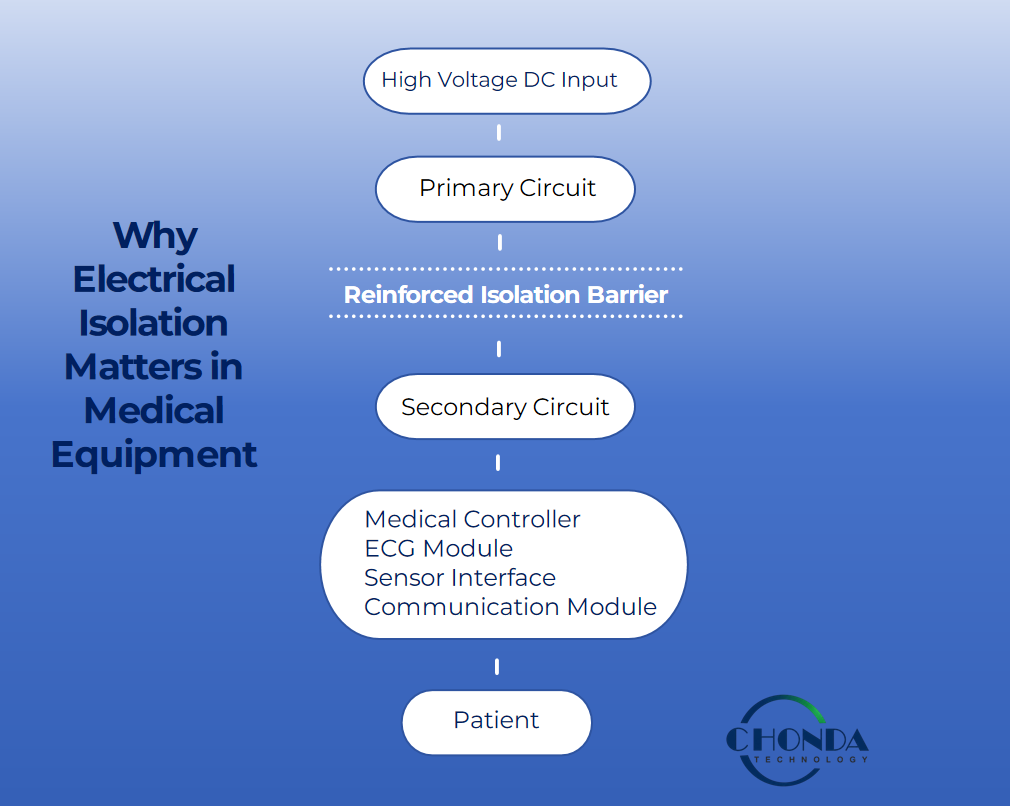
A medical isolation power supply creates a physical electrical barrier between the high-voltage input source and the low-voltage medical electronics. This isolation helps protect patients, medical personnel, and sensitive electronic circuits while maintaining reliable equipment operation under various electrical conditions.
2.1.Protecting Patient Safety
Many medical devices connect directly to the human body through sensors, electrodes, or monitoring probes. Without proper electrical isolation, voltage faults or leakage currents from the primary power source could present a potential safety risk.
An isolated power supply helps prevent hazardous electrical energy from reaching patient-connected circuits, significantly improving overall system safety.
2.2.Reducing Leakage Current
Leakage current is one of the most important design considerations in medical power systems. Even very small leakage currents may affect patient safety or prevent medical equipment from meeting international regulatory requirements.
Proper isolation design helps minimize leakage current while supporting compliance with medical safety standards such as IEC 60601-1.
2.3.Improving Noise Immunity and Signal Accuracy
Medical monitoring equipment often processes extremely small physiological signals, including ECG, EEG, blood pressure, and oxygen saturation measurements.
Electrical noise introduced through the primary power system may reduce measurement accuracy or interfere with communication between electronic modules. An isolated auxiliary power supply helps reduce common-mode noise, improving signal integrity and ensuring more stable operation of sensitive medical electronics.
2.4.Supporting Regulatory Compliance
Medical devices are subject to much stricter electrical safety regulations than general industrial equipment. Isolation requirements are evaluated during product certification to verify that electrical barriers, insulation performance, leakage current, and protective measures satisfy applicable medical standards.
Selecting an appropriate isolated power supply simplifies certification while reducing engineering risks during medical device development.
3. Common Isolation Requirements in Medical Power Systems
Medical isolation power supplies must satisfy a variety of electrical safety requirements that go beyond ordinary industrial applications. During system design, engineers often evaluate isolation performance according to medical safety standards, leakage current limits, and the level of protection required for different parts of the equipment.
The following questions represent some of the most common concerns when selecting an isolated power solution for medical devices.
3.1.What Is MOPP?
MOPP (Means of Patient Protection) is the highest level of electrical protection defined for medical equipment that may come into direct contact with patients.
A power supply designed to meet MOPP requirements typically provides:
- Reinforced electrical insulation
- Increased creepage and clearance distances
- Very low leakage current
- Higher dielectric withstand capability
Because patient safety is the primary concern, MOPP requirements are generally more stringent than those used for industrial equipment.
3.2.What Is MOOP?
MOOP (Means of Operator Protection) refers to the level of electrical protection intended for medical personnel or equipment operators rather than patients.
Compared with MOPP, MOOP requirements are generally less demanding because operators are not normally connected directly to the medical device through electrodes or sensors.
Medical equipment may use either MOOP or MOPP depending on the specific application and the level of patient contact involved.
3.3.How Much Isolation Voltage Is Required?
The required isolation voltage depends on the equipment design, working voltage, installation environment, and applicable medical safety standards.
Rather than selecting the highest isolation rating available, engineers typically evaluate:
- Primary input voltage
- Secondary output voltage
- Required insulation level
- Creepage and clearance distances
- Medical safety classification
Selecting an appropriate isolation level helps balance safety, reliability, system size, and overall cost.
3.4.Why Is Leakage Current Important?
Leakage current refers to the small amount of electrical current that may flow through insulation or protective circuits under normal operating conditions.
In medical equipment, excessive leakage current may:
- Affect patient safety
- Reduce measurement accuracy
- Prevent compliance with medical regulations
- Increase certification risks
For this reason, leakage current is carefully controlled throughout medical power supply design.
3.5.Which Standards Apply to Medical Isolation Power Supplies?
Medical power systems are typically designed according to internationally recognized safety standards.
Among them, IEC 60601-1 is one of the most widely adopted standards for medical electrical equipment.
It defines requirements covering areas such as:
- Electrical isolation
- Patient protection
- Leakage current
- Insulation coordination
- Safety testing
Compliance with applicable standards helps manufacturers improve product safety while simplifying certification for global markets.
4. How High Voltage DC-DC Converters Provide Medical Isolation
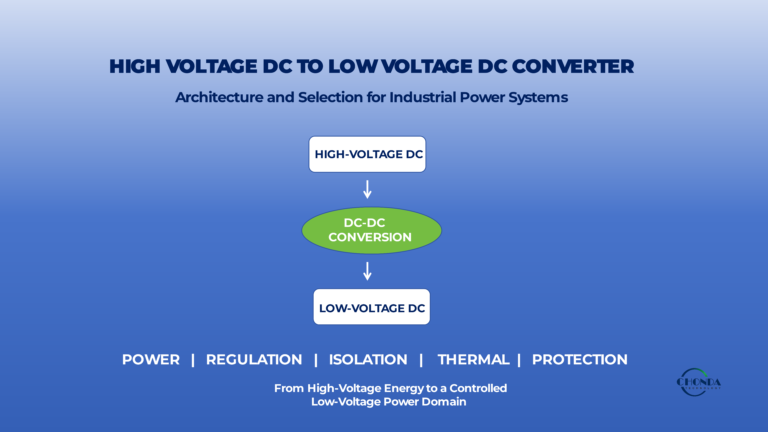
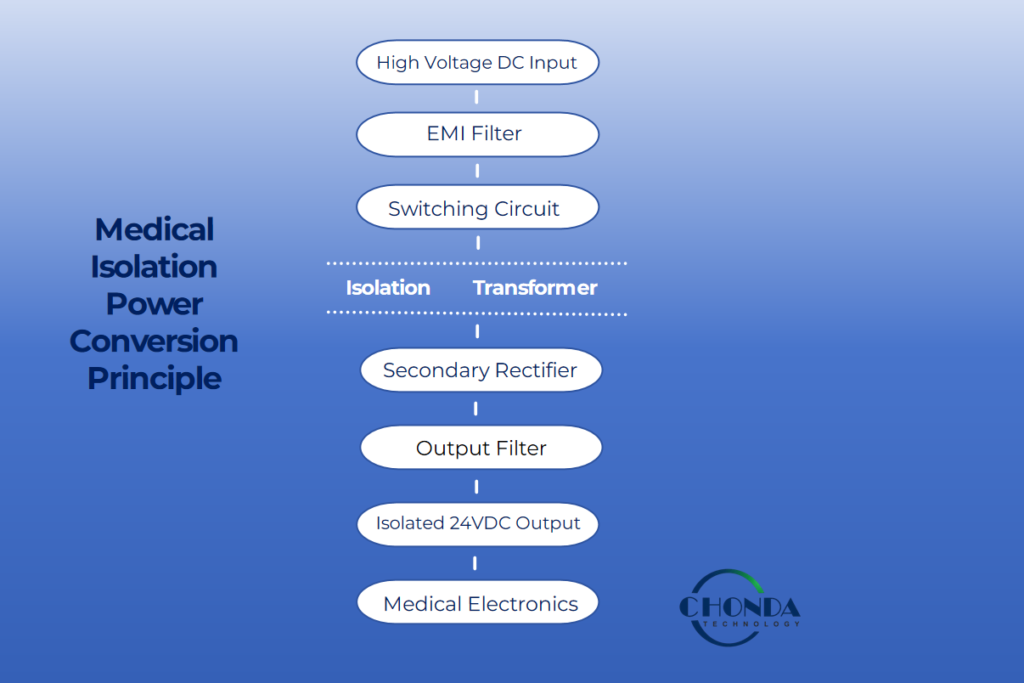
High voltage DC-DC converters achieve medical-grade electrical isolation by separating the primary high-voltage input from the secondary low-voltage output through an internal isolation transformer and reinforced insulation structure.
Unlike non-isolated converters that share a common electrical ground between input and output, isolated DC-DC converters create an electrical barrier that prevents hazardous voltage, fault currents, and electrical noise from reaching sensitive medical electronics.
In a typical medical auxiliary power architecture, the converter performs three essential functions:
- Converts the high-voltage DC bus into a stable low-voltage DC output.
- Electrically isolates patient-connected electronics from the primary power source.
- Supplies reliable auxiliary power for controllers, communication modules, sensors, displays, and monitoring circuits.
The following diagram illustrates how an isolated high voltage DC-DC converter separates the primary power domain from the secondary medical electronics.
4.1.Isolation Transformer: The Core of Medical Power Safety
The isolation transformer is the key component that enables galvanic isolation inside a high voltage DC-DC converter.
Instead of transferring electrical energy through a direct conductive path, the transformer transfers energy magnetically between its primary and secondary windings. This allows power to be delivered while maintaining complete electrical separation between the two circuits.
For medical equipment, this electrical separation helps:
- Prevent dangerous fault voltages from reaching patient-connected circuits.
- Reduce common-mode electrical noise.
- Improve signal integrity for sensitive analog measurements.
- Increase overall system safety and long-term reliability.
4.2.Reinforced Isolation Barrier
In medical applications, electrical isolation involves more than simply adding a transformer.
A reinforced isolation barrier is designed using multiple protective measures, including:
- Reinforced insulation materials
- Appropriate creepage and clearance distances
- High dielectric withstand capability
- Controlled leakage current performance
Together, these features help ensure that electrical faults on the primary side cannot propagate to the secondary medical electronics, supporting compliance with international medical safety standards.
4.3.Stable Isolated Auxiliary Power Distribution
After isolation, the low-voltage output is distributed to multiple electronic subsystems within the medical device.
Typical loads include:
- Medical controllers (MCU)
- ECG and signal acquisition circuits
- Communication modules
- Display interfaces
- Sensor interfaces
- Alarm and protection circuits
Because these subsystems share the same isolated auxiliary power bus, stable voltage regulation and low electrical noise are essential for maintaining reliable long-term operation.
5. CHONDA High Voltage DC-DC Converter Solution for Medical Isolation
Medical equipment requires isolated auxiliary power solutions that combine electrical safety, stable power conversion, and long-term reliability. CHONDA develops high voltage DC-DC converters that help engineers build isolated auxiliary power architectures for medical electronic systems operating from high-voltage DC sources.
Designed for demanding industrial environments and adaptable to medical applications, CHONDA’s PHV Series provides isolated low-voltage power for controllers, monitoring circuits, communication modules, displays, and other auxiliary electronic systems where electrical isolation is essential.
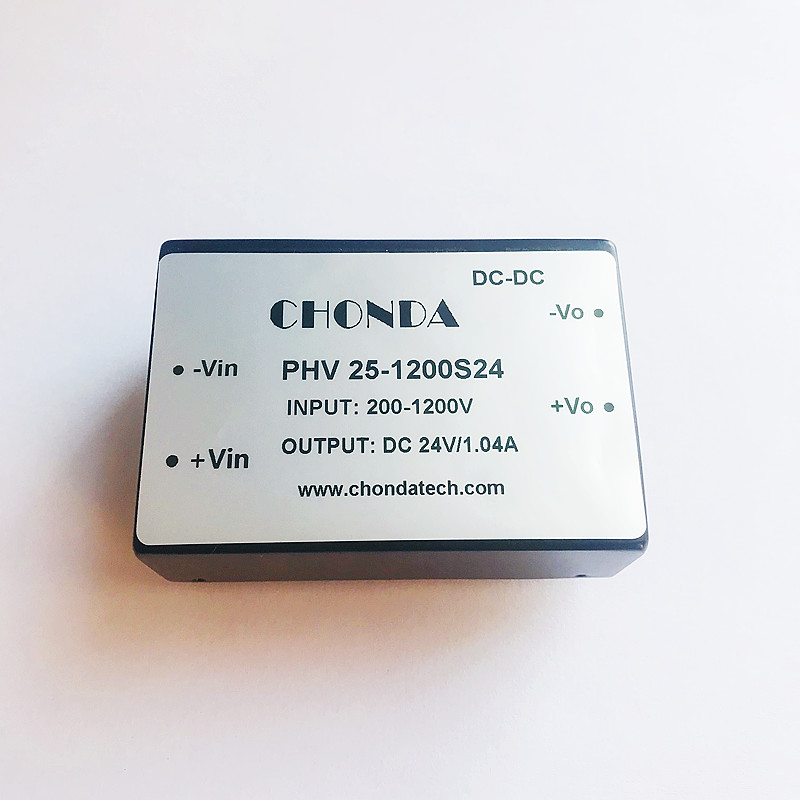
5.1.PHV25-1200S24 High Voltage DC-DC Converter
The PHV25-1200S24 is one of CHONDA’s isolated high voltage DC-DC converters designed for applications requiring wide input voltage capability together with reliable electrical isolation.
Typical specifications include:
- Input Voltage: 200–1200 VDC
- Output Voltage: 24 VDC
- Output Power: 25 W
- Reinforced Electrical Isolation
- Wide Input Voltage Range
- High Conversion Efficiency
- Low EMI Design
- Multiple Protection Functions
- Long-Term Industrial Reliability
These characteristics make the PHV25-1200S24 suitable for auxiliary power systems used in patient monitoring devices, laboratory equipment, medical communication systems, diagnostic instruments, and other medical electronic applications requiring isolated DC power.
👉 Learn more about the PHV25-1200S24 High Voltage DC-DC Converter.
5.2.Custom Medical Isolation Power Solutions
Medical equipment manufacturers often require customized auxiliary power solutions to match different system architectures, safety requirements, installation spaces, and regulatory specifications.
CHONDA supports OEM customization for high voltage DC-DC converters, including:
- Custom input voltage ranges
- Custom output voltages
- Different output power levels
- Isolation voltage customization
- PCB mounting and package options
- Thermal optimization
- Industrial and medical application adaptation
Whether you are developing new medical equipment or upgrading an existing auxiliary power architecture, CHONDA can assist with customized isolated power solutions based on your project requirements.
👉 Explore our OEM Customization for High Voltage DC-DC Converters.
6. How to Select the Right Medical Isolation Power Supply
Selecting a medical isolation power supply involves more than matching the input and output voltage specifications. Engineers must evaluate electrical safety, isolation performance, long-term reliability, and regulatory compliance to ensure stable operation throughout the equipment lifecycle.
The following considerations can help identify a suitable isolated DC-DC converter for medical applications.
6.1.Determine the Required Isolation Level
The required isolation level depends on the function of the medical equipment and whether it includes patient-connected circuits.
When evaluating an isolated power supply, engineers should consider:
- Required isolation voltage
- Patient-contact versus non-patient-contact equipment
- Reinforced or basic insulation
- MOPP and MOOP requirements
- Applicable medical safety standards
Choosing an appropriate isolation level helps reduce electrical hazards while supporting regulatory compliance.
6.2.Verify the Input and Output Specifications
Medical equipment may operate from different DC bus architectures depending on the application. Selecting the correct input voltage range and output characteristics ensures reliable auxiliary power under all operating conditions.
Typical parameters include:
- Input voltage range
- Output voltage
- Output power
- Voltage regulation
- Startup performance
- Over-voltage protection
A converter with sufficient design margin can improve long-term system stability.
6.3.Evaluate EMI and Leakage Current Performance
Medical electronics often include precision analog front ends, communication interfaces, and sensitive measurement circuits. Excessive electrical noise or leakage current can affect both equipment performance and patient safety.
When comparing converters, engineers should evaluate:
- Conducted and radiated EMI
- Leakage current characteristics
- Isolation capacitance
- Noise suppression capability
- Compatibility with EMC requirements
Low-noise auxiliary power helps maintain accurate signal acquisition and stable communication.
6.4.Consider Reliability and Environmental Conditions
Medical equipment is frequently required to operate continuously in hospitals, laboratories, or healthcare facilities. The auxiliary power supply should therefore provide dependable long-term performance under varying environmental conditions.
Key evaluation factors include:
- Operating temperature range
- Conversion efficiency
- Thermal performance
- Protection functions
- Expected service life
- Long-term reliability
Selecting a robust isolated DC-DC converter can reduce maintenance requirements and improve overall equipment availability.
6.5.Choose a Supplier with Customization Capability
Standard products are suitable for many medical systems, but OEM equipment often requires customized electrical or mechanical specifications.
A qualified power supply supplier should be able to support:
- Custom input voltage ranges
- Different output voltages and power ratings
- Isolation level customization
- Mechanical package optimization
- Application-specific engineering support
- Long-term product availability
Working with an experienced supplier helps simplify product development while supporting future upgrades and certification requirements.
7. Conclusion
Medical isolation power supplies play a critical role in protecting patients, ensuring measurement accuracy, and maintaining the reliable operation of modern medical equipment. From patient monitoring systems and laboratory instruments to medical communication devices, electrical isolation is an essential part of auxiliary power design rather than an optional feature.
Selecting an appropriate isolated high voltage DC-DC converter requires engineers to evaluate multiple factors, including:
- Required isolation level
- Input voltage range
- Output voltage and power
- Leakage current performance
- EMI characteristics
- Long-term operational reliability
- Compliance with applicable medical safety standards
By combining reinforced electrical isolation, stable power conversion, and reliable auxiliary power distribution, a properly designed high voltage DC-DC converter helps improve both equipment safety and long-term system performance.
CHONDA continues to provide isolated high voltage DC-DC converter solutions that support industrial and medical electronic applications requiring dependable auxiliary power from high-voltage DC sources.
Related Articles
- What Is a High Voltage DC-DC Converter?
- Medical Auxiliary Power Supply Design
- High Voltage DC-DC Converter for Patient Monitoring Systems
- High Voltage DC-DC Converter Applications
- OEM Custom High Voltage DC-DC Converter Solutions
Recommended Products
Need an Isolated High Voltage DC-DC Converter for Your Medical Project?
If you are designing patient monitoring equipment, diagnostic instruments, laboratory systems, or other medical electronic devices requiring isolated auxiliary power, CHONDA can provide both standard and customized high voltage DC-DC converter solutions.
Contact our engineering team to discuss your application requirements.