We help the world since 2012

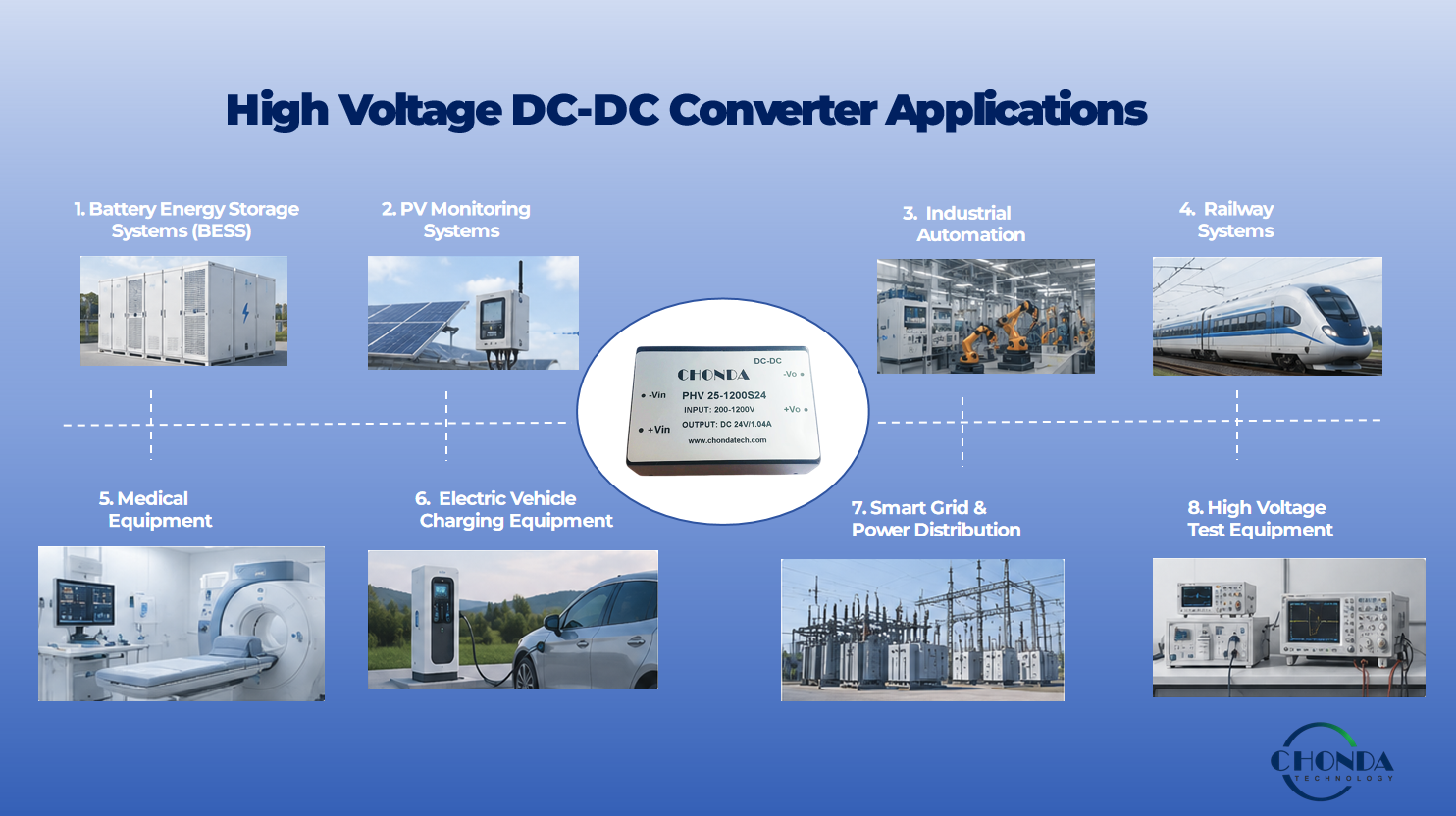
High Voltage DC-DC Converter Applications
High voltage DC-DC converters are widely used in renewable energy, industrial automation, railway transportation, medical electronics, telecommunications, and many other high-voltage power systems.
Different applications require different combinations of isolation, input voltage range, EMC performance, efficiency, and long-term reliability.
This article provides an overview of the most common high voltage DC-DC converter applications and explains how they support various industrial power systems.
1. Common Applications of High Voltage DC-DC Converters
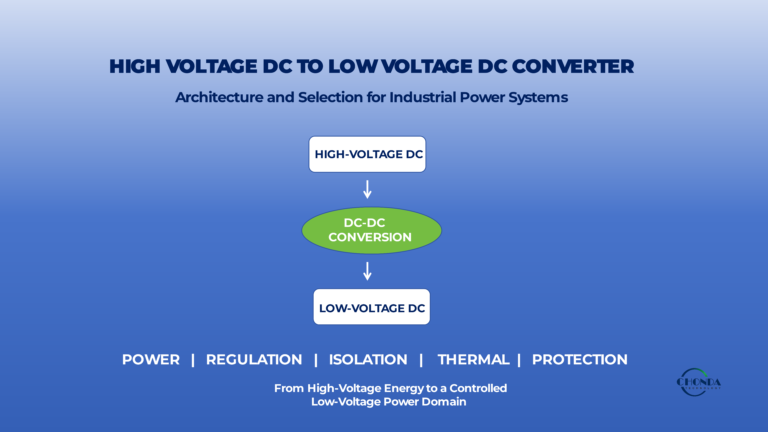
High voltage DC-DC converters are widely used wherever high voltage DC sources must be converted into isolated low-voltage auxiliary power for electronic equipment.
Across different industries, these converters perform the same fundamental role while supporting different types of control, monitoring, communication, and protection systems.
Typical applications include:
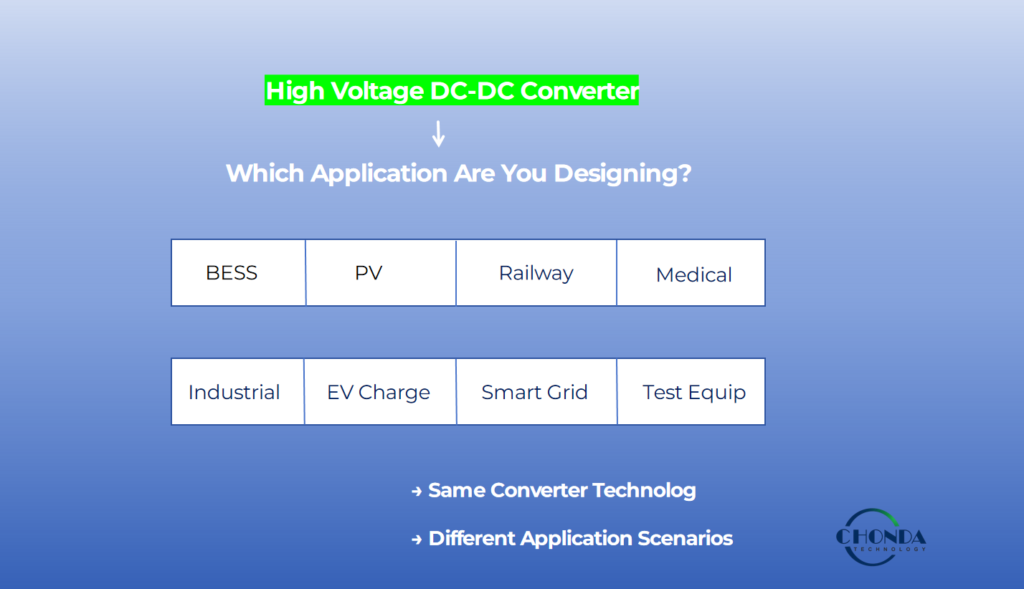
Figure 1. Typical industries where high voltage DC-DC converters provide isolated auxiliary power.
Although different industries require different system architectures, they all rely on the same core high voltage DC-DC converter technology to provide isolated auxiliary power for monitoring, control, communication, and protection systems.
1.1.Battery Energy Storage Systems (BESS)
Battery energy storage systems often operate with DC bus voltages ranging from several hundred volts to over 1000VDC.
High voltage DC-DC converters provide isolated auxiliary power for:
- Battery Management Systems (BMS)
- Energy management controllers
- Communication modules
- Protection circuits
Related article:
➡ High Voltage DC-DC Converter for Battery Energy Storage Systems
1.2.PV Monitoring Systems
Solar photovoltaic installations require reliable auxiliary power for string monitoring devices and communication electronics.
Typical powered equipment includes:
- PV monitoring controllers
- Data acquisition modules
- Communication gateways
- Environmental sensors
Related article:
➡ High Voltage DC-DC Converter for PV Monitoring Systems
1.3.Industrial Automation
Industrial automation systems frequently use high-voltage DC buses to improve efficiency and reduce power losses.
High voltage DC-DC converters supply isolated low-voltage power for:
- PLCs
- Industrial controllers
- Communication modules
- Sensors
Related article:
➡ High Voltage DC-DC Converter for Industrial Automation
1.4.Railway Systems
Modern railway applications require reliable auxiliary power under harsh operating conditions.
Typical applications include:
- Vehicle Control Units (VCU)
- Passenger information systems
- Communication equipment
- Railway sensors
Related article:
➡ High Voltage DC-DC Converter for Railway Applications
1.5.Medical Equipment
Medical systems require highly reliable isolated power for sensitive electronic devices.
Typical applications include:
- Patient monitoring systems
- Medical controllers
- Laboratory equipment
- Medical communication systems
Related article:
➡ High Voltage DC-DC Converter for Medical Equipment
1.6.Electric Vehicle Charging Equipment
High-voltage DC-DC converters are also widely used in EV charging systems to provide isolated auxiliary power for control electronics, communication units, cooling systems, and monitoring devices.
1.7.Smart Grid & Power Distribution
Power distribution equipment, switchgear, and smart grid systems require isolated low-voltage power supplies for protection relays, communication equipment, and intelligent monitoring devices.
1.8.High Voltage Test Equipment
High-voltage testing instruments require isolated auxiliary power supplies that can operate safely under demanding electrical environments while maintaining measurement accuracy.
2. Why Isolation Matters in High Voltage DC-DC Converter Applications
Electrical isolation is one of the most important characteristics of a high voltage DC-DC converter. It safely separates the high-voltage power source from sensitive low-voltage electronics while allowing reliable power transfer between different parts of the system.
In modern industrial applications, high-voltage DC buses often operate at several hundred volts or even above 1000VDC. Without proper isolation, electrical faults, voltage surges, or common-mode noise may affect low-voltage control circuits, reducing system reliability and increasing safety risks.
2.1.Improving Electrical Safety
Isolation protects low-voltage electronic equipment from hazardous high-voltage DC sources.
By electrically separating the input and output circuits, isolated converters help reduce the risk of equipment damage while improving operator and system safety in demanding industrial environments.
This is particularly important in applications such as:
- Battery Energy Storage Systems
- Railway power systems
- Medical equipment
- Industrial automation
- High-voltage power distribution
2.2.Reducing Common-Mode Noise
High-voltage power systems can generate common-mode noise that interferes with communication interfaces, sensors, and precision electronic circuits.
An isolated high voltage DC-DC converter helps minimize electrical interference by breaking unwanted ground loops and reducing noise coupling between different system sections.
Benefits include:
- Improved communication stability
- Higher measurement accuracy
- Better EMC performance
- More reliable control systems
2.3.Increasing System Reliability
Isolation also improves long-term system reliability by preventing electrical disturbances from propagating through the entire power architecture.
Even if abnormal conditions occur on the high-voltage side, properly isolated auxiliary power supplies help maintain stable operation of controllers, communication modules, monitoring equipment, and other critical electronics.
This contributes to:
- Improved equipment protection
- Reduced maintenance costs
- Higher system availability
- Longer service life
3. How to Choose the Right High Voltage DC-DC Converter
Selecting the appropriate high voltage DC-DC converter depends on the electrical characteristics of the application as well as the operating environment. Different industries have different power requirements, but several key parameters should always be evaluated before selecting a converter.
3.1.Input Voltage Range
The converter should support the full operating range of the high-voltage DC source.
Applications such as Battery Energy Storage Systems, photovoltaic monitoring systems, railway equipment, and industrial automation often experience significant input voltage variation during normal operation.
Choosing a converter with a wide input voltage range helps maintain stable auxiliary power while simplifying overall system design.
3.2.Output Voltage and Power Rating
The output voltage should match the requirements of the auxiliary electronic equipment.
Common output voltages include:
- 24VDC
- 12VDC
- 5VDC
The converter should also provide sufficient output power for controllers, communication modules, sensors, displays, and other electronic loads while maintaining adequate design margin.
3.3.Isolation Voltage
Isolation is a critical parameter in high-voltage applications.
Higher isolation voltage improves electrical safety, reduces common-mode noise, and protects sensitive electronic equipment from hazardous DC bus voltages.
Applications involving medical equipment, railway systems, and renewable energy installations generally require reinforced electrical isolation.
3.4.Protection Functions
Industrial power systems should include comprehensive protection mechanisms to improve equipment reliability.
Typical protection features include:
- Over Voltage Protection (OVP)
- Under Voltage Lockout (UVLO)
- Over Current Protection (OCP)
- Short Circuit Protection (SCP)
- Over Temperature Protection (OTP)
These functions help protect both the converter and connected electronic equipment during abnormal operating conditions.
3.5.Long-Term Reliability
High voltage DC-DC converters are often expected to operate continuously for many years with minimal maintenance.
Industrial-grade components, stable thermal performance, and high manufacturing quality contribute to longer service life and reduced maintenance costs.
Selecting a converter designed for continuous industrial operation helps improve overall system reliability while minimizing unexpected downtime.
4. CHONDA High Voltage DC-DC Converter Solutions
CHONDA specializes in high voltage DC-DC converter solutions for industrial power applications, providing reliable auxiliary power across a wide range of industries including renewable energy, industrial automation, railway transportation, medical equipment, and intelligent monitoring systems.
Our high voltage DC-DC converter modules are designed to deliver stable isolated low-voltage power while maintaining excellent electrical safety, low EMI performance, and long-term industrial reliability.
4.1.PHV25-1200S24 High Voltage DC-DC Converter
One of CHONDA’s representative products is the PHV25-1200S24, which is suitable for a wide variety of high-voltage auxiliary power applications.
Key features include:
- Wide input voltage range: 200–1200VDC
- Regulated 24VDC output
- High electrical isolation
- Low EMI performance
- Integrated protection functions
- High conversion efficiency
- Industrial-grade reliability
- Compact encapsulated design
These features make the PHV25-1200S24 suitable for Battery Energy Storage Systems, PV monitoring systems, industrial automation, railway equipment, medical devices, and other high-voltage DC applications.
4.2.Custom High Voltage DC-DC Converter OEM
Different applications often require customized electrical and mechanical specifications.
CHONDA provides custom OEM services including:
- Custom input voltage ranges
- Custom output voltages
- Isolation voltage customization
- Mechanical dimension optimization
- Connector customization
- Application-specific power solutions
Whether your project involves renewable energy, transportation, industrial control, or medical equipment, our engineering team can provide customized high voltage DC-DC converter solutions based on your application requirements.
Explore our High Voltage DC-DC Modules product series or contact us to discuss your custom OEM requirements.
5. Conclusion
High voltage DC-DC converters have become an essential building block in modern high-voltage power systems. By converting high-voltage DC sources into stable isolated low-voltage auxiliary power, they support reliable operation across renewable energy, industrial automation, railway transportation, medical equipment, and many other industrial applications.
When selecting a high voltage DC-DC converter, engineers should evaluate key factors such as input voltage range, output voltage, electrical isolation, protection functions, efficiency, and long-term reliability to ensure stable system performance.
CHONDA provides high voltage DC-DC converter solutions designed to meet the demanding requirements of industrial applications while supporting both standard products and customized OEM projects.
Related Articles
What Is a High Voltage DC-DC Converter?
High Voltage DC-DC Converter for Battery Energy Storage Systems
High Voltage DC-DC Converter for PV Monitoring Systems
High Voltage DC-DC Converter for Industrial Automation
High Voltage DC-DC Converter for Railway Applications
High Voltage DC-DC Converter for Medical Equipment
Custom High Voltage DC-DC Converter OEM