We help the world since 2012

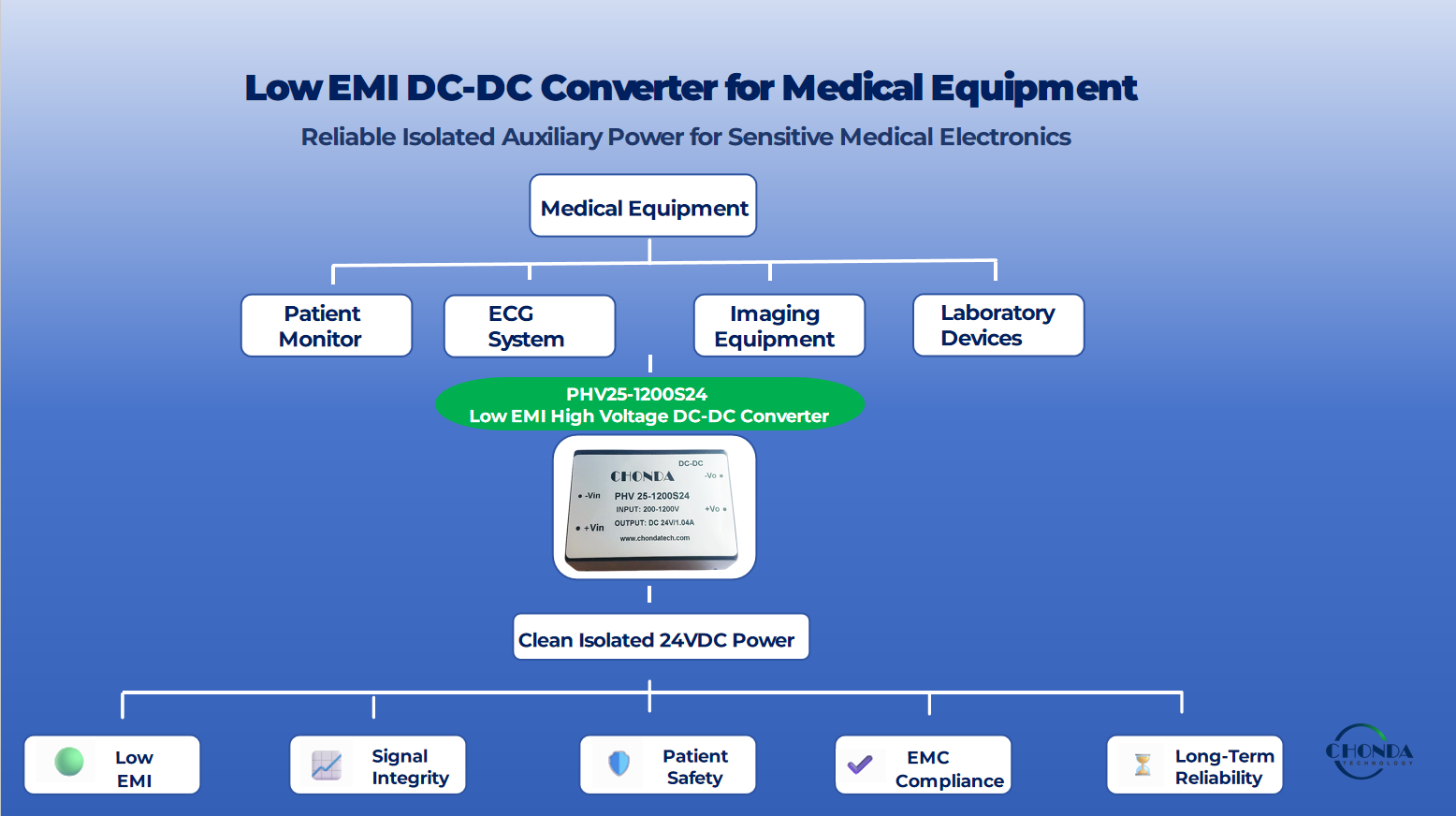
Low EMI DC-DC Converter for Medical Equipment
Medical electronic equipment often processes extremely small physiological signals such as ECG, EEG, blood pressure, oxygen saturation, and other diagnostic measurements. Even a small amount of electrical noise generated by the power supply can affect signal quality, communication stability, and overall equipment performance.
A low EMI DC-DC converter is designed to minimize conducted and radiated electromagnetic interference while providing stable isolated auxiliary power for sensitive medical electronics. Compared with conventional industrial power converters, medical low EMI power supplies place greater emphasis on noise suppression, signal integrity, EMC compliance, and reliable long-term operation.
This article explains why low EMI performance is important in medical equipment, how low EMI isolated DC-DC converters reduce electrical noise, the key design requirements for medical EMC power supplies, and how CHONDA high voltage DC-DC converters support low-noise medical auxiliary power systems.
1. Why EMI Is a Critical Issue in Medical Equipment
Medical equipment processes extremely small electrical signals generated by the human body. Even minor electromagnetic interference (EMI) from the power supply can reduce signal quality, affect measurement accuracy, or interrupt communication between critical subsystems.
Unlike many industrial applications, medical devices must maintain stable performance while operating near highly sensitive analog circuits, digital processors, wireless communication modules, and patient-connected sensors. This makes low-EMI power design an essential part of overall system reliability.
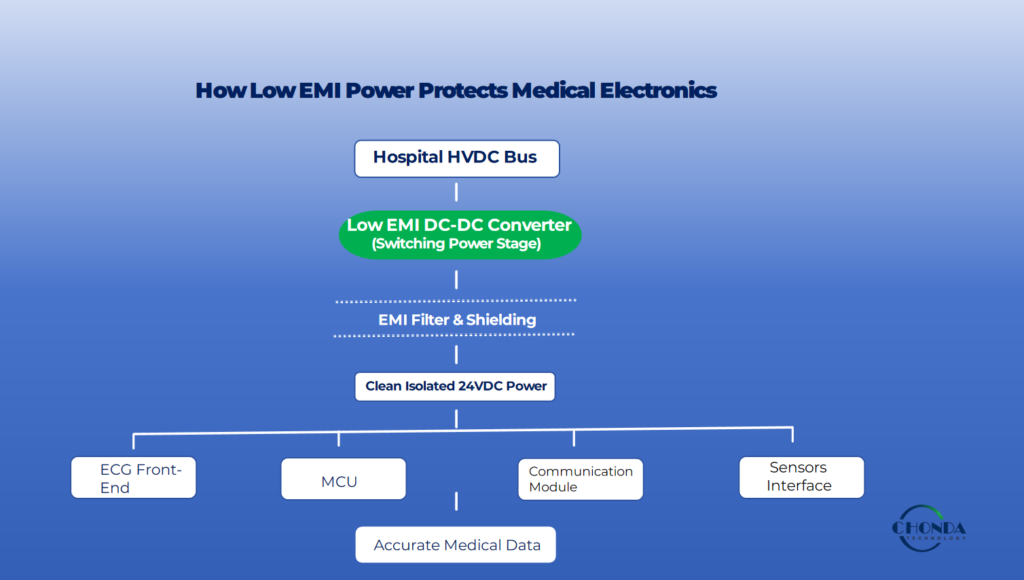
The diagram below illustrates how a low EMI DC-DC converter helps isolate switching noise from sensitive medical electronics.
1.1. EMI Can Affect Measurement Accuracy
Many medical devices detect electrical signals that are only a few microvolts or millivolts in amplitude. Examples include:
- Electrocardiogram (ECG)
- Electroencephalogram (EEG)
- Electromyography (EMG)
- Blood oxygen monitoring (SpO₂)
- Ultrasound signal processing
Switching noise generated by the auxiliary power supply may introduce unwanted interference into these low-level signals, increasing measurement errors or reducing diagnostic accuracy.
1.2. Conducted EMI Can Spread Throughout the System
Conducted EMI travels through power distribution lines and PCB traces, allowing switching noise to propagate into multiple electronic subsystems.
If not properly controlled, conducted EMI may influence:
- Analog front-end circuits
- Precision ADCs
- Communication interfaces
- Microcontrollers
- Sensor modules
Using a low EMI isolated DC-DC converter helps reduce conducted noise before it reaches sensitive electronic circuits.
1.3. Radiated EMI May Interfere with Communication Modules
Modern medical equipment often integrates Ethernet, CAN, RS485, Wi-Fi, Bluetooth, or other communication interfaces.
Excessive radiated EMI can increase communication errors, reduce wireless performance, or affect synchronization between medical subsystems.
Proper converter layout, shielding, and EMI optimization help maintain reliable communication under continuous operation.
1.4. Medical EMC Standards Require Low EMI Design
Medical electronic equipment must satisfy strict electromagnetic compatibility (EMC) requirements to ensure safe operation in hospitals and clinical environments.
Although specific certification requirements vary by product category and target market, designers typically evaluate:
- Conducted emissions
- Radiated emissions
- Immunity to external interference
- Electrostatic discharge (ESD)
- Surge and transient immunity
Selecting a low EMI DC-DC converter at the beginning of the design process can simplify EMC testing and reduce the risk of costly redesigns later in product development.
2. How High Voltage DC-DC Converters Reduce EMI in Medical Equipment
Selecting a low EMI DC-DC converter is one of the most effective ways to improve electromagnetic compatibility (EMC) in medical equipment. While PCB layout and shielding remain important, the converter itself plays a critical role in controlling switching noise before it spreads throughout the system.
A well-designed isolated DC-DC converter combines optimized switching topology, transformer isolation, input/output filtering, and careful circuit design to deliver clean auxiliary power for sensitive medical electronics.
2.1. Isolated Transformer Helps Block Noise Propagation
The isolation transformer inside a high voltage DC-DC converter separates the primary high-voltage input from the secondary low-voltage output.
This electrical isolation helps prevent common-mode noise from propagating into sensitive medical electronics, reducing interference between the high-power stage and precision measurement circuits.
For medical applications such as ECG monitors, patient monitoring systems, and laboratory analyzers, transformer isolation is an important foundation for both electrical safety and signal quality.
2.2. Input and Output Filtering Reduce Conducted EMI
Medical equipment often operates in environments containing multiple electronic devices sharing the same power distribution system.
High-quality DC-DC converters typically integrate optimized input and output filtering to suppress conducted EMI before it reaches downstream circuits.
Effective filtering helps provide:
- Cleaner auxiliary power rails
- Improved signal stability
- Reduced noise coupling
- Better EMC performance during certification testing
2.3. Stable Switching Design Minimizes High-Frequency Noise
Switching converters naturally generate high-frequency energy during power conversion.
A low EMI DC-DC converter minimizes this unwanted energy through optimized switching control, transformer design, PCB layout, and magnetic component selection.
Compared with conventional industrial converters, medical-grade power designs place greater emphasis on reducing switching noise while maintaining high conversion efficiency and long-term reliability.
2.4. Low EMI Improves Overall Medical System Reliability
Reducing EMI is not only about passing EMC compliance tests.
Lower electrical noise also contributes to:
- More stable communication between medical subsystems
- Improved sensor accuracy
- Reduced false alarms
- Better long-term system reliability
- Higher diagnostic confidence
For designers developing modern medical equipment, selecting a low EMI isolated DC-DC converter early in the design process can simplify development while reducing engineering risk.
3. CHONDA Low EMI DC-DC Converter Solution for Medical Equipment
Medical equipment requires auxiliary power supplies that combine high-voltage isolation, stable output, and low electromagnetic interference. Selecting the right DC-DC converter early in the design stage helps simplify EMC compliance, improve signal integrity, and increase overall system reliability.
CHONDA’s PHV Series High Voltage DC-DC Converters are designed to provide isolated low-voltage auxiliary power for high-voltage medical power systems while supporting long-term continuous operation.
3.1. PHV25-1200S24 for Medical Auxiliary Power
The PHV25-1200S24 converts 200–1200VDC high-voltage input into a stable 24VDC isolated auxiliary power output, making it suitable for medical equipment requiring reliable low-voltage power distribution.
Typical features include:
- Wide input voltage: 200–1200VDC
- Isolated 24VDC auxiliary output
- Reinforced electrical isolation
- Low EMI design for sensitive medical electronics
- Compact encapsulated structure
- High reliability for continuous operation
- Suitable for custom medical power architectures
👉 Product Page:
PHV25-1200S24 High Voltage DC-DC Converter
3.2. Typical Medical Applications
The PHV Series can provide isolated auxiliary power for a wide variety of medical electronic systems, including:
- Patient monitoring equipment
- ECG and EEG systems
- Medical imaging equipment
- Diagnostic laboratory instruments
- Medical communication terminals
- Hospital automation systems
- Medical control cabinets
- Intelligent medical devices
Its isolated low-voltage output supplies power to controllers, communication modules, displays, sensors, and other critical electronic subsystems while helping reduce electrical noise throughout the system.
3.3. OEM & Custom Medical Power Solutions
Different medical devices often require different auxiliary power architectures, isolation levels, output voltages, and packaging formats.
CHONDA provides OEM and custom engineering support, including:
- Custom input voltage ranges
- Multiple isolated output voltages
- Output power customization
- Mechanical package optimization
- Enhanced isolation requirements
- Medical equipment integration support
Learn more about our engineering capabilities:
👉 OEM High Voltage DC-DC Converter Solutions
4. How to Select the Right Low EMI DC-DC Converter for Medical Equipment
Selecting a low EMI DC-DC converter for medical equipment involves much more than matching the input and output voltage. Engineers must evaluate electrical safety, EMC performance, reliability, and long-term operating conditions to ensure the auxiliary power supply supports both medical compliance and stable equipment operation.
The following checklist can help simplify the selection process.
4.1. Verify the High-Voltage Input Range
The converter should operate reliably across the entire DC bus voltage range used by the medical equipment, including startup, shutdown, and transient conditions.
Typical questions include:
- What is the nominal DC bus voltage?
- What is the maximum operating voltage?
- Will input voltage fluctuate during operation?
- Does the converter provide sufficient operating margin?
Choosing a converter with an appropriate wide input range helps improve long-term stability while reducing system redesign.
4.2. Confirm Isolation Requirements
Medical equipment requires reinforced electrical isolation to protect patients and sensitive electronics.
Before selecting a converter, engineers should verify:
- Isolation voltage rating
- Reinforced isolation capability
- Leakage current performance
- Compliance with applicable medical safety standards
- Creepage and clearance requirements
Proper isolation improves both electrical safety and overall system reliability.
4.3. Evaluate EMI Performance
Many medical devices contain precision analog circuits and communication interfaces that are highly sensitive to electrical noise.
When comparing DC-DC converters, consider:
- Conducted EMI performance
- Radiated EMI performance
- Internal filtering design
- Switching topology
- Ease of EMC certification
A low EMI converter often reduces engineering effort during EMC testing while improving measurement accuracy.
4.4. Check Thermal and Reliability Performance
Medical equipment frequently operates continuously for many hours or even 24/7.
Important evaluation factors include:
- Operating temperature range
- Conversion efficiency
- Long-term reliability
- Thermal management requirements
- Expected service life
Selecting a converter with proven long-term stability helps reduce maintenance costs and improve overall equipment availability.
4.5. Consider Future Customization Requirements
Medical equipment designs often evolve throughout product development.
Working with a supplier capable of OEM customization provides greater flexibility for future revisions, including:
- Custom input voltage ranges
- Multiple output options
- Mechanical package optimization
- Connector customization
- Enhanced isolation specifications
- Project-specific engineering support
Planning for customization early can shorten development cycles and simplify future product upgrades.
5. Buyer Quick Checklist
Before selecting a medical isolation power supply, verify the following:
✅ Wide high-voltage input range
✅ Reinforced electrical isolation
✅ Low EMI performance
✅ Stable thermal operation
✅ High long-term reliability
✅ Compliance with medical safety requirements
✅ OEM customization capability
6. Conclusion
Low EMI power design has become an essential requirement for modern medical equipment rather than an optional performance enhancement. From patient monitoring systems and diagnostic instruments to medical communication devices and laboratory equipment, reducing electromagnetic interference helps improve signal integrity, measurement accuracy, and overall system reliability.
Selecting the right isolated high voltage DC-DC converter requires engineers to consider much more than basic electrical specifications. Input voltage range, reinforced electrical isolation, EMI performance, thermal stability, long-term reliability, and future customization capability all contribute to the success of the final medical power architecture.
CHONDA’s PHV Series high voltage DC-DC converters provide reliable isolated auxiliary power for medical electronic systems operating from high-voltage DC sources. By combining wide input voltage capability, reinforced isolation, low EMI design, and OEM customization support, they help engineers develop safer and more reliable medical equipment.
Whether you are designing a new medical device or upgrading an existing auxiliary power system, selecting a properly engineered low EMI DC-DC converter can simplify development while supporting long-term equipment performance.
Related Articles
- What Is a High Voltage DC-DC Converter?
- Medical Auxiliary Power Supply Design
- Medical Isolation Power Supply
- High Voltage DC-DC Converter for Patient Monitoring Systems
- High Voltage DC-DC Converter Applications
- OEM Custom High Voltage DC-DC Converter Solutions
Recommended Products
Looking for a Low EMI High Voltage DC-DC Converter?
If your medical equipment requires isolated auxiliary power with low electromagnetic interference, CHONDA can provide both standard products and customized OEM solutions for demanding medical applications.
Contact our engineering team to discuss your project requirements.