We help the world since 2012

How Reinforced Isolation Improves Medical Device Safety
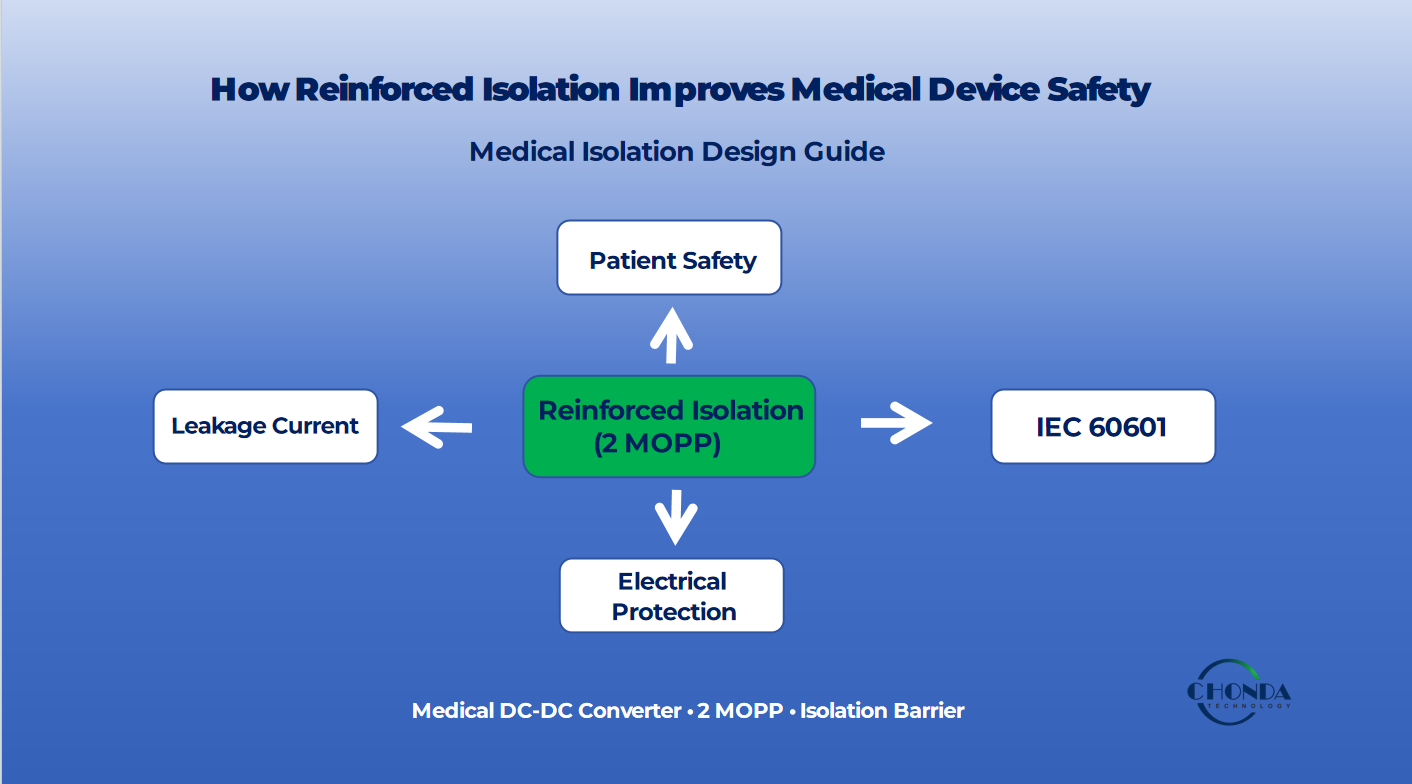
Modern medical equipment operates in environments where electrical safety is just as important as functional performance. Unlike many industrial electronic systems, medical devices often connect directly or indirectly to patients, making reliable electrical isolation a fundamental design requirement rather than an optional feature.
During normal operation, medical power systems must continuously protect patients, healthcare professionals, and sensitive electronic circuits from electrical faults, leakage current, and high-voltage transients. If the isolation barrier fails, even a small electrical fault may compromise equipment reliability or create potential safety risks.
For this reason, reinforced isolation has become one of the most important design principles in modern medical power supplies. It provides a higher level of protection than basic insulation by maintaining electrical separation even under abnormal operating conditions. Reinforced isolation also helps medical equipment manufacturers comply with internationally recognized safety standards such as IEC 60601, which defines electrical safety requirements for medical devices.
This article explains how reinforced isolation improves medical device safety, compares reinforced isolation with other insulation methods, discusses its relationship with IEC 60601 compliance, and provides practical guidance for selecting isolated high voltage DC-DC converters used in modern medical systems.
1. Why Electrical Isolation Is Critical in Medical Equipment
Medical equipment operates in environments where electrical safety directly affects human health. Unlike most industrial electronics, many medical devices are used in close proximity to patients or establish direct electrical contact through sensors, monitoring electrodes, probes, or diagnostic accessories. As a result, even very small electrical leakage or insulation failure may create unacceptable safety risks.
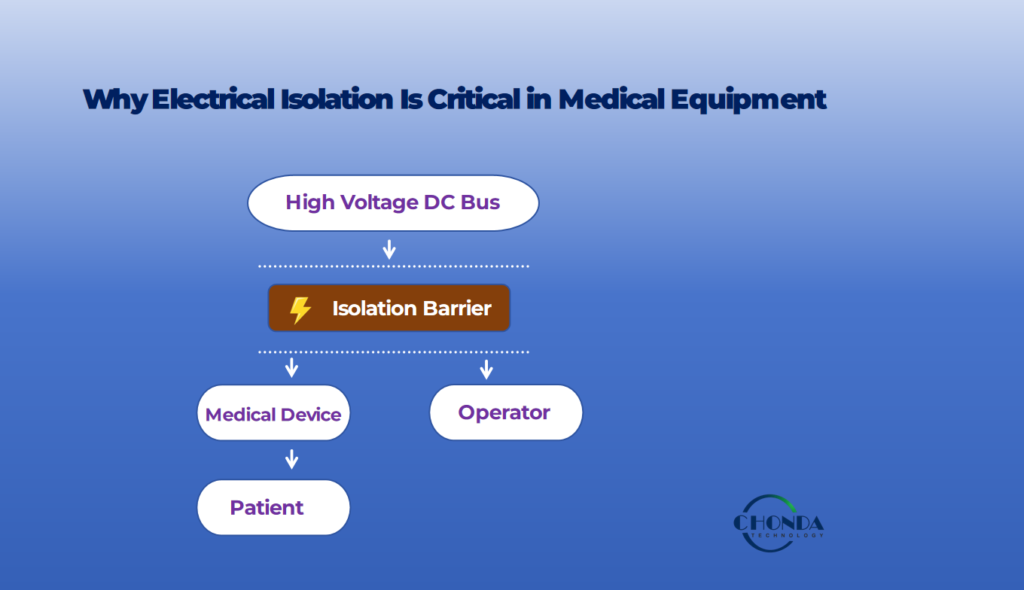
Electrical isolation creates a protective barrier between hazardous high-voltage circuits and low-voltage medical electronics. By preventing dangerous electrical energy from reaching patient-connected circuits, isolation significantly improves equipment safety, system reliability, and regulatory compliance.
The importance of electrical isolation becomes even more evident when considering the four major risks faced by medical equipment.
1.1. Leakage Current Control
Leakage current refers to the small amount of unintended electrical current that may flow through insulation or parasitic coupling paths. Although the current may appear insignificant, even extremely low leakage current can become hazardous when medical equipment is connected directly to a patient.
Proper electrical isolation minimizes leakage current by separating primary power circuits from secondary patient-side electronics, helping ensure that patient-connected equipment remains within the limits defined by medical safety standards.
1.2. Patient Contact Protection
Many medical devices are designed to monitor, diagnose, or treat patients through electrodes, sensors, imaging probes, or wearable accessories. These interfaces establish a direct electrical path between the equipment and the human body.
Without sufficient isolation, electrical faults occurring inside the power system could potentially propagate toward patient-connected circuits. Reinforced isolation provides an additional layer of protection, significantly reducing the possibility of hazardous fault currents reaching the patient.
1.3. Operator Safety
Medical equipment must protect not only patients but also doctors, nurses, laboratory technicians, and maintenance personnel who operate the equipment every day.
Proper isolation prevents hazardous voltages from appearing on accessible metal parts, communication interfaces, or external connectors. This protection helps reduce the risk of accidental electric shock during equipment operation, servicing, or maintenance.
1.4. Protection Against Electrical Faults
Electrical systems may experience abnormal operating conditions throughout their service life, including component failures, power surges, insulation degradation, wiring mistakes, or unexpected transient events.
An effective isolation barrier prevents these faults from propagating into sensitive medical electronics and patient-connected circuits. By containing electrical faults within the power stage, reinforced isolation improves overall equipment reliability while supporting long-term operational safety.
📚 Continue Reading
To understand the differences between various insulation methods used in medical equipment, continue with:
→ Medical Isolation Power Supply
2. What Is Reinforced Isolation?
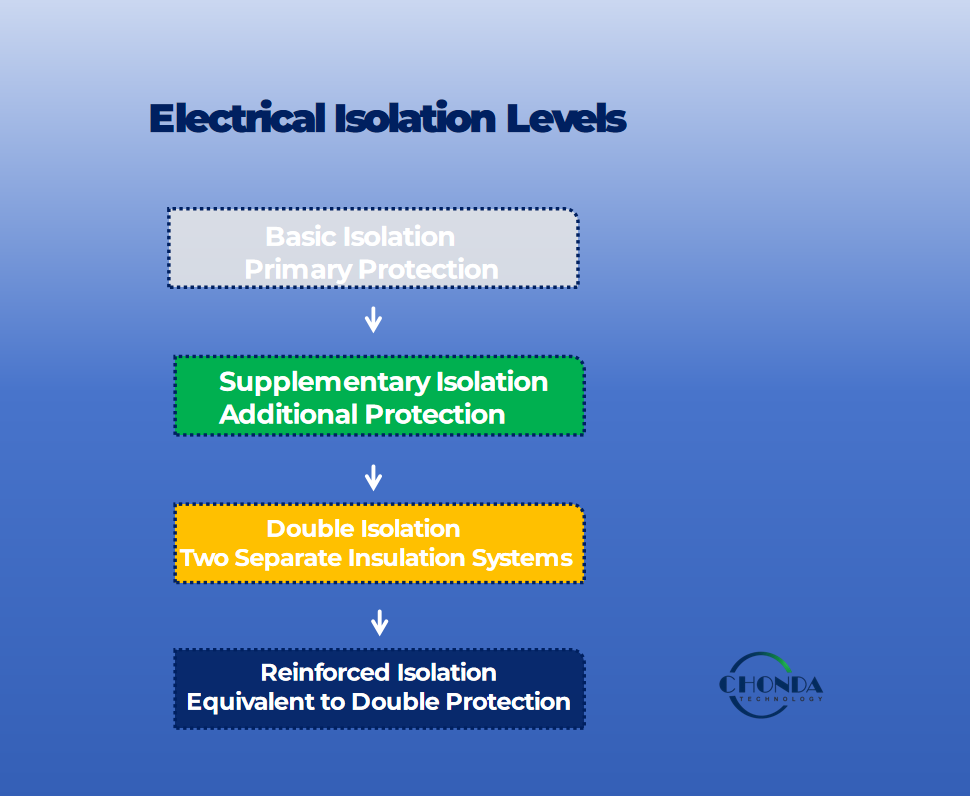
Electrical isolation is not simply classified as either “isolated” or “non-isolated.” International medical safety standards define several different levels of insulation, each providing a different degree of protection against electric shock.
Understanding these classifications helps engineers determine whether a particular DC-DC converter is suitable for medical equipment, industrial systems, or other safety-critical applications.
Among these classifications, reinforced isolation provides the highest level of protection within a single insulation system and is widely used in modern medical power supplies.
2.1. Basic Isolation
Basic isolation is the minimum level of insulation required to protect users during normal operating conditions.
It separates hazardous voltages from accessible conductive parts but assumes that only one protective barrier is present.
If the insulation becomes damaged or deteriorates over time, electrical safety can no longer be guaranteed.
Basic isolation is commonly used in industrial equipment where additional protective measures are provided elsewhere in the system.
2.2. Supplementary Isolation
Supplementary isolation is an independent insulation layer added to basic insulation.
By itself, supplementary insulation is not intended to protect users.
Instead, it serves as a backup safety barrier if the primary insulation fails.
When combined with basic insulation, the overall system becomes significantly more resistant to electrical faults.
2.3. Double Isolation
Double isolation consists of two completely independent insulation systems:
- Basic insulation
- Supplementary insulation
Because the two insulation layers operate independently, failure of one barrier does not immediately expose hazardous voltage.
Many household appliances and portable electrical equipment rely on double insulation to eliminate the need for protective grounding.
2.4. Reinforced Isolation
Reinforced isolation provides the same level of electrical protection as basic insulation plus supplementary insulation, but achieves this through a single enhanced insulation system.
Rather than relying on two physically separate insulation barriers, reinforced insulation is specifically designed, tested, and certified to withstand higher electrical stress throughout the product’s lifetime.
In practical engineering terms:
Reinforced Isolation = Basic Isolation + Supplementary Isolation
This is why reinforced isolation has become the preferred solution for medical equipment, where compact size, high reliability, and strict patient safety requirements must all be satisfied simultaneously.
Modern medical DC-DC converters frequently employ reinforced isolation to simplify system design while meeting international safety regulations.
2.5. Why Reinforced Isolation Is Preferred in Medical Equipment
Medical devices often operate near patients, healthcare personnel, and sensitive monitoring electronics.
Any insulation failure could potentially allow hazardous voltage to reach accessible circuits.
Reinforced isolation helps reduce this risk by providing:
- Higher protection against electric shock
- Improved long-term insulation reliability
- Simplified medical safety certification
- Reduced system complexity
- Better compliance with international medical standards
For this reason, reinforced isolation has become the standard choice for many patient-connected medical power supplies.
📚 Continue Reading
To understand how isolation voltage is specified when selecting a converter, continue with:
→ High Voltage DC-DC Converter Isolation Design: Principles and Applications
3. Reinforced Isolation vs Basic Isolation
Although both basic isolation and reinforced isolation separate high-voltage and low-voltage circuits, they are designed for different safety requirements and application environments.
For industrial equipment, basic isolation may be sufficient when additional protective measures are provided elsewhere in the system.
However, medical equipment, patient-connected devices, and other safety-critical applications often require reinforced isolation to provide a higher level of protection without relying on secondary safeguards.
The table below summarizes the key differences.
3.1. Reinforced Isolation vs Basic Isolation Comparison
| Feature | Basic Isolation | Reinforced Isolation |
|---|---|---|
| Protection Level | Basic electrical separation | Equivalent to Basic + Supplementary insulation |
| Patient Protection | Not suitable for patient protection alone | Suitable for medical safety requirements |
| Leakage Current Protection | Limited | Higher protection against leakage current |
| Fault Tolerance | May require additional protection | Maintains protection even under single-fault conditions |
| Compliance | General industrial equipment | Medical equipment and high-safety applications |
| Typical Standards | IEC 62368, industrial equipment | IEC 60601 medical equipment |
| Typical Applications | Industrial automation, communication equipment | Patient monitoring, diagnostic equipment, medical auxiliary power |
3.2. Why Reinforced Isolation Is Preferred in Medical Equipment
Medical equipment frequently operates in environments where patients may have direct physical contact with sensors, monitoring cables, or diagnostic instruments.
Even a single insulation failure could create a hazardous leakage path.
Reinforced isolation significantly reduces this risk by providing a protection level equivalent to two independent insulation barriers while remaining compact enough for modern power module designs.
For this reason, reinforced isolation has become the preferred choice for many medical auxiliary power supplies.
3.3. When Basic Isolation Is Still Appropriate
Basic isolation is not “unsafe.” It remains widely used in industrial automation, telecommunication systems, railway electronics, and other applications where additional protective measures are already incorporated into the overall system design.
Examples include:
- Industrial control cabinets
- Communication base stations
- Railway power systems
- Smart grid monitoring equipment
- PV monitoring systems
In these applications, the overall equipment safety is achieved through system-level design rather than relying solely on the power converter.
📚 Continue Reading
To learn more about medical isolation power design, continue with:
→ Medical Isolation Power Supply
4. IEC 60601 and Reinforced Isolation Requirements
Medical electrical equipment is subject to far more stringent safety requirements than ordinary industrial or commercial electronics.
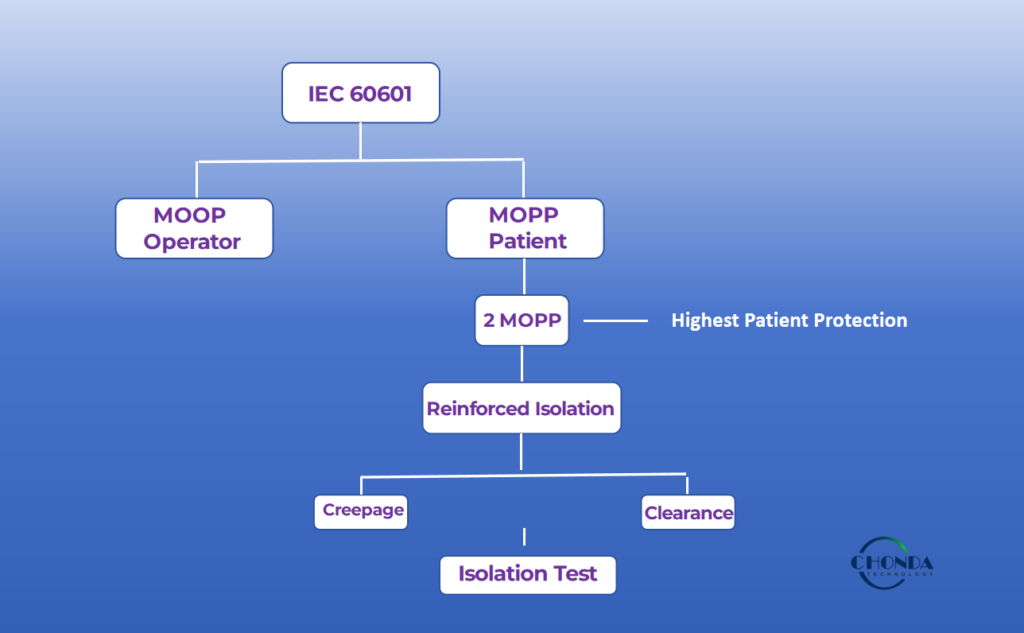
The internationally recognized standard IEC 60601-1 defines the electrical safety requirements for medical equipment, including insulation systems, leakage current limits, isolation testing, creepage distance, and clearance distance.
Unlike general industrial standards, IEC 60601 focuses on protecting both patients and operators, even under abnormal operating conditions or single-fault events.
Understanding these requirements helps engineers select isolation power supplies that satisfy medical safety expectations from the beginning of the design process rather than attempting costly redesigns during certification.
4.1. MOPP vs MOOP
IEC 60601 introduces two different protection concepts:
- MOOP (Means of Operator Protection) protects medical staff and equipment operators.
- MOPP (Means of Patient Protection) protects patients who may be directly connected to medical devices through electrodes, sensors, or monitoring cables.
Because patients are generally more vulnerable to electrical hazards than operators, MOPP requires stricter insulation and lower allowable leakage current.
In most patient-connected medical equipment, designers select power supplies that satisfy 2 MOPP requirements.
4.2. Why 2 MOPP Is Often Required
A single insulation layer may be sufficient under normal operating conditions.
However, IEC 60601 also considers the possibility of component failure, environmental stress, aging, or accidental faults.
2 MOPP (Two Means of Patient Protection) provides two independent levels of protection, allowing patient safety to be maintained even if one protective layer becomes compromised.
For this reason, many patient monitoring systems, diagnostic instruments, and life-support equipment specify reinforced isolation equivalent to 2 MOPP rather than relying on basic insulation alone.
4.3. Working Voltage and Isolation Test Voltage
One of the most common misunderstandings during converter selection is confusing working voltage with isolation test voltage.
- Working voltage refers to the continuous operating voltage that the converter experiences during normal service.
- Isolation test voltage (often expressed as 1500 VAC, 3000 VAC, or higher) is a short-duration dielectric withstand test used to verify insulation integrity during qualification and production testing.
A converter with a high isolation test voltage is not necessarily suitable for every application unless its working voltage, insulation design, and safety certification also match the system requirements.
Engineers should always evaluate both parameters together rather than relying on isolation test voltage alone.
4.4. Creepage and Clearance Distance
IEC 60601 also specifies minimum insulation distances between conductive parts.
Two important concepts are:
- Clearance — the shortest distance through air between two conductive parts.
- Creepage — the shortest distance along the surface of an insulating material.
Both distances help prevent electrical breakdown under high voltage, humidity, pollution, or long-term aging.
Higher operating voltages generally require larger creepage and clearance distances to maintain safe insulation performance throughout the product lifetime.
For this reason, medical-grade power modules often feature optimized internal insulation structures that satisfy both electrical performance and mechanical space constraints.
📚 Continue Reading
To better understand practical medical isolation design, continue with:
→ Medical Isolation Power Supply
→ Medical Auxiliary Power Supply Design
→ How Reinforced Isolation Improves Medical Device Safety
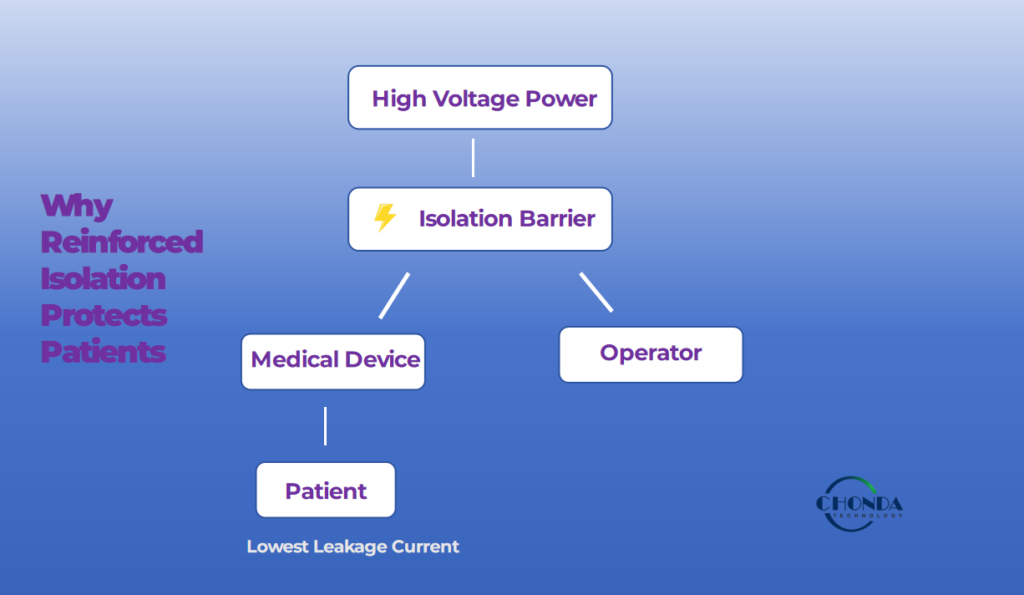
5. How Reinforced Isolation Protects Patients
Electrical isolation is designed to do more than separate two electrical circuits. In medical equipment, its primary purpose is to prevent hazardous electrical energy from reaching the patient, even if an unexpected fault occurs inside the system.
Patients connected to medical devices are often far more vulnerable to electrical hazards than ordinary users. Electrodes, catheters, monitoring probes, and other patient-applied parts may create direct conductive paths into the human body. Even extremely small leakage currents that would normally be harmless can become dangerous in clinical environments.
Reinforced isolation minimizes this risk by maintaining a high-integrity insulation barrier between hazardous primary circuits and accessible secondary circuits throughout the equipment’s operating life.
5.1. Leakage Current Control
One of the most important functions of reinforced isolation is limiting leakage current.
Leakage current refers to the small amount of electrical current that unintentionally flows from energized circuits to exposed conductive parts or patient-connected circuits.
In medical equipment, leakage current must remain well below the limits specified by IEC 60601 because excessive current may lead to patient injury or interfere with sensitive physiological measurements.
A reinforced isolation barrier significantly reduces the possibility of hazardous current passing from the primary high-voltage side to the low-voltage patient interface.
5.2. Maintaining Isolation Under Fault Conditions
Medical equipment cannot be evaluated only under normal operating conditions.
Safety standards require engineers to consider abnormal situations, including component aging, insulation degradation, wiring failures, and unexpected electrical faults.
Reinforced isolation is specifically intended to continue providing protection even when a single fault occurs inside the equipment.
Unlike basic insulation, which assumes normal operation, reinforced insulation provides an additional safety margin that helps maintain patient protection if one protective element becomes compromised.
This approach greatly improves overall equipment safety and reduces the probability of dangerous electrical exposure.
5.3. Protecting Patient-Connected Medical Devices
Patient-connected equipment often demands the highest level of electrical isolation because the device may remain in continuous contact with the human body.
Typical examples include:
- Patient monitoring systems
- ECG monitors
- EEG equipment
- Ultrasound systems
- Medical imaging accessories
- Defibrillator monitoring circuits
These applications require extremely stable auxiliary power supplies while maintaining strict electrical separation between the high-voltage power system and patient-accessible circuits.
Selecting a high voltage DC-DC converter with reinforced isolation helps designers achieve both reliable power conversion and compliance with medical electrical safety requirements.
📚 Continue Reading
If you would like to learn more about medical isolation power architecture, continue reading:
→ Medical Isolation Power Supply
→ Low EMI DC-DC Converter for Medical Equipment
→ High Voltage DC-DC Converter for Medical Equipment
6. CHONDA Reinforced Isolation DC-DC Converter Solutions
Medical equipment requires more than high isolation voltage. Long-term reliability, stable auxiliary power, low electromagnetic interference, and compliance with medical safety standards all influence the overall performance of the final system.
CHONDA provides high voltage isolated DC-DC converter solutions designed for industrial and medical auxiliary power applications. Our engineering team supports both standard products and customized designs to meet different electrical, mechanical, and regulatory requirements.
Whether your project requires a standard converter or a fully customized power solution, reinforced isolation can be integrated according to the application’s safety objectives.
6.1. Standard PHV25 High Voltage DC-DC Converter Series
For many medical auxiliary power applications, the PHV25 Series provides a practical solution for converting high voltage DC bus power into stable isolated low-voltage outputs.
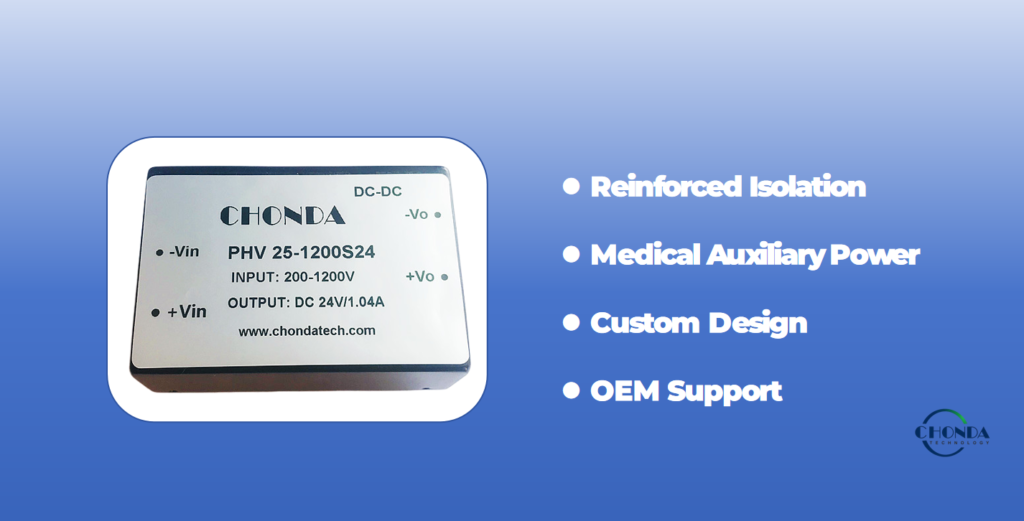
Typical features include:
- Input voltage up to 1200 VDC
- Isolated 24 VDC output
- High isolation capability
- Compact module design
- Low EMI performance
- Industrial-grade reliability
The PHV25 series is suitable for applications where auxiliary power is required for controllers, communication interfaces, monitoring circuits, and embedded medical electronics.
6.2. Custom Reinforced Isolation Power Solutions
Not every medical project has identical electrical requirements.
CHONDA supports customized DC-DC converter development based on customer specifications, including:
- Custom input voltage ranges
- Custom output voltages
- Higher isolation voltage requirements
- Reinforced insulation structures
- Medical auxiliary power optimization
- Mechanical customization
- Thermal optimization
- EMI optimization
Custom development allows engineers to integrate the converter more effectively into complete medical systems while satisfying application-specific safety requirements.
6.3. OEM & Engineering Support
Beyond standard modules, CHONDA also provides OEM and engineering support throughout the product development process.
Our engineering services include:
- Converter selection support
- Isolation architecture recommendations
- EMC optimization guidance
- Thermal design consultation
- Application evaluation
- Long-term supply support
By working closely with equipment manufacturers, CHONDA helps simplify power supply integration and improve overall system reliability.
📚 Continue Reading
Explore our medical power solution articles:
→ High Voltage DC-DC Converter for Medical Equipment
→ Medical Isolation Power Supply
→ Low EMI DC-DC Converter for Medical Equipment
→ DC-DC Converter for Patient Monitoring Systems
7. Frequently Asked Questions
Q1. What is reinforced isolation?
Reinforced isolation is a single insulation system that provides a level of protection equivalent to both basic insulation and supplementary insulation combined. It is designed to protect users against electric shock even if one insulation layer fails and is widely required in medical and safety-critical equipment.
Q2. Is reinforced isolation mandatory for medical equipment?
Not every medical device requires reinforced isolation. However, equipment with patient-connected circuits or applications requiring 2 MOPP (Means of Patient Protection) under IEC 60601-1 typically requires reinforced isolation or an equivalent level of electrical protection.
Q3. What is the difference between reinforced isolation and double insulation?
Double insulation uses two independent insulation layers: basic insulation plus supplementary insulation. Reinforced isolation achieves an equivalent protection level with a single reinforced insulation system designed to withstand the same electrical stresses and fault conditions.
Q4. What isolation voltage is required for medical devices?
The required isolation voltage depends on the equipment category, working voltage, pollution degree, and the protection level specified by IEC 60601-1. Engineers should evaluate creepage distance, clearance distance, and dielectric withstand requirements rather than selecting isolation voltage based on a single specification.
Q5. Does reinforced isolation reduce leakage current?
Yes. Reinforced isolation helps minimize unwanted leakage current between hazardous high-voltage circuits and accessible low-voltage circuits. Proper isolation design improves patient protection, operator safety, and overall electrical reliability in medical equipment.
Q6. Can reinforced isolation improve IEC 60601 compliance?
Reinforced isolation is an important design element for achieving IEC 60601 compliance, especially when 2 MOPP protection is required. However, compliance also depends on creepage, clearance, leakage current, EMC performance, and overall system design.
8. Conclusion
Selecting the appropriate isolation architecture is one of the most important decisions in medical power supply design.
Reinforced isolation not only protects patients and operators from electrical hazards but also helps equipment manufacturers satisfy IEC 60601 safety requirements while improving long-term system reliability.
When designing high-voltage auxiliary power supplies for medical equipment, engineers should evaluate isolation level, leakage current, creepage and clearance distances, thermal performance, EMC characteristics, and application requirements as a complete system rather than considering isolation voltage alone.
By understanding these engineering principles, designers can select high-voltage DC-DC converters that provide safer, more reliable, and regulation-compliant medical power solutions.
📚 Related Articles
Continue exploring CHONDA’s Medical Power Knowledge Base:
- High Voltage DC-DC Converter for Medical Equipment
- DC-DC Converter for Patient Monitoring Systems
- Medical Auxiliary Power Supply Design
- Medical Isolation Power Supply
- Low EMI DC-DC Converter for Medical Equipment
- How to Select the Right High Voltage DC-DC Converter
Need help selecting a reinforced isolation DC-DC converter for your medical project?
Contact CHONDA’s engineering team to discuss standard modules, custom power solutions, and OEM development services.