We help the world since 2012

High Voltage DC-DC Converter Design Challenges
Most engineers focus on electrical specifications when selecting a high voltage DC-DC converter, but designing a reliable converter involves far more than choosing the correct input and output voltage.
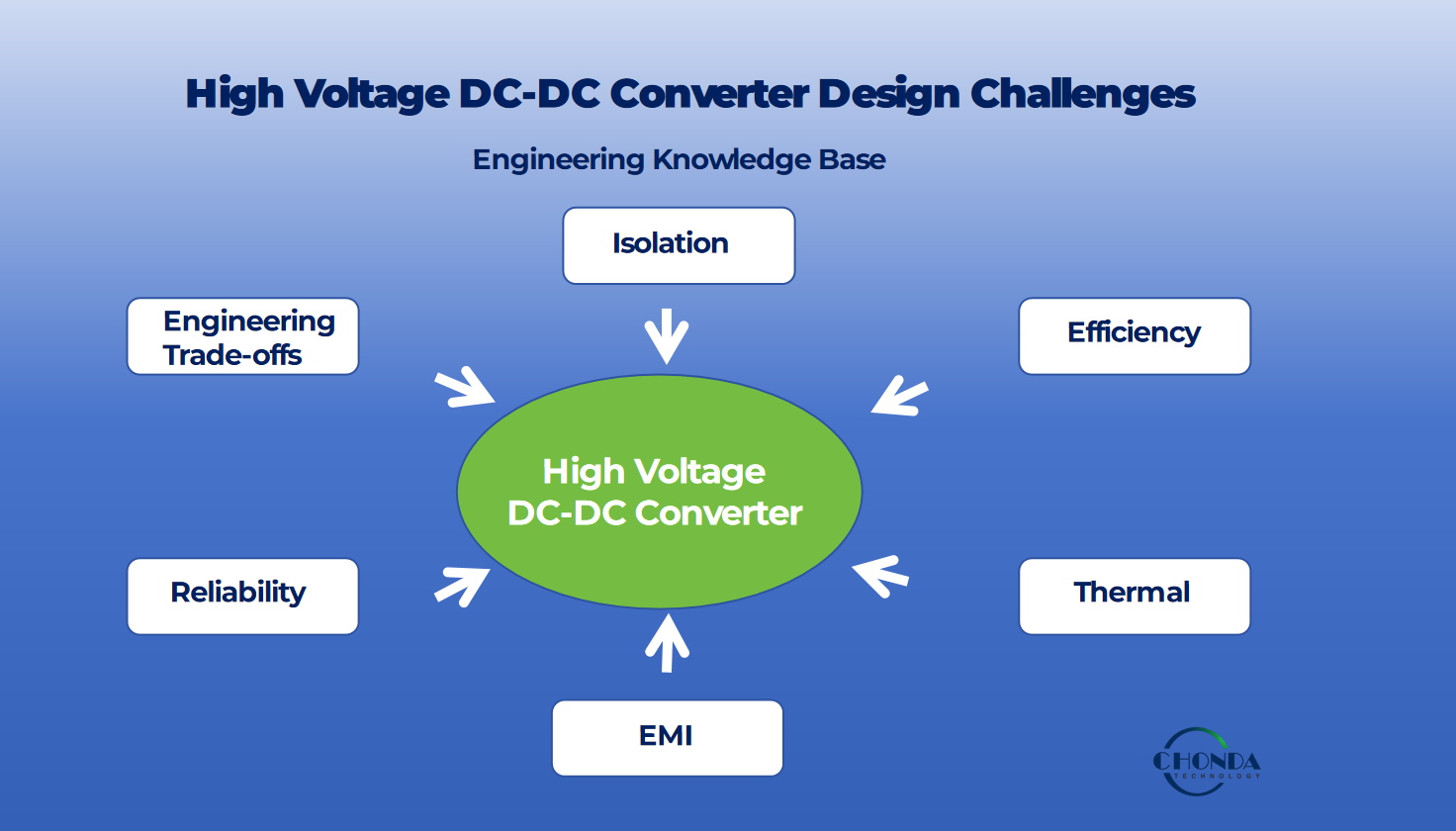
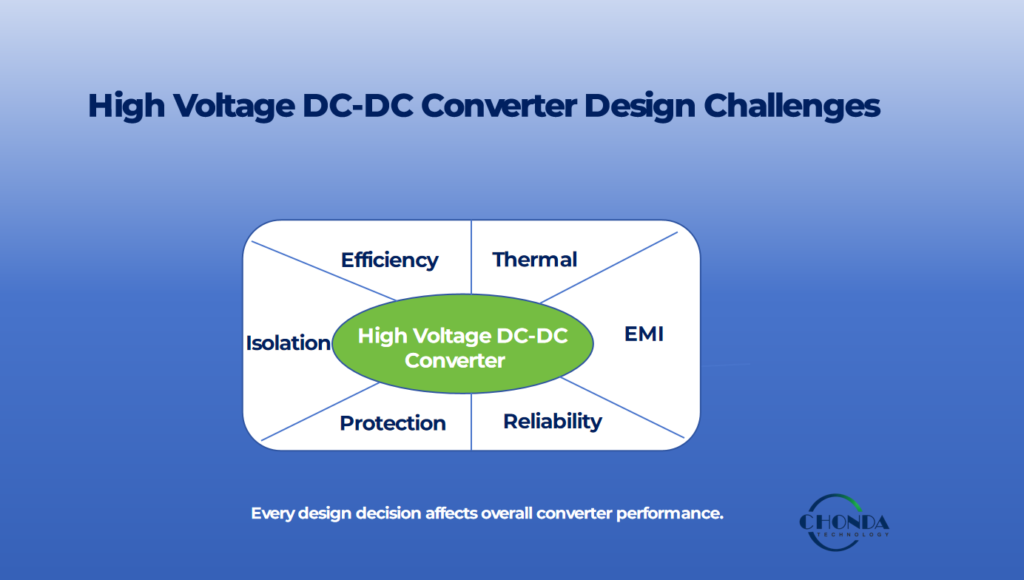
High voltage systems introduce unique engineering challenges, including insulation design, thermal management, electromagnetic compatibility (EMI), protection strategies, efficiency optimization, and long-term reliability. These factors interact with one another, meaning that improving one performance characteristic often requires compromises in another.
For example, increasing isolation distance improves electrical safety but may enlarge the converter size. Higher switching frequencies reduce transformer volume while making EMI suppression more difficult. Improving thermal performance may require additional heat dissipation space, affecting mechanical integration.
Successful converter design therefore requires balancing multiple engineering constraints rather than optimizing a single specification.
This guide explains the most common design challenges encountered in high voltage DC-DC converter development and discusses how engineers evaluate these trade-offs when designing reliable industrial, medical, railway, energy storage, photovoltaic, and smart grid power systems.
Why High Voltage DC-DC Converter Design Is Challenging
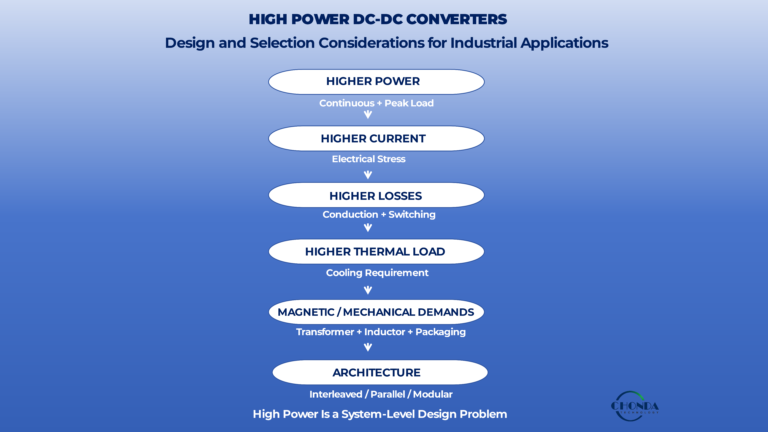
Designing a high voltage DC-DC converter involves far more than converting one voltage level to another. As operating voltages increase, engineers must simultaneously balance electrical safety, efficiency, thermal performance, electromagnetic compatibility (EMI), mechanical constraints, and long-term reliability.
Unlike low-voltage converters, high voltage designs introduce multiple engineering trade-offs. Improving one performance characteristic may negatively affect another, requiring careful optimization rather than maximizing a single specification.
For example, increasing isolation distance enhances electrical safety but often increases transformer size. Raising switching frequency can reduce magnetic component size while making EMI control more difficult. Improving efficiency lowers heat generation but may require more advanced switching devices and control strategies.
Because these design factors are closely interconnected, successful high voltage converter development depends on achieving the best overall balance for the intended application rather than optimizing a single parameter.
The following sections explain the major engineering challenges that influence high voltage DC-DC converter design.
1. High Voltage Isolation Design
One of the most important challenges is providing sufficient electrical isolation between the high voltage input and the low voltage output.
As input voltages increase, engineers must carefully design:
- Isolation barriers
- Transformer insulation
- Creepage distance
- Clearance distance
- Isolation testing requirements
Insufficient isolation may increase leakage current, reduce operator safety, or prevent compliance with international standards such as IEC 60601 or IEC 62368.
Related Article
→ High Voltage DC-DC Converter Isolation Design: Principles and Applications
2. Thermal Management
Even highly efficient converters generate heat during power conversion.
As output power increases, excessive temperature can shorten component lifetime, accelerate insulation aging, reduce reliability, and affect long-term performance.
Thermal design therefore includes:
- Converter efficiency optimization
- Heat sink design
- PCB thermal layout
- Airflow management
- Operating temperature derating
A well-designed thermal solution significantly improves long-term converter reliability.
Related Article
→ High Voltage DC-DC Converter Thermal Management
3. Electromagnetic Compatibility (EMI)
High voltage switching circuits naturally generate electromagnetic interference.
Without proper EMI control, switching noise may affect:
- Communication interfaces
- Sensors
- Control electronics
- Medical monitoring equipment
- Industrial automation systems
Effective EMI design typically combines optimized PCB layout, transformer design, shielding, filtering, and switching topology selection.
Meeting EMC standards often requires balancing switching efficiency against electromagnetic performance.
Related Article
→ High Voltage DC-DC Converter EMI Design Considerations
The Biggest Challenges in High Voltage DC-DC Converter Design
Designing a high voltage DC-DC converter is far more complex than simply increasing the input voltage range. As operating voltages continue to rise in photovoltaic systems, battery energy storage, railway power supplies, and industrial automation, engineers must simultaneously balance multiple performance requirements that often compete with one another.
A successful converter design requires optimization across electrical performance, thermal management, electromagnetic compatibility, insulation safety, long-term reliability, and manufacturing constraints. Improving one parameter may negatively affect another, making converter development a continuous engineering trade-off rather than a single optimization problem.
The most common design challenges include the following aspects.
Challenge 1 — Achieving High Efficiency at High Input Voltages
One of the primary objectives of any DC-DC converter is maximizing conversion efficiency. However, maintaining high efficiency becomes increasingly difficult as input voltages rise into the hundreds or even thousands of volts.
Higher switching voltages increase switching losses, while higher electric-field stress places greater demands on semiconductor devices, magnetic components, and transformer insulation. Engineers must carefully optimize switching frequency, transformer design, semiconductor selection, and control topology to minimize power loss without compromising system stability.
Even small efficiency improvements can significantly reduce operating temperature and improve long-term reliability, especially in continuously operating industrial equipment.
📚 Continue Reading
To learn how efficiency directly affects converter lifetime and thermal performance:
→ Thermal Performance in High Voltage DC-DC Converters
Challenge 2 — Managing Thermal Performance
Power loss inside the converter is ultimately converted into heat. If thermal energy cannot be removed efficiently, internal component temperatures rise rapidly, reducing efficiency, accelerating material aging, and shortening product lifetime.
Thermal design therefore becomes a critical part of converter development rather than a secondary consideration.
Effective thermal management involves multiple design decisions, including:
- PCB layout optimization
- Transformer heat dissipation
- Power device placement
- Heat sink design
- Airflow management
- Material selection
A converter operating only a few degrees cooler may achieve significantly longer service life than one operating continuously near its thermal limits.
📚 Continue Reading
→ Thermal Performance in High Voltage DC-DC Converters
Challenge 3 — Maintaining Reliable Electrical Isolation
As operating voltage increases, maintaining adequate electrical isolation becomes more difficult.
Isolation barriers must withstand continuous working voltage while also surviving transient surge events and fault conditions throughout the product’s service life.
Designers must consider:
- Creepage distance
- Clearance distance
- Transformer insulation
- Isolation materials
- Safety standards
- Partial discharge performance
Insufficient isolation may not immediately cause failure, but it greatly increases the risk of insulation degradation and long-term reliability problems.
For medical, railway, and industrial safety applications, reinforced isolation is often required to satisfy international safety standards.
📚 Continue Reading
→ How Reinforced Isolation Improves Medical Device Safety
Challenge 4 — Controlling EMI in High Voltage DC-DC Converters
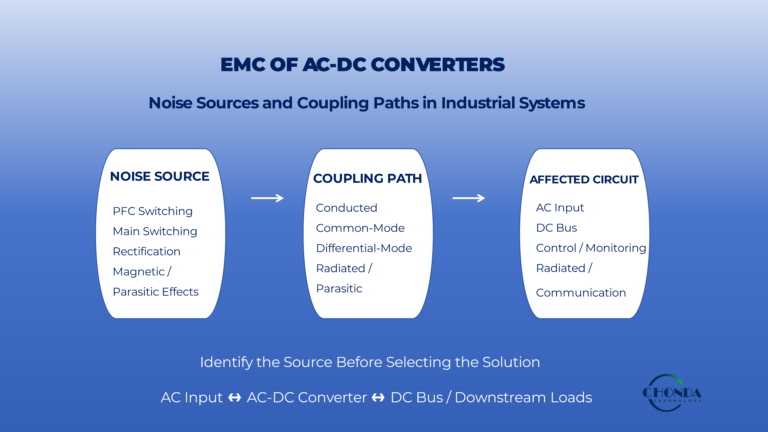
As switching frequencies continue to increase, electromagnetic interference (EMI) has become one of the most challenging aspects of high voltage DC-DC converter design.
Unlike efficiency or output regulation, EMI problems are often not immediately visible during normal operation. A converter may appear to function correctly while still generating excessive electromagnetic noise that interferes with nearby equipment or causes compliance failures during EMC testing.
For converters operating in industrial automation, railway systems, medical equipment, telecommunications, or smart grid applications, effective EMI control is essential for both product reliability and regulatory compliance.
Designing for low EMI requires engineers to consider the entire power system rather than focusing only on the converter itself.
Challenge 4.1 — Reducing Conducted EMI
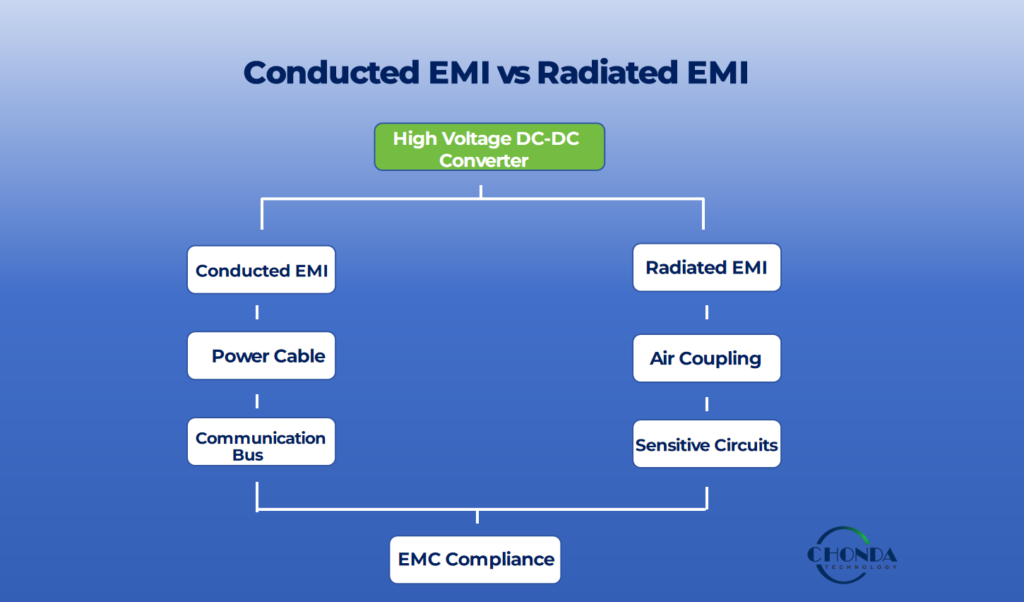
Conducted EMI travels through electrical conductors such as input power cables, output cables, and grounding paths.
High switching currents generated by DC-DC converters may propagate through the power distribution network and interfere with nearby controllers, communication modules, or sensitive electronic equipment.
To reduce conducted EMI, engineers typically optimize:
- Input filter design
- Output filter design
- PCB current loop layout
- Grounding strategy
- Switching waveform control
Careful filter design significantly improves EMC performance while maintaining converter efficiency.
Challenge 4.2 — Controlling Radiated EMI
Radiated EMI spreads through electromagnetic fields instead of electrical wiring.
Fast voltage transitions (high dv/dt) and current transitions (high di/dt) create electromagnetic radiation that may couple into nearby signal cables, sensors, communication systems, or control circuits.
Radiated EMI becomes increasingly important in compact equipment where electronic components are placed close together.
Typical design methods include:
- Optimized PCB layout
- Reduced loop area
- Transformer shielding
- Metal enclosure design
- Proper cable routing
Good mechanical design is often just as important as electrical design when reducing radiated emissions.
Challenge 4.3 — Passing EMC Compliance Testing
Most commercial high voltage DC-DC converters must comply with international EMC standards before entering the market.
Typical compliance testing evaluates:
- Conducted emissions
- Radiated emissions
- Electrostatic discharge (ESD)
- Electrical fast transients (EFT)
- Surge immunity
Passing EMC testing requires the combined optimization of hardware design, component selection, PCB layout, transformer structure, shielding, grounding, and filtering.
Engineers should therefore consider EMC performance during the earliest design stages rather than treating EMI as a problem to solve after prototype testing.
📚 Continue Reading
To learn more about EMI mechanisms and practical suppression techniques:
→ How to Reduce EMI in High Voltage DC-DC Converters
Challenge 5 — Ensuring Long-Term Reliability
High voltage DC-DC converters are often expected to operate continuously for many years under demanding environmental conditions.
Unlike consumer electronics that may only operate intermittently, industrial equipment, railway systems, renewable energy installations, medical equipment, and telecommunication infrastructure frequently require uninterrupted operation throughout their entire service life.
For these applications, long-term reliability is just as important as electrical performance.
A converter that provides stable output voltage but fails prematurely due to thermal stress, component aging, or environmental factors may result in expensive maintenance, unexpected downtime, or complete system shutdown.
Engineers therefore evaluate reliability from the earliest design stage rather than considering it only after product deployment.
Challenge 5.1 — Component Lifetime
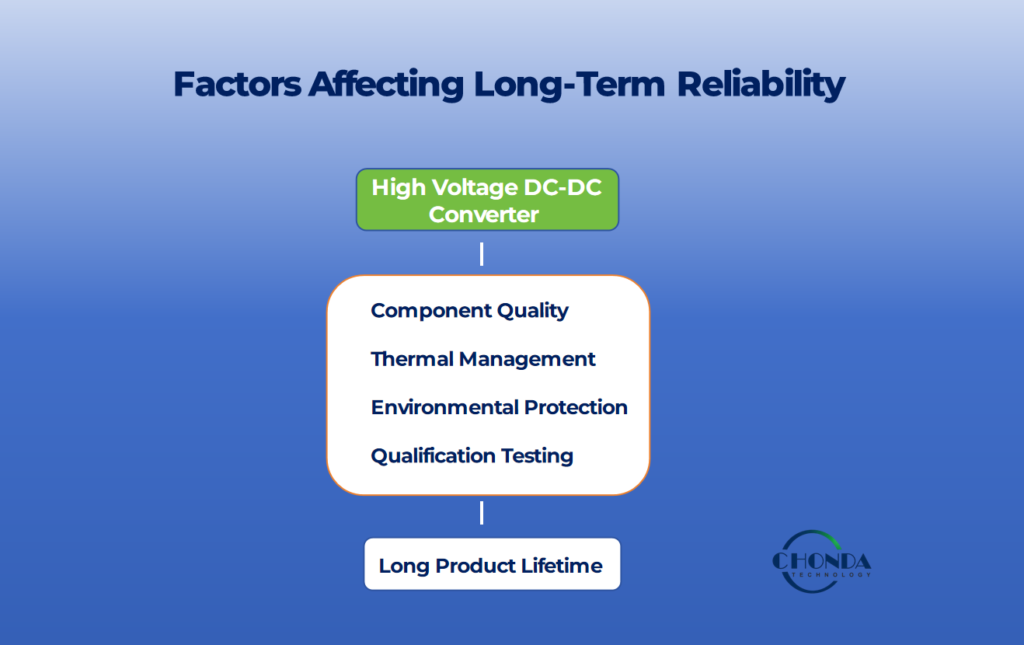
The lifetime of a high voltage DC-DC converter largely depends on the quality and operating conditions of its internal components.
Although semiconductor devices continue to improve, many failures still originate from passive components that experience long-term electrical and thermal stress.
Typical lifetime-limiting components include:
- Electrolytic capacitors
- Magnetic components
- Power semiconductors
- Optocouplers
- Isolation materials
Selecting industrial-grade components and operating them within their specified ratings significantly increases converter lifetime.
Challenge 5.2 — Thermal Aging
Temperature is one of the most important factors affecting converter reliability.
Every increase in operating temperature accelerates the aging of electronic components.
Excessive heat may gradually reduce capacitor lifetime, weaken insulation materials, and increase semiconductor stress even when the converter continues operating normally.
For this reason, engineers pay close attention to:
- Internal temperature rise
- Heat dissipation capability
- Cooling airflow
- Ambient operating temperature
- Hot spot distribution
Lower operating temperatures generally translate into longer service life and improved long-term stability.
Challenge 5.3 — Environmental Protection
Many high voltage DC-DC converters operate in harsh industrial environments where dust, humidity, vibration, and electrical disturbances are unavoidable.
Environmental conditions may gradually affect insulation performance, solder joints, connectors, and mechanical structures.
Reliable converter design therefore considers protection against:
- Dust contamination
- Moisture
- Mechanical vibration
- Temperature cycling
- Corrosion
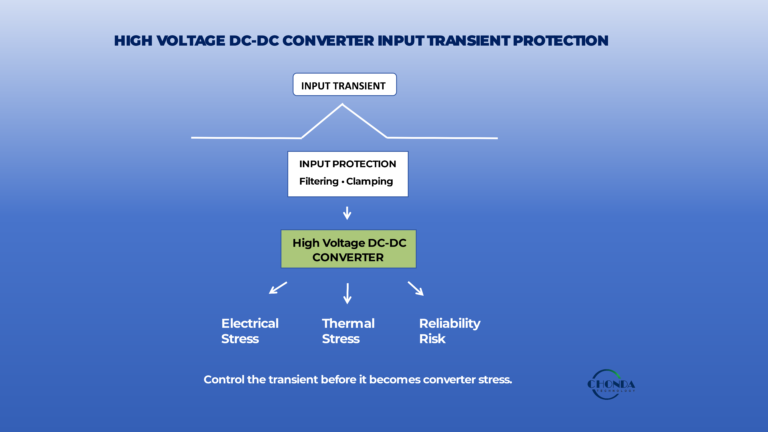
- Electrical surges
Depending on the application, additional protection methods such as conformal coating, encapsulation, or reinforced mechanical structures may be required.
Challenge 5.4 — Reliability Validation
Long-term reliability cannot be guaranteed through theoretical calculations alone.
Manufacturers typically perform extensive qualification testing before releasing a converter for production.
Common reliability verification includes:
- High temperature operating life (HTOL)
- Thermal cycling
- Humidity testing
- Vibration testing
- Burn-in testing
- Isolation endurance testing
These evaluations help verify that the converter maintains stable performance throughout its intended operating lifetime.
📚 Continue Reading
To learn more about improving converter lifetime and reliability:
→ How to Improve High Voltage DC-DC Converter Reliability
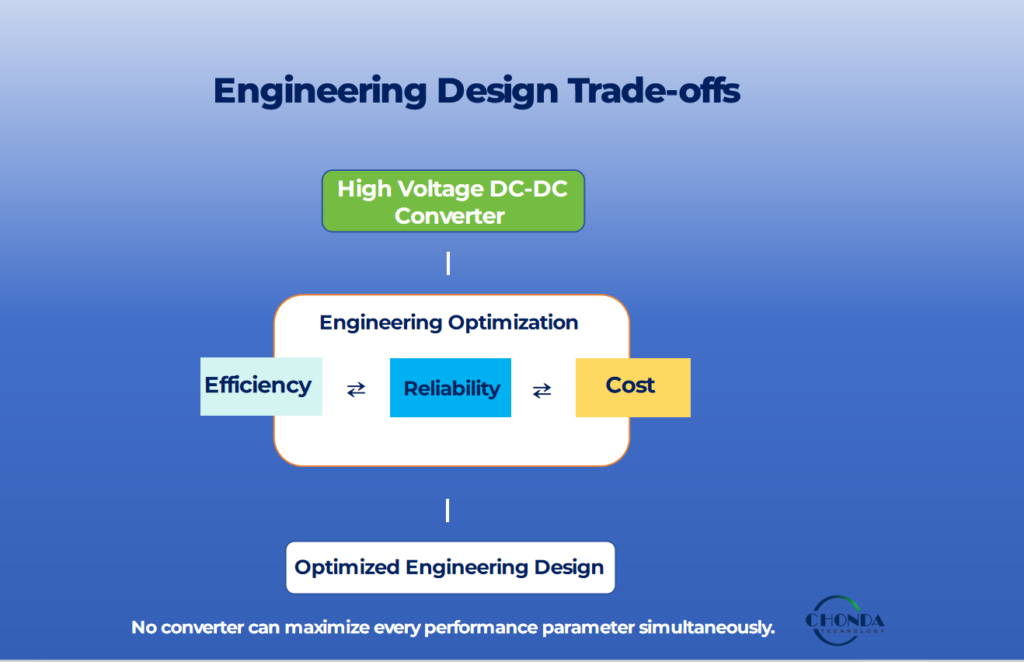
Challenge 6 — Balancing Performance, Cost, and Reliability
Designing a high voltage DC-DC converter is rarely about maximizing a single performance parameter.
Instead, engineers must continuously balance efficiency, thermal performance, electrical isolation, electromagnetic compatibility (EMI), protection features, reliability, mechanical size, and overall system cost.
Improving one aspect often requires compromises in another.
For example, increasing switching frequency may reduce transformer size but also increase switching losses and EMI. Improving thermal performance may require larger heat sinks or additional cooling, while higher isolation levels may increase transformer size and manufacturing cost.
Successful converter design therefore focuses on achieving the optimal balance for the intended application rather than maximizing every specification.
Challenge 6.1 — No Universal Converter Exists
There is no single high voltage DC-DC converter suitable for every application.
Medical equipment, railway systems, photovoltaic monitoring, industrial automation, battery energy storage, and telecommunication infrastructure all operate under different electrical, environmental, and regulatory conditions.
Each application emphasizes different priorities.
For example:
- Medical equipment prioritizes patient safety and reinforced isolation.
- Railway systems require vibration resistance and long service life.
- PV monitoring focuses on wide input voltage and outdoor reliability.
- Industrial automation values efficiency and EMC stability.
- Battery energy storage emphasizes continuous operation and thermal management.
The best converter is therefore the one that matches the application’s actual engineering requirements.
Challenge 6.2 — Avoid Over-Specification
Selecting the highest specification available does not always produce the best engineering solution.
Converters with unnecessarily high voltage ratings, excessive power margins, or redundant protection features may increase cost, size, and complexity without providing meaningful system benefits.
Instead of selecting the largest or most powerful converter, engineers should evaluate:
- Actual operating voltage
- Required output power
- Safety requirements
- Environmental conditions
- Expected service life
- Regulatory compliance
An optimized specification usually delivers better overall system performance than an oversized design.
Challenge 6.3 — Engineering Optimization Is the Goal
Professional converter selection is ultimately an engineering optimization process.
Rather than asking,
“Which converter has the highest specification?”
engineers should ask,
“Which converter best fits the application?”
This design philosophy improves:
- System reliability
- Cost efficiency
- Thermal performance
- Installation flexibility
- Long-term maintenance
A well-balanced design provides the highest overall value throughout the product lifecycle.
📚 Continue Reading
To learn how to choose the most appropriate converter for different applications:
→ How to Select the Right High Voltage DC-DC Converter
→ High Voltage DC-DC Converter Applications
→ Medical Equipment DC-DC Converter
→ Industrial Automation DC-DC Converter
→ Battery Energy Storage Systems
→ Telecommunication Systems
→ Wind Energy Power Supplies
→ Marine Power Systems
How CHONDA Solves High Voltage DC-DC Converter Design Challenges
Design challenges cannot be solved by optimizing only a single parameter. In real engineering projects, electrical isolation, efficiency, thermal management, EMC performance, protection strategy, and long-term reliability must all be considered simultaneously.
CHONDA develops isolated high voltage DC-DC converter solutions based on practical engineering experience across industrial automation, medical equipment, railway systems, renewable energy, telecommunications, and other demanding applications.
Instead of offering a one-size-fits-all converter, CHONDA provides application-oriented power solutions designed around actual system requirements.
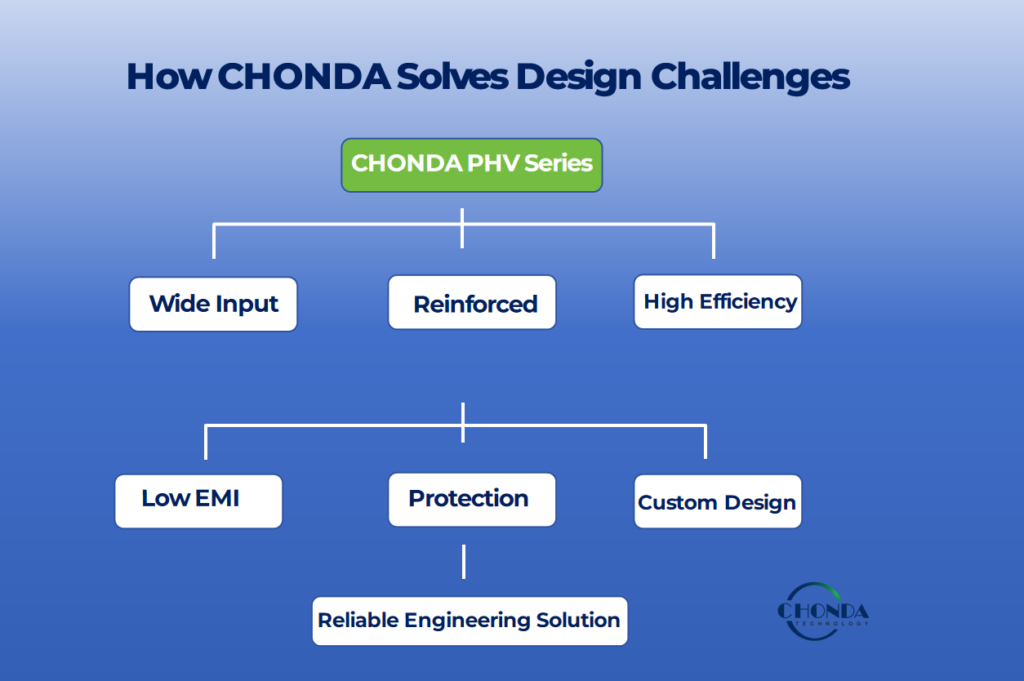
Wide Input Voltage Design
One of the biggest challenges in high voltage applications is accommodating unstable or wide-ranging DC bus voltages.
Many systems experience significant voltage fluctuations caused by battery discharge, PV generation changes, or industrial operating conditions.
CHONDA PHV Series supports wide input voltage ranges such as:
- 100–1000 VDC
- 200–1200 VDC
- Custom high-voltage ranges
Wide input capability helps maintain stable auxiliary power without requiring additional front-end voltage regulation.
Reinforced Isolation Architecture
For applications requiring high safety standards, reinforced isolation provides an additional layer of electrical protection between the high-voltage input and the low-voltage output.
CHONDA high voltage DC-DC converters are designed with reinforced isolation structures that support demanding industries including:
- Medical equipment
- Industrial control
- Railway electronics
- Smart grid monitoring
- Battery energy storage systems
The isolation architecture is optimized to improve operator safety, patient protection, and long-term system reliability.
High Efficiency Power Conversion
Power conversion efficiency directly affects temperature rise, system reliability, and overall energy consumption.
CHONDA designs converters with optimized switching topologies and magnetic components to achieve high conversion efficiency while maintaining electrical isolation.
Higher efficiency helps reduce:
- Heat generation
- Cooling requirements
- Operating costs
- Component stress
EMC-Oriented Design
Electromagnetic compatibility is considered throughout the converter development process rather than being addressed only during final testing.
CHONDA engineers optimize:
- PCB layout
- Switching current paths
- Transformer structure
- Filtering
- Shielding
- Grounding
These design practices help reduce both conducted and radiated EMI, improving the probability of passing EMC compliance testing.
Flexible Customization
Every industrial system has different voltage, power, isolation, and environmental requirements.
CHONDA supports OEM and customized development for projects requiring:
- Custom input voltage ranges
- Custom output voltages
- Different isolation levels
- Special protection functions
- Mechanical customization
- Industry-specific solutions
Engineering customization allows customers to integrate power modules more efficiently into their systems.
Typical Applications
CHONDA high voltage DC-DC converters are widely used in:
- Medical Equipment
- Industrial Automation
- Railway Systems
- Battery Energy Storage Systems (BESS)
- PV Monitoring
- EV Charging
- Smart Grid
- Telecommunication
- Wind Energy
- Marine Applications
Each application has different electrical requirements, making application-oriented converter selection essential.
Frequently Asked Questions
Q1. Why is designing a high voltage DC-DC converter more difficult than a low voltage converter?
Designing a high voltage DC-DC converter is more challenging because higher operating voltages increase electrical stress, insulation requirements, switching losses, electromagnetic interference (EMI), and thermal management complexity.
Engineers must balance efficiency, reinforced isolation, EMC performance, protection functions, reliability, and cost while ensuring compliance with relevant safety standards.
Q2. What is the biggest challenge in high voltage DC-DC converter design?
There is no single biggest challenge because every design parameter influences the others.
In most applications, engineers must simultaneously optimize isolation, efficiency, thermal performance, EMI suppression, protection features, and long-term reliability to achieve the best overall system performance.
Q3. How does electrical isolation affect converter reliability?
Proper electrical isolation protects low-voltage circuits from hazardous high-voltage inputs and prevents electrical faults from propagating through the system.
Reinforced isolation also improves long-term reliability by reducing insulation stress and helping equipment comply with international safety standards.
Q4. Why is EMI an important design consideration?
High switching frequencies generate conducted and radiated electromagnetic interference that may affect communication circuits, sensors, controllers, and other sensitive electronics.
Good EMI design improves system stability, reduces interference, and increases the likelihood of passing EMC certification.
Q5. Why is thermal management important for high voltage converters?
Even highly efficient converters generate heat during power conversion.
Proper thermal management reduces component temperature, improves reliability, extends operating lifetime, and helps maintain stable electrical performance during continuous operation.
Q6. How can engineers select the right high voltage DC-DC converter?
Engineers should evaluate the complete application rather than selecting only by voltage or power rating.
Important selection factors include:
- Input voltage range
- Output voltage
- Isolation level
- Power rating
- Thermal performance
- EMI performance
- Protection functions
- Industry safety standards
Application-oriented selection usually provides the most reliable long-term solution.
📚 Continue Reading
→ How to Select the Right High Voltage DC-DC Converter
Conclusion
Designing a high voltage DC-DC converter is not simply a matter of selecting the highest voltage rating or the most powerful module. Successful converter design requires balancing multiple engineering factors, including electrical isolation, efficiency, thermal performance, electromagnetic compatibility (EMI), protection functions, reliability, manufacturability, and application-specific requirements.
No single converter can maximize every performance parameter simultaneously. Instead, engineers must evaluate the complete operating environment and determine the optimal balance between performance, safety, reliability, and cost.
Whether the converter is used in medical equipment, industrial automation, railway systems, battery energy storage, photovoltaic monitoring, telecommunication infrastructure, EV charging, or smart grid applications, application-oriented engineering design always produces better long-term system performance than specification-driven selection alone.
At CHONDA, we develop high voltage DC-DC converter solutions based on practical engineering requirements rather than generic specifications. Our PHV Series and customized OEM solutions are designed to help engineers build safer, more reliable, and more efficient power systems across a wide range of high-voltage applications.
If you are selecting a high voltage DC-DC converter for your next project, understanding these design challenges is the first step toward building a reliable and future-ready power solution.
Looking for a high voltage DC-DC converter for your application?
Contact CHONDA engineers to discuss standard PHV Series modules or customized OEM power solutions.
📚 Related Articles
Engineering Fundamentals
- → How to Select the Right High Voltage DC-DC Converter
- → What Is a High Voltage DC-DC Converter? Design Principles and Applications
- → DC-DC Converter Selection Guide: Key Parameters for High Voltage Applications
Design & Engineering
- → High Voltage DC-DC Converter Isolation Design: Principles and Applications
- → High Voltage DC-DC Converter EMI Design Considerations
- → High Voltage DC-DC Converter Thermal Management
- → High Voltage DC-DC Converter Protection Features
Application Hub
Industry Solutions
→ High Voltage DC-DC Converter for Telecommunication Systems
→ High Voltage DC-DC Converter for Battery Energy Storage Systems (BESS)
→ High Voltage DC-DC Converter for PV Monitoring
→ High Voltage DC-DC Converter for Industrial Automation
→ High Voltage DC-DC Converter for Railway Systems
→ High Voltage DC-DC Converter for Medical Equipment