We help the world since 2012

High Voltage DC-DC Converter Isolation Design: Principles and Applications
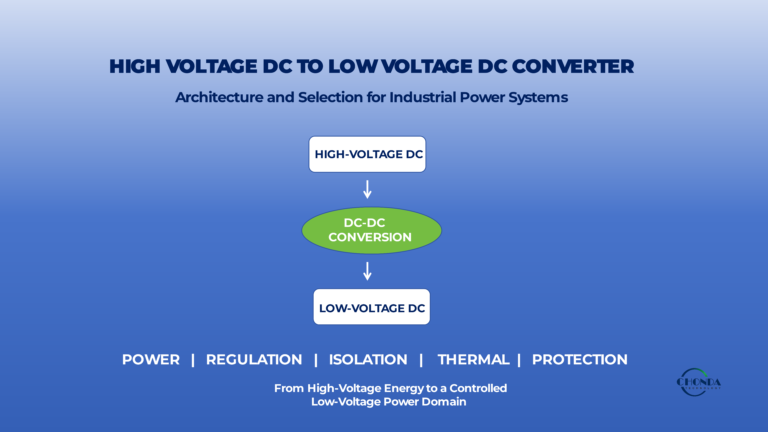
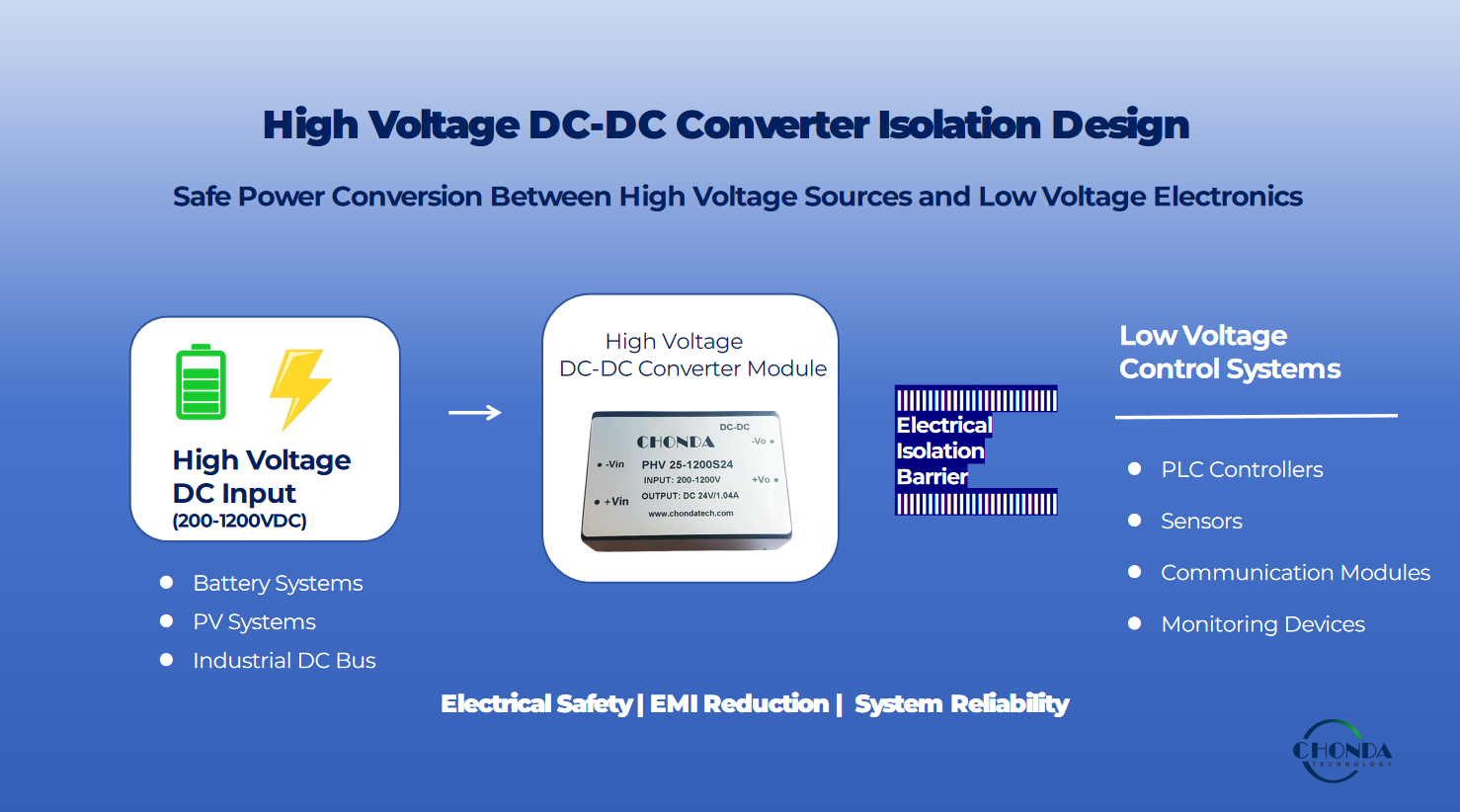
High voltage DC-DC converters are widely used in industrial systems where high-voltage DC sources need to supply power to low-voltage electronic control and monitoring circuits.
Applications such as photovoltaic systems, battery energy storage systems (BESS), industrial automation equipment, and railway power systems often operate with DC voltage levels ranging from hundreds of volts to over 1000VDC.
In these environments, electrical isolation is one of the most important design considerations for ensuring system safety, reliability, and electromagnetic compatibility.
A properly isolated high voltage DC-DC converter separates the high-voltage input side from the low-voltage output side while maintaining efficient power transfer. This isolation helps protect sensitive electronic components, reduce electrical noise, and improve the overall stability of industrial power systems.
This article explains the principles of high voltage DC-DC converter isolation design, its technical importance, and how isolation performance affects industrial applications.
1. What Is Electrical Isolation in a High Voltage DC-DC Converter?
Electrical isolation in a high voltage DC-DC converter refers to the separation between the high-voltage input circuit and the low-voltage output circuit while allowing power conversion through electromagnetic coupling or other isolation technologies.
Unlike non-isolated converters, isolated DC-DC converters use isolation components such as transformers to prevent direct electrical connection between input and output circuits.
The main purpose of isolation is to provide:
- Electrical safety
- Protection of low-voltage electronics
- Reduction of ground loop problems
- Improved system reliability
In high voltage applications, isolation becomes especially important because the input voltage may reach several hundred volts or even higher. Sensitive control devices, sensors, communication modules, and monitoring systems typically require stable low-voltage power supplies such as 12VDC or 24VDC.
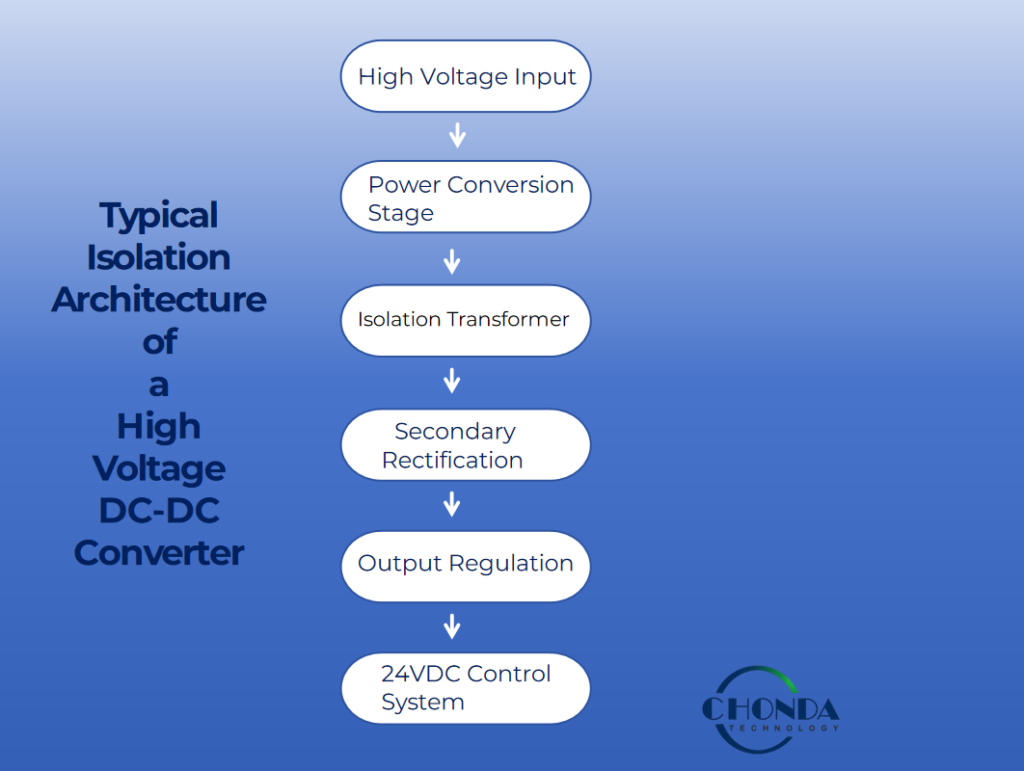
A typical isolated high voltage DC-DC converter structure can be illustrated as:
2. How Does Isolation Work in High Voltage DC-DC Converters?
Isolation is one of the most important design features in high voltage DC-DC converters. It creates an electrical separation between the high-voltage input side and the low-voltage output side while still allowing energy transfer.
In industrial power systems, high voltage DC sources such as battery systems, photovoltaic systems, and industrial DC buses may operate at hundreds or even thousands of volts. However, control circuits, sensors, communication modules, and monitoring devices typically require low-voltage DC power such as 12VDC or 24VDC.
An isolated high voltage DC-DC converter uses advanced power conversion technology and isolation components to transfer energy safely while preventing direct electrical connection between the input and output circuits.
A typical isolated high voltage DC-DC converter includes several key stages:
High Voltage Input → Power Conversion Stage → Isolation Transformer → Secondary Rectification and Output Regulation → Low Voltage DC Output
This structure enables reliable voltage conversion while maintaining electrical safety, reducing noise coupling, and protecting sensitive electronic components.
2.1.Isolation Transformer Design
The isolation transformer is the core component responsible for electrical separation inside an isolated high voltage DC-DC converter.
Instead of transferring power through a direct conductive path, the converter transfers energy through magnetic coupling between the primary and secondary windings of the transformer.
This design provides several advantages:
- Electrical separation between high voltage and low voltage circuits
- Improved operator and equipment safety
- Reduced transmission of electrical noise
- Better protection for sensitive control electronics
For industrial applications, the transformer design must consider factors such as insulation materials, winding structure, isolation distance, and operating voltage requirements.
A properly designed isolation transformer allows high voltage DC-DC converter modules to operate reliably in demanding environments including energy storage systems, industrial automation equipment, and renewable energy applications.
2.2.Galvanic Isolation
Galvanic isolation means that there is no direct conductive connection between the input circuit and output circuit.
In a high voltage DC-DC converter, galvanic isolation prevents dangerous high-voltage potentials from reaching low-voltage control systems and connected electronic devices.
The isolation barrier separates:
- High voltage DC input circuits
- Power conversion circuits
- Low voltage control and monitoring circuits
This separation is especially important in systems where human interaction, communication networks, and sensitive electronic devices are involved.
By implementing galvanic isolation, engineers can improve system reliability while reducing the risk of electrical faults affecting downstream equipment.
2.3.Isolation Voltage Rating
Isolation voltage rating defines the maximum voltage that the isolation barrier can withstand between the input and output sides.
For high voltage DC-DC converter applications, isolation voltage is a critical specification because it directly affects system safety and compliance.
Common isolation ratings include:
- 1000VAC
- 1500VAC
- 3000VAC or higher
The required isolation voltage depends on factors such as:
- Input voltage level
- System safety requirements
- Application environment
- Industry standards
For example, a converter operating in a 1000VDC battery or photovoltaic system requires sufficient isolation capability to ensure stable and safe operation.
CHONDA high voltage DC-DC converter modules are designed with electrical isolation considerations to support applications requiring wide input voltage ranges, stable DC output, and reliable operation in industrial environments.
3. Why Is Isolation Important in Industrial Applications?
In industrial power systems, high voltage DC sources are increasingly used in applications such as battery energy storage systems, photovoltaic monitoring systems, industrial automation equipment, and railway power systems.
However, many critical electronic devices, including PLC controllers, sensors, communication modules, and monitoring circuits, operate at much lower voltage levels.
Electrical isolation provides a safety barrier between high voltage power sources and low voltage control electronics. By separating the input and output circuits, isolated high voltage DC-DC converters help improve system safety, reduce electrical interference, and protect sensitive components from voltage-related failures.
For industrial applications, isolation is not only a safety requirement but also an important design consideration that directly affects system reliability, electromagnetic compatibility, and long-term operating performance.
3.1.Electrical Safety
One of the primary purposes of isolation in high voltage DC-DC converters is to improve electrical safety.
High voltage DC systems, such as 1000VDC battery platforms or photovoltaic power systems, contain potentially dangerous voltage levels. Without proper isolation, fault conditions or voltage transients could transfer high electrical potential to low voltage control circuits.
An isolated converter creates a physical and electrical separation between the high voltage input side and the low voltage output side, helping to:
- Reduce the risk of electric shock
- Protect operators and maintenance personnel
- Prevent damage to connected control equipment
- Improve overall system safety
In industrial environments, reliable isolation design allows engineers to integrate low voltage electronics into high voltage systems while maintaining safe operation.
3.2.EMI Reduction
Electromagnetic interference (EMI) is another important consideration in industrial high voltage power conversion systems.
High voltage switching converters generate high-frequency electrical noise during power conversion. Without effective isolation and filtering design, this noise can affect communication signals, sensors, and control circuits.
Isolation helps reduce unwanted noise coupling between the high voltage power stage and sensitive electronic systems.
A well-designed isolated high voltage DC-DC converter can improve:
- Electromagnetic compatibility (EMC)
- Communication reliability
- Signal integrity
- System stability
This is particularly important in applications such as PV monitoring systems, BESS monitoring systems, and industrial automation equipment where continuous communication and accurate measurements are required.
3.3.Protection of Sensitive Electronics
Modern industrial systems rely heavily on sensitive electronic components, including:
- PLC controllers
- Monitoring devices
- Communication interfaces
- Sensors
- Embedded control systems
These devices typically require stable low voltage DC power supplies, such as 12VDC or 24VDC, but they often operate near high voltage power sources.
Isolation protects these components by preventing:
- High voltage faults from reaching control circuits
- Voltage spikes from damaging electronics
- Ground potential differences from affecting system operation
By providing a stable and isolated power interface, high voltage DC-DC converter modules help ensure reliable operation of industrial control and monitoring systems.
4. Key Isolation Parameters for High Voltage DC-DC Converter Selection
When selecting a high voltage DC-DC converter for industrial applications, isolation performance is one of the most important design considerations.
A converter with proper isolation capability ensures safe operation between high voltage power sources and low voltage control circuits while improving system reliability and electromagnetic compatibility.
Engineers should evaluate several key isolation parameters, including isolation voltage rating, creepage and clearance distance, and insulation performance.
These parameters directly affect the converter’s ability to operate safely in demanding environments such as battery energy storage systems, PV monitoring systems, industrial automation equipment, and other high voltage DC applications.
4.1.Isolation Voltage
Isolation voltage defines the maximum voltage that the isolation barrier can withstand between the input and output sides of a high voltage DC-DC converter.
This specification is critical because industrial systems may operate with high DC bus voltages, such as 400VDC, 800VDC, or 1000VDC battery systems.
A suitable isolation voltage rating helps prevent electrical breakdown between high voltage circuits and low voltage control electronics.
Common isolation voltage ratings include:
- 1000VAC
- 1500VAC
- 3000VAC or higher
When selecting a converter, engineers should consider:
- Maximum system voltage
- Voltage transient conditions
- Safety requirements
- Applicable industry standards
For example, a high voltage DC-DC converter used in a photovoltaic monitoring system or battery energy storage system requires sufficient isolation voltage to maintain reliable operation under continuous high voltage conditions.
4.2.Creepage and Clearance Distance
Creepage and clearance distances are important factors in high voltage isolation design.
Clearance distance refers to the shortest distance through air between two conductive parts.
Creepage distance refers to the shortest distance along the surface of an insulating material between conductive parts.
Proper creepage and clearance design helps prevent:
- Electrical arcing
- Insulation failure
- Voltage tracking
- Safety risks under high humidity or contamination conditions
For industrial high voltage DC-DC converter modules, sufficient creepage and clearance distance is required to maintain stable operation over the product lifetime.
This is especially important in applications exposed to harsh environments, including outdoor renewable energy systems, industrial equipment, and transportation systems.
4.3.Insulation Performance
Insulation performance determines how effectively the isolation barrier maintains electrical separation during long-term operation.
A reliable insulation system typically considers:
- Insulation materials
- Transformer construction
- Thermal stress
- Environmental conditions
- Long-term aging characteristics
High-quality insulation design helps the converter maintain stable isolation performance despite temperature variations, voltage fluctuations, and continuous operating conditions.
For industrial applications, strong insulation performance improves system reliability and reduces the risk of unexpected failures in critical power conversion systems.
Engineers selecting a high voltage DC-DC converter module should also evaluate other factors such as input voltage range, EMI performance, efficiency, and thermal management. Learn more in our article How to Select a High Voltage DC-DC Converter Module for Industrial Applications.
5. CHONDA High Voltage DC-DC Converter Solution
For industrial applications requiring reliable high voltage DC power conversion, CHONDA provides high voltage DC-DC converter modules designed with wide input voltage capability, electrical isolation, and stable low-voltage output performance.
High voltage systems such as photovoltaic monitoring platforms, battery energy storage systems (BESS), and industrial automation equipment require power supplies that can operate safely under demanding electrical conditions.
By integrating isolation design, protection functions, and regulated DC output, CHONDA high voltage DC-DC converter modules provide a reliable power interface between high voltage DC sources and low voltage control electronics.
PHV25-1200S24 High Voltage DC-DC Converter Module
The PHV25-1200S24 high voltage DC-DC converter module is designed for industrial applications requiring wide input voltage operation and reliable electrical isolation.
The module supports a wide input voltage range suitable for high voltage DC systems and provides a regulated 24VDC output for powering control, monitoring, and communication equipment.
Key features include:
- Wide input voltage range up to 1200VDC
- Stable 24VDC regulated output
- Electrical isolation between input and output sides
- Low EMI performance for sensitive electronic systems
- Compact module design for industrial integration
The PHV25-1200S24 is suitable for applications including:
- PV monitoring systems
- Battery energy storage systems (BESS)
- Industrial automation equipment
- High voltage battery applications
- Industrial monitoring and control systems
By providing isolated and stable DC power conversion, the PHV25-1200S24 helps ensure reliable operation of critical electronic systems in high voltage environments.
Engineers selecting a high voltage DC-DC converter should consider not only voltage conversion capability but also isolation performance, safety requirements, EMI characteristics, and long-term reliability.
CHONDA supports customized high voltage DC-DC converter solutions for applications requiring reliable power conversion between high voltage DC sources and low voltage electronic systems.
6. Conclusion
High voltage DC-DC converter isolation is a critical design consideration for industrial power systems where high-voltage DC sources must supply reliable power to low-voltage electronic devices.
Through electrical isolation, isolated DC-DC converters provide important benefits including improved safety, reduced electromagnetic interference, and better protection for sensitive control and monitoring circuits.
When selecting a high voltage DC-DC converter, engineers should evaluate key isolation parameters such as isolation voltage rating, creepage and clearance distance, and insulation performance to ensure reliable long-term operation.
With wide input voltage capability, stable DC output, and electrical isolation design, CHONDA high voltage DC-DC converter modules support demanding applications including PV monitoring systems, battery energy storage systems, industrial automation equipment, and other high voltage DC applications.
Related Articles
What Is a High Voltage DC-DC Converter? Design Principles and Applications
How to Select a High Voltage DC-DC Converter Module for Industrial Applications