We help the world since 2012

Power Supply Design for BESS Monitoring Systems
As Battery Energy Storage Systems (BESS) become an essential part of modern renewable energy infrastructure, reliable monitoring has become increasingly important for ensuring battery safety, operational efficiency, and long-term system performance.
A BESS monitoring system continuously collects data such as battery voltage, current, temperature, state of charge (SOC), and alarm status, allowing operators to detect abnormalities before they develop into critical failures. Since these monitoring devices often operate within high-voltage battery environments, providing a stable and isolated power supply is one of the most important design considerations.
Unlike conventional low-voltage control systems, battery energy storage installations expose monitoring equipment to high DC voltages, electrical noise, voltage fluctuations, and demanding industrial operating conditions. Selecting the appropriate DC-DC converter therefore plays a key role in maintaining reliable communication, accurate data acquisition, and long-term system stability.
This article explains the power supply requirements of BESS monitoring systems, discusses common design challenges, and demonstrates how high-voltage isolated DC-DC converters can provide dependable power for industrial battery monitoring applications.
1. What Is a BESS Monitoring System
A Battery Energy Storage System (BESS) monitoring system is responsible for supervising the operating status of battery energy storage installations by collecting, processing, and transmitting critical operating data in real time. It provides operators with continuous visibility into battery performance, enabling safer operation, predictive maintenance, and optimized energy management.
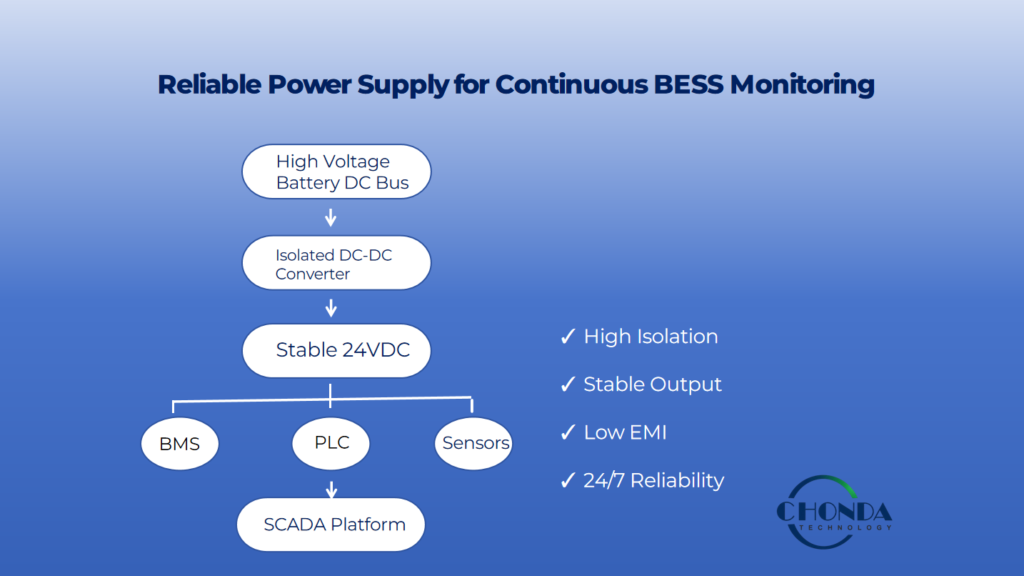
In a typical BESS installation, the monitoring system gathers information from battery modules, battery management systems (BMS), sensors, and communication controllers. These devices measure key parameters including battery voltage, current, temperature, state of charge (SOC), state of health (SOH), and fault conditions. The collected data is then transmitted to a supervisory platform, where operators can monitor system status, analyze performance trends, and respond quickly to abnormal events.
Unlike conventional industrial control systems, BESS monitoring equipment often operates inside high-voltage battery cabinets where electrical isolation, electromagnetic compatibility (EMC), and stable power delivery are essential. Any interruption or instability in the monitoring power supply may result in communication failures, inaccurate data collection, or delayed fault detection.
Therefore, selecting a reliable isolated DC-DC power supply is a fundamental part of BESS monitoring system design, ensuring continuous operation even under demanding industrial and renewable energy environments.
2. Why BESS Monitoring Requires Reliable Power Supplies
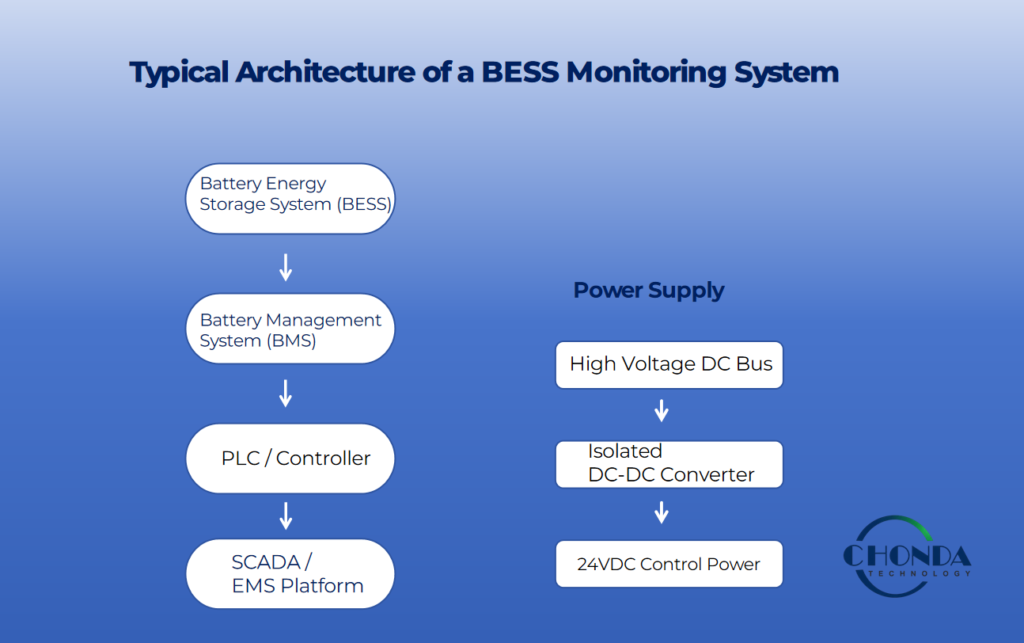
A Battery Energy Storage System (BESS) monitoring network operates continuously, collecting critical operating data from battery racks, battery management systems (BMS), PLCs, sensors, and communication devices. Unlike ordinary industrial equipment, these monitoring systems must remain active 24 hours a day to ensure battery safety, system efficiency, and fault detection.
If the auxiliary power supply becomes unstable, monitoring devices may experience unexpected shutdowns, communication failures, or inaccurate data collection. Even short interruptions can affect battery diagnostics and reduce the reliability of the entire energy storage system.
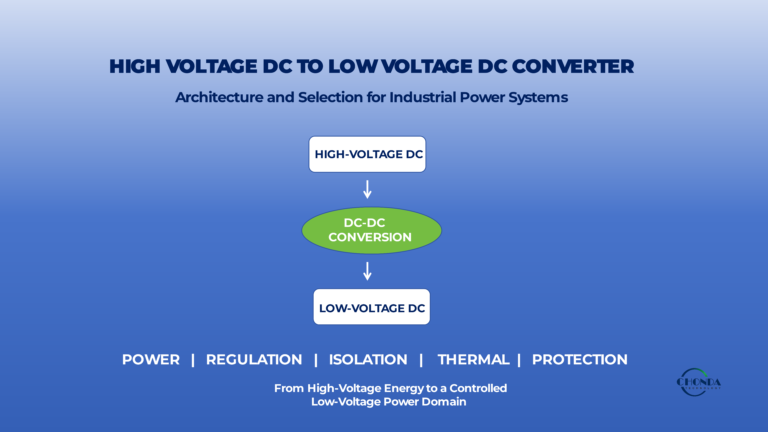
Because most utility-scale BESS installations operate with hundreds of volts of DC battery voltage, the monitoring equipment cannot be powered directly from the battery bank. Instead, an isolated DC-DC converter is required to safely convert the high-voltage DC bus into a stable 24VDC control power supply.
A properly designed power supply should provide:
- Wide input voltage range for battery voltage fluctuations
- High isolation between the battery system and monitoring electronics
- Low ripple and low electromagnetic interference (EMI)
- Stable output during charging and discharging cycles
- Long-term industrial reliability
These characteristics help maintain uninterrupted communication between the BMS, PLC, and SCADA platform while improving the overall stability of the BESS monitoring system.
3. Power Challenges in Battery Energy Storage Systems
Battery Energy Storage Systems (BESS) present unique power supply challenges that are significantly different from conventional industrial control systems. Monitoring devices are expected to operate continuously under demanding electrical conditions while maintaining reliable communication with the Battery Management System (BMS), PLC, and SCADA platform.
One of the primary challenges is the high DC bus voltage used in utility-scale battery systems. Depending on the battery configuration, the DC voltage can range from several hundred volts to well over 1000VDC, making direct power distribution to monitoring electronics both unsafe and impractical.
Another important factor is continuous voltage fluctuation. During battery charging, discharging, balancing, and load changes, the DC bus voltage is constantly changing. A power supply must maintain stable output across a wide input range without affecting monitoring accuracy.
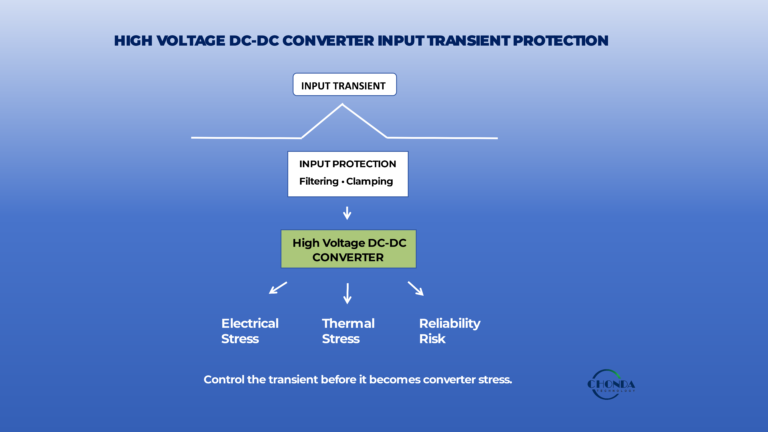
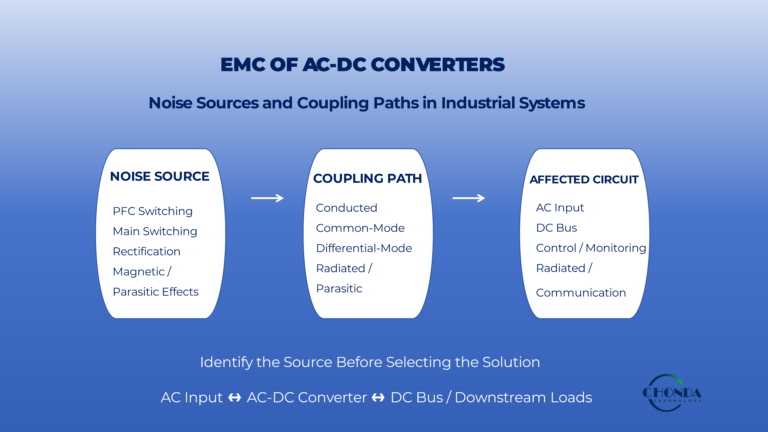
Battery energy storage systems also contain numerous switching devices, including battery converters, PCS (Power Conversion Systems), and high-current switching circuits. These components generate electrical noise and electromagnetic interference (EMI) that can disturb communication networks and reduce measurement accuracy if the power supply is not properly designed.
Because monitoring equipment is directly connected to high-energy battery systems, electrical isolation is another essential requirement. Galvanic isolation protects low-voltage control circuits from high-voltage battery faults while improving overall system safety.
Finally, BESS installations are designed to operate for many years with minimal maintenance. This places high demands on the long-term reliability of every auxiliary power supply. Stable operation under continuous service conditions is critical for maintaining accurate monitoring, reducing downtime, and ensuring safe battery management.
4. Key Requirements for BESS Power Supplies
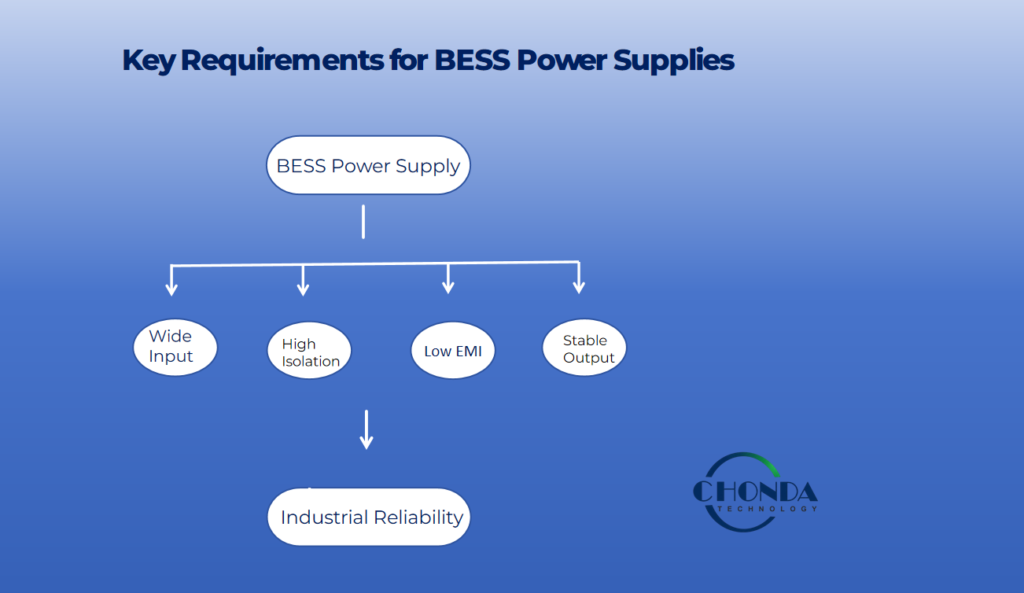
Selecting the right DC-DC converter for a Battery Energy Storage System (BESS) is essential for maintaining reliable monitoring, communication, and long-term system stability. A high-quality auxiliary power supply should not only provide stable voltage but also withstand the demanding electrical environment inside modern energy storage systems.
The following characteristics are particularly important.
Wide Input Voltage Range
Battery voltage changes continuously during charging, discharging, and balancing. A DC-DC converter should support a wide input range to ensure uninterrupted operation under all battery conditions without affecting monitoring equipment.
High Electrical Isolation
Monitoring devices such as BMS controllers, PLCs, sensors, and SCADA interfaces operate at low voltage, while the battery system itself may exceed several hundred volts DC. High isolation protects personnel and electronic equipment while reducing the risk of high-voltage faults propagating into control circuits.
Low EMI and Low Ripple
Power conversion equipment inside BESS installations generates switching noise that can interfere with communication networks. A low-EMI, low-ripple DC-DC converter helps improve signal integrity for RS485, CAN Bus, Ethernet, and other industrial communication protocols.
Stable Output Under Continuous Operation
Monitoring systems operate 24 hours a day throughout the entire life of the battery installation. A stable 24VDC output ensures reliable operation of controllers, communication devices, and sensors even during load variations.
Industrial-Grade Reliability
Energy storage projects are expected to operate for many years with minimal maintenance. Choosing industrial-grade DC-DC converters with high reliability reduces maintenance costs, minimizes downtime, and improves the overall availability of the monitoring system.
5. Choosing the Right DC-DC Converter for BESS Monitoring
Battery Energy Storage Systems (BESS) require DC-DC power supplies that can operate reliably under high-voltage battery conditions while providing stable isolated power for monitoring equipment.
When selecting a DC-DC converter for BESS monitoring applications, engineers should consider several critical specifications:
- Wide input voltage range for different battery voltages
- High isolation to protect communication equipment
- Low EMI and low ripple output
- Stable 24VDC output for PLC, BMS, sensors, and SCADA devices
- Industrial-grade reliability for continuous operation
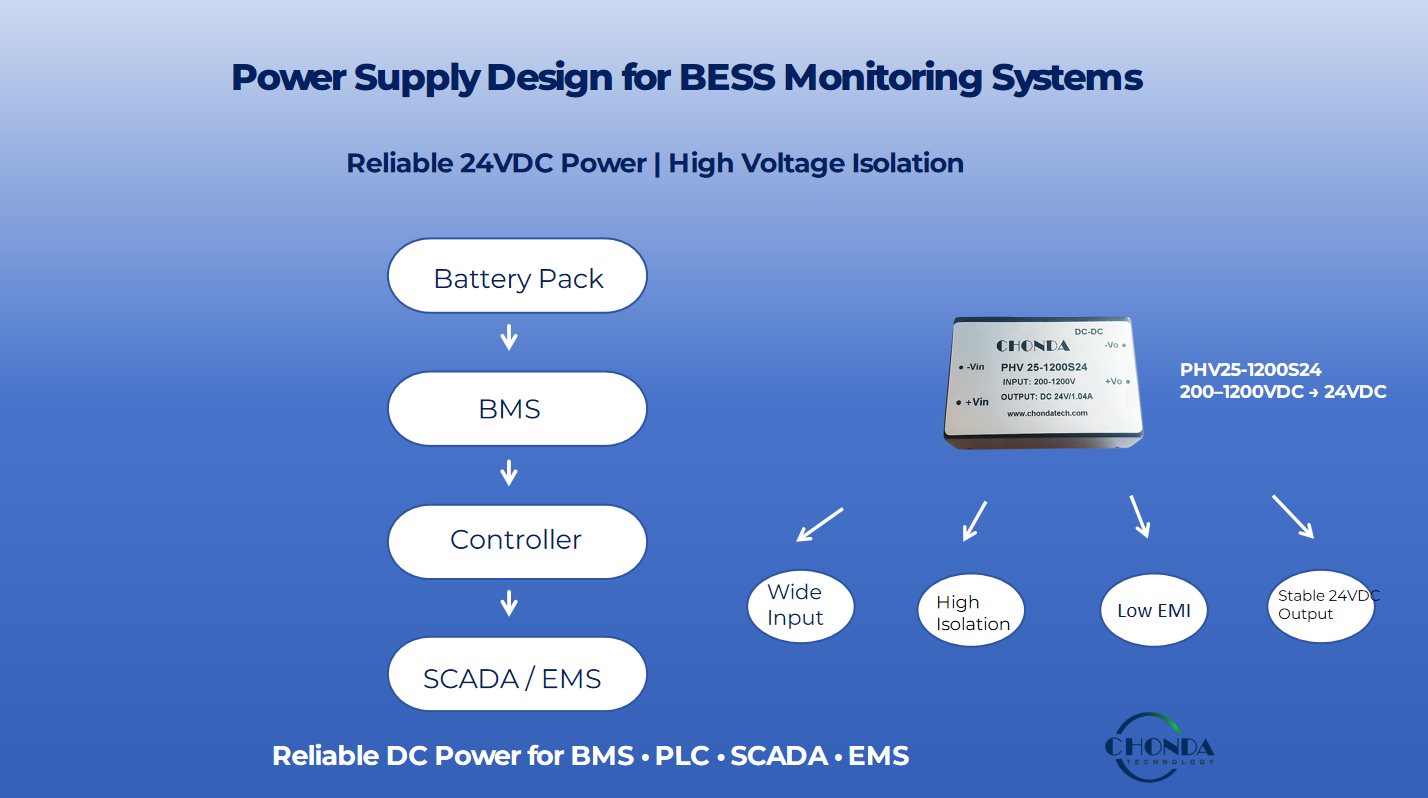
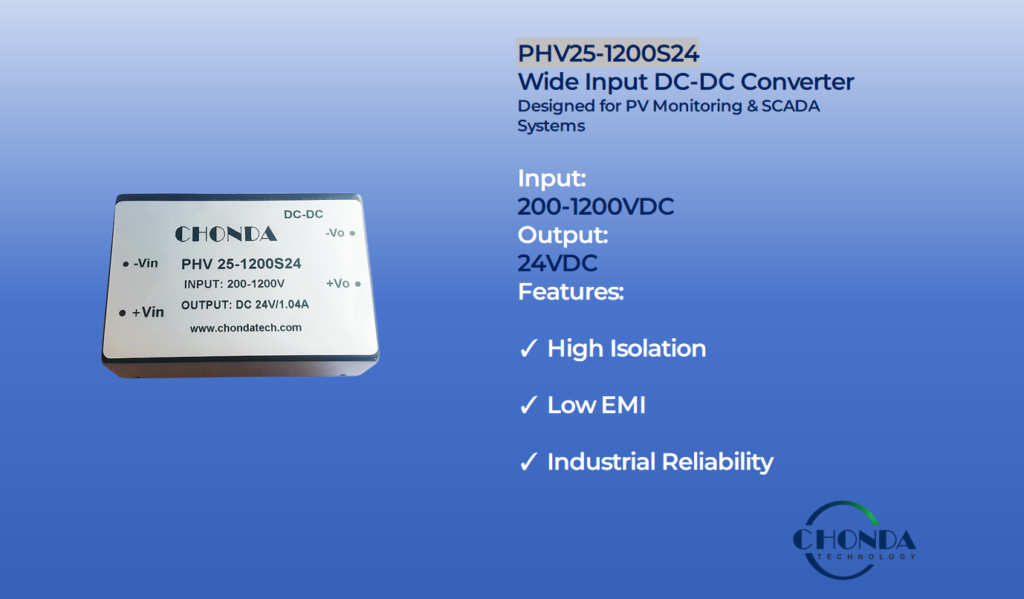
The CHONDA PHV25-1200S24 is designed specifically for these demanding industrial environments.
Typical specifications include:
- Input Voltage: 200–1200VDC
- Output Voltage: 24VDC
- Reinforced Isolation
- Low EMI
- Industrial Reliability
It provides stable isolated power for battery monitoring systems, helping improve communication reliability and long-term system stability.
6. Conclusion
Battery Energy Storage Systems (BESS) rely on continuous monitoring to ensure operational safety, battery health, and long-term system performance. Since BMS, PLCs, sensors, and SCADA controllers all require stable DC power, selecting the right isolated DC-DC converter becomes a critical part of overall system reliability.
A properly designed power supply should provide:
- Wide input voltage compatibility
- High isolation between battery packs and monitoring electronics
- Low EMI and low ripple output
- Stable 24VDC power for continuous communication
- Long-term industrial reliability
The CHONDA PHV25-1200S24 High Voltage DC-DC Converter is specifically designed for these applications, converting 200–1200VDC directly into isolated 24VDC power for BESS monitoring systems, helping engineers improve system stability while reducing maintenance costs.
🔵 Related Technical Articles
To help you understand PV monitoring systems in more detail, you may explore the following technical articles:
How to Integrate PLC with PV Monitoring Power Supplies
SCADA Power Supply Design for PV Monitoring Systems
High Voltage DC-DC Converter for PV Monitoring
How to Reduce EMI in Industrial DC-DC Power Supplies