We help the world since 2012

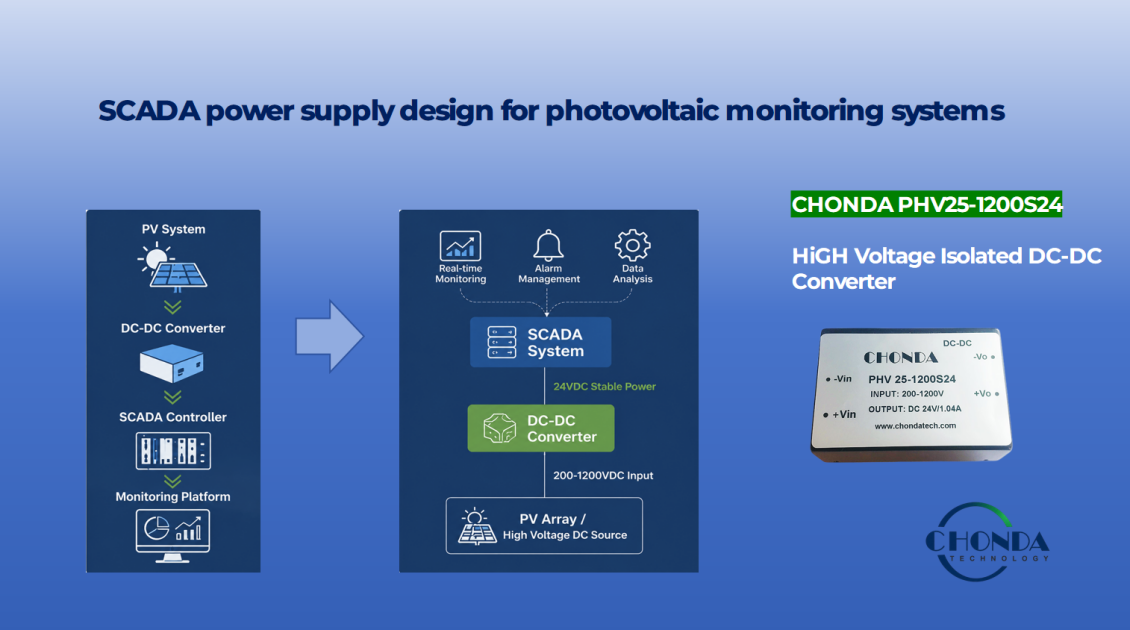
SCADA Power Supply Design for PV Monitoring Systems
SCADA systems play an essential role in photovoltaic monitoring applications by collecting, processing, and analyzing operational data from PV plants. However, reliable SCADA operation depends not only on communication networks and monitoring devices, but also on a stable and properly designed power supply system.
In high-voltage photovoltaic environments, power supply design must consider electrical isolation, voltage fluctuations, electromagnetic interference (EMI), and long-term system reliability.
1. What Is a SCADA System in PV Monitoring?
A SCADA (Supervisory Control and Data Acquisition) system is an industrial monitoring and control platform used to collect, process, and analyze operational data from photovoltaic (PV) systems.
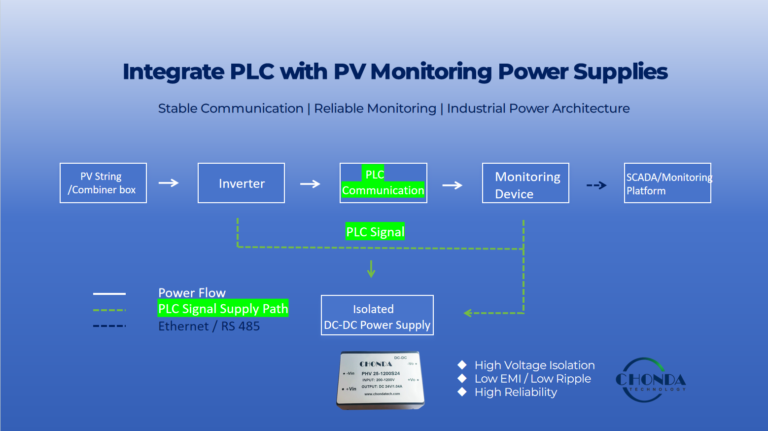
In PV monitoring applications, SCADA systems receive information from field devices such as inverters, sensors, PLC controllers, and data acquisition units. This collected data allows operators to monitor power generation, equipment status, alarms, and system performance in real time.
A typical PV SCADA architecture includes multiple layers, including field-level devices, communication networks, control units, and a central monitoring platform. These components work together to ensure efficient operation and reliable management of photovoltaic installations.
Since SCADA systems often operate in high-voltage and electrically noisy environments, each control and communication component requires a stable and reliable power supply to maintain continuous monitoring performance.
2. Why SCADA Power Supply Design Is Critical
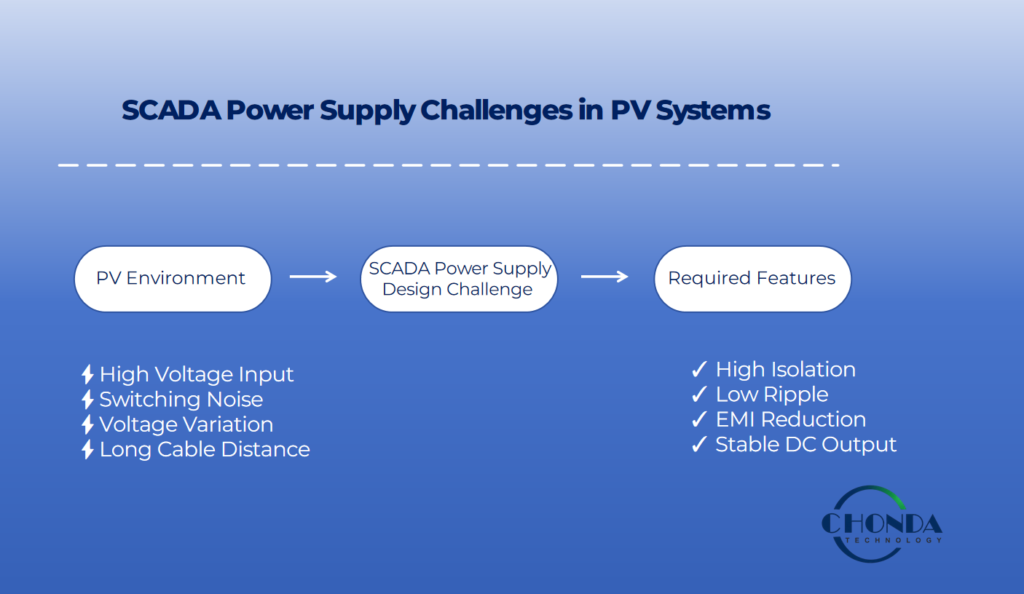
In photovoltaic monitoring systems, SCADA equipment is required to operate continuously under demanding electrical and environmental conditions. Unlike ordinary electronic applications, PV systems involve high-voltage DC sources, power conversion equipment, switching operations, and long-distance wiring. These factors can introduce voltage fluctuations, electrical noise, and electromagnetic interference (EMI), which may affect the stability of monitoring devices.
A properly designed SCADA power supply helps maintain stable operation by providing reliable voltage conversion, electrical isolation, and improved noise immunity. Without a suitable power supply architecture, communication interruptions, inaccurate measurements, or unexpected system downtime may occur.
Therefore, SCADA power supplies must be designed to meet industrial requirements, including wide input voltage capability, low ripple performance, high isolation voltage, and long-term reliability.
3. Key Requirements for SCADA Power Supplies
SCADA power supplies used in photovoltaic monitoring systems must meet strict electrical performance requirements to ensure stable operation of control and communication equipment.
Since PV installations typically involve high-voltage DC sources and complex electrical environments, the power supply must provide reliable conversion, protection, and isolation between the power input and sensitive monitoring circuits.
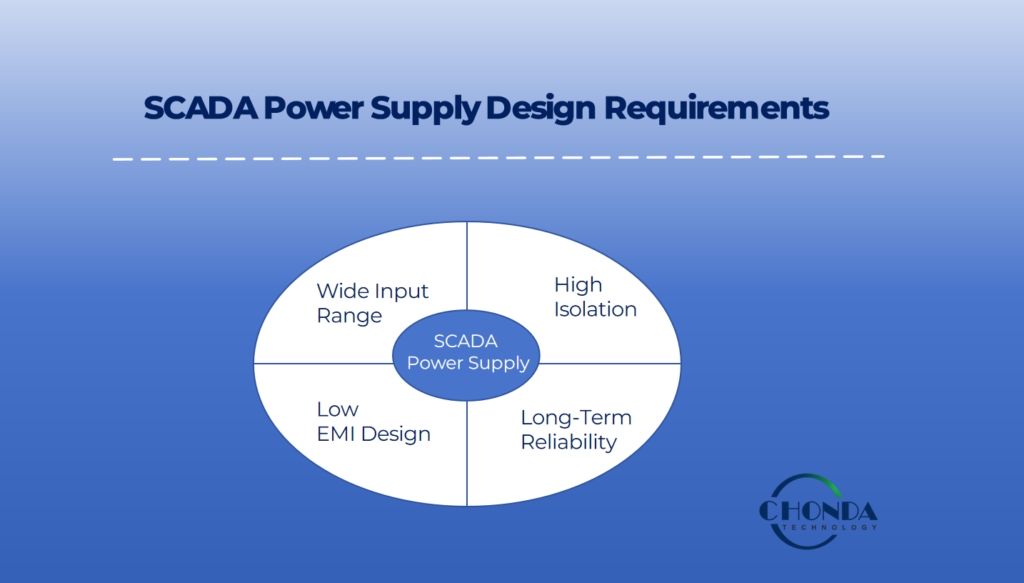
The key requirements for SCADA power supplies include:
Wide Input Voltage Range
PV systems often operate with variable DC voltage levels depending on system configuration, environmental conditions, and power generation status. A wide input voltage range allows SCADA power supplies to operate reliably under changing photovoltaic conditions without requiring additional voltage regulation equipment.
High Electrical Isolation
Electrical isolation is essential in PV monitoring applications because it helps protect communication devices, sensors, and control systems from high-voltage transients and potential ground-related issues.
High isolation voltage improves system safety and reduces the risk of interference between the power stage and communication circuits.
Low EMI and Low Ripple Performance
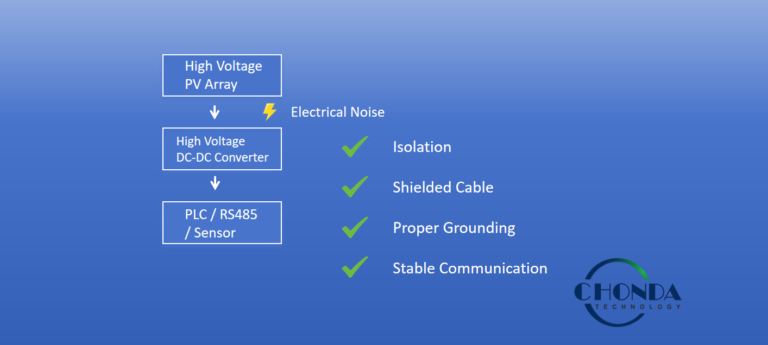
SCADA communication networks require clean and stable power to maintain accurate data transmission. Excessive electrical noise or output ripple from the power supply may affect sensitive communication interfaces such as PLC, RS485, and industrial sensors.
Therefore, low EMI design and low ripple output are important factors for maintaining reliable monitoring performance.
Long-Term Reliability
PV monitoring systems are usually installed in industrial environments where continuous operation is required for many years. A reliable SCADA power supply should provide stable thermal performance, strong protection features, and long service life to minimize maintenance requirements and system downtime.
By meeting these requirements, SCADA power supplies can provide a stable power foundation for photovoltaic monitoring systems and support reliable data acquisition, communication, and system control.
4. Choosing the Right DC-DC Converter for SCADA Applications
Selecting the right DC-DC converter is an important part of designing a reliable SCADA power supply system for photovoltaic applications.
Since SCADA devices are often connected to high-voltage PV systems, the DC-DC converter must provide stable voltage conversion while maintaining electrical isolation between the power source and sensitive monitoring circuits.
For high-voltage photovoltaic monitoring applications, isolated DC-DC converters with wide input ranges, low EMI performance, and robust protection features are preferred to ensure long-term system reliability.
High Voltage Input Capability
PV monitoring systems may be connected to high-voltage DC sources from solar arrays, combiner boxes, or energy management systems. A DC-DC converter with a wide input voltage range can simplify system design and improve compatibility with different photovoltaic architectures.
Electrical Isolation for SCADA Protection
Electrical isolation helps separate the high-voltage input side from low-voltage SCADA control circuits. This isolation improves system safety, reduces noise coupling, and helps protect communication interfaces such as PLC, RS485, and industrial sensors.
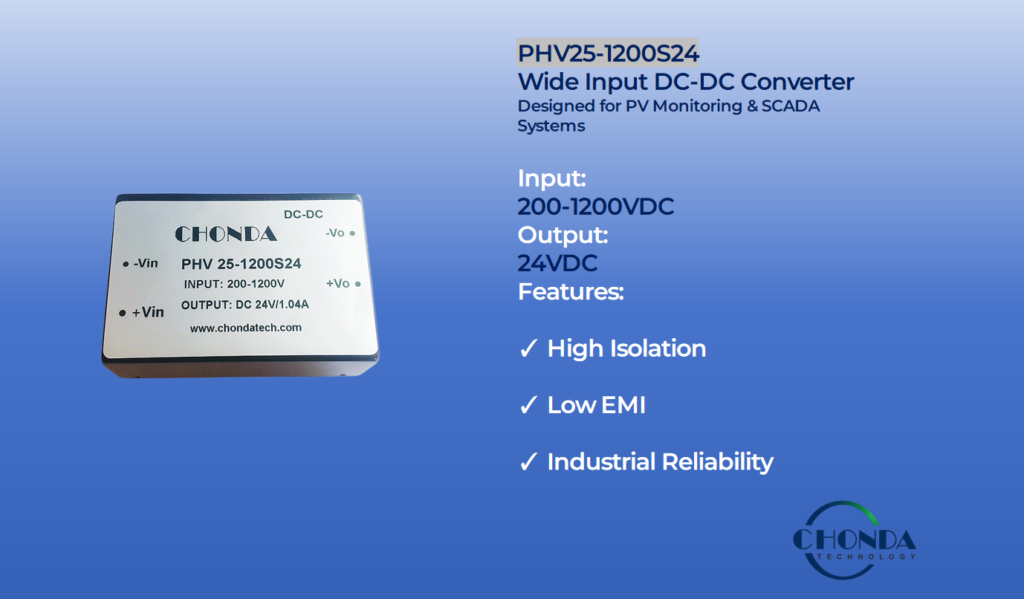
Recommended Solution: PHV25-1200S24 High Voltage Isolated DC-DC Converter
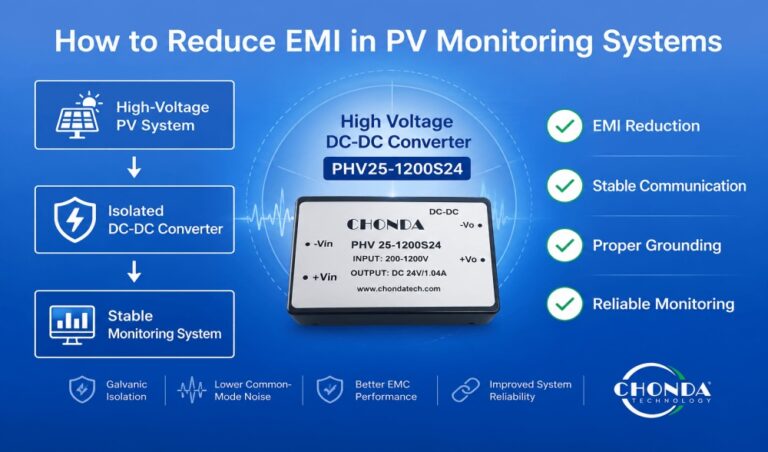
For photovoltaic SCADA applications requiring reliable auxiliary power, the PHV25-1200S24 high voltage isolated DC-DC converter provides a practical solution. Designed for high-voltage DC environments, this module supports a wide input voltage range from 200VDC to 1200VDC and provides a stable 24V output for industrial monitoring equipment.
With high electrical isolation, low EMI characteristics, and reliable operation under demanding conditions, the PHV25-1200S24 is suitable for applications including PV monitoring systems, SCADA controllers, PLC communication nodes, and industrial solar power systems.
5. Conclusion: Reliable Power Supply Design for PV SCADA Systems
A reliable power supply is a critical foundation for stable SCADA operation in photovoltaic monitoring systems. Due to the high-voltage environment, switching noise, and long-term operating requirements of PV installations, SCADA power supplies must provide stable voltage conversion, electrical isolation, low EMI performance, and long-term reliability. Isolated DC-DC converters with wide input voltage capability provide an effective solution for powering SCADA controllers, PLC communication devices, and industrial monitoring equipment.
By selecting a properly designed DC-DC converter, PV system designers can improve monitoring reliability, reduce communication issues, and ensure continuous data acquisition in demanding solar power applications.
Related Articles
PLC in PV Monitoring: EMI Reduction and Communication Stability Guide
Grounding Design for PV Monitoring Systems | EMC & Noise Reduction Guide
High Voltage DC-DC Converter for Solar and Industrial Applications