We help the world since 2012

PV String Monitoring Power Supply for 24VDC System Design
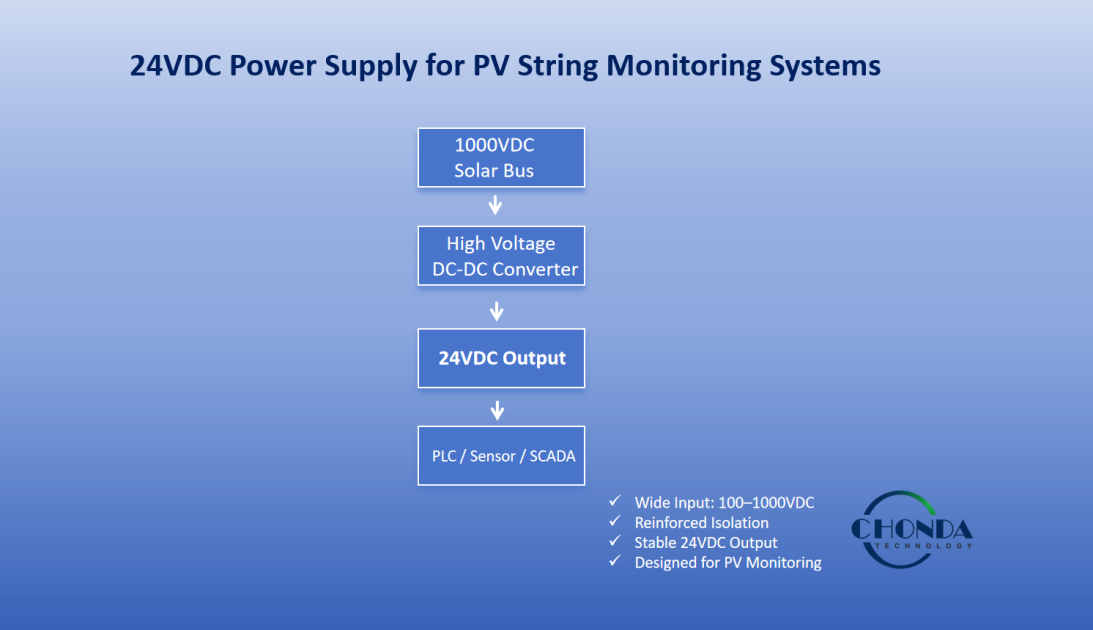
In PV string monitoring systems, a 24VDC power supply serves as the key interface between high-voltage DC buses (up to 1000VDC) and low-voltage communication and control electronics, ensuring stable and reliable operation in photovoltaic environments.
1. Why 24VDC is Common in PV Monitoring Systems
24VDC is widely used in PV string monitoring systems as the standard auxiliary power level for low-voltage control and communication circuits. It provides a stable and efficient supply for a wide range of monitoring and automation components used in photovoltaic power plants.
In most PV monitoring architectures, 24VDC is commonly adopted to power:
- PLC (Programmable Logic Controller) for system logic control and data processing
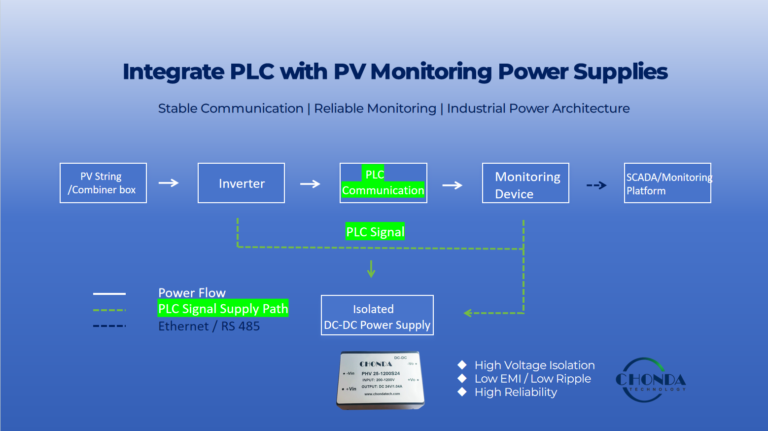
- Communication modules such as RS485, Ethernet, or wireless gateways for data transmission
- Sensor systems used for current, voltage, temperature, and environmental monitoring
- SCADA interfaces that enable remote monitoring and centralized control of PV installations
Compared with other voltage levels, 24VDC offers a good balance between safety, compatibility, and efficiency, making it the preferred standard in industrial control and photovoltaic monitoring applications.
2. Challenges of Powering 24V from High Voltage DC Bus
In PV string monitoring systems, generating a stable 24VDC supply directly from a high-voltage DC bus (typically up to 1000VDC) presents several technical and safety challenges. These challenges must be properly addressed to ensure reliable system operation and long-term stability.
High-Voltage DC Environment (Up to 1000VDC)
PV string systems operate at extremely high DC voltage levels, often reaching 600VDC to 1000VDC or even higher in modern photovoltaic plants. Direct power conversion in such environments requires power components that can withstand continuous high-voltage stress.
Isolation Requirements
Electrical isolation is essential to separate high-voltage PV strings from low-voltage control electronics. Without proper isolation, sensitive devices such as PLCs, sensors, and communication modules may be exposed to dangerous voltage spikes or ground potential differences.
Voltage Fluctuation
Solar power systems are highly dynamic due to changing irradiance and load conditions. As a result, the DC bus voltage can fluctuate significantly, requiring the DC-DC converter to maintain stable output under wide input voltage variations.
Safety Issues
Safety is a critical concern in high-voltage photovoltaic systems. Proper isolation and protection design are necessary to prevent electrical hazards, equipment damage, and system failures, especially in outdoor or industrial environments.
3. Typical Power Architecture
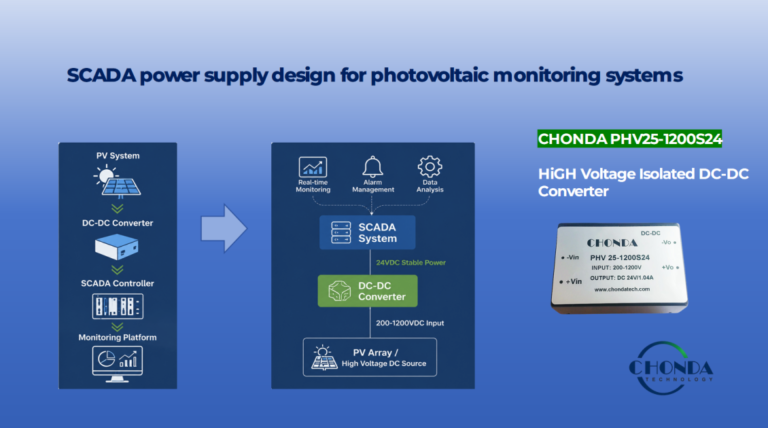
In PV string monitoring systems, the power architecture is typically designed to convert high-voltage DC bus power into a stable low-voltage supply for control and communication electronics.
The system generally follows a standard power conversion chain:
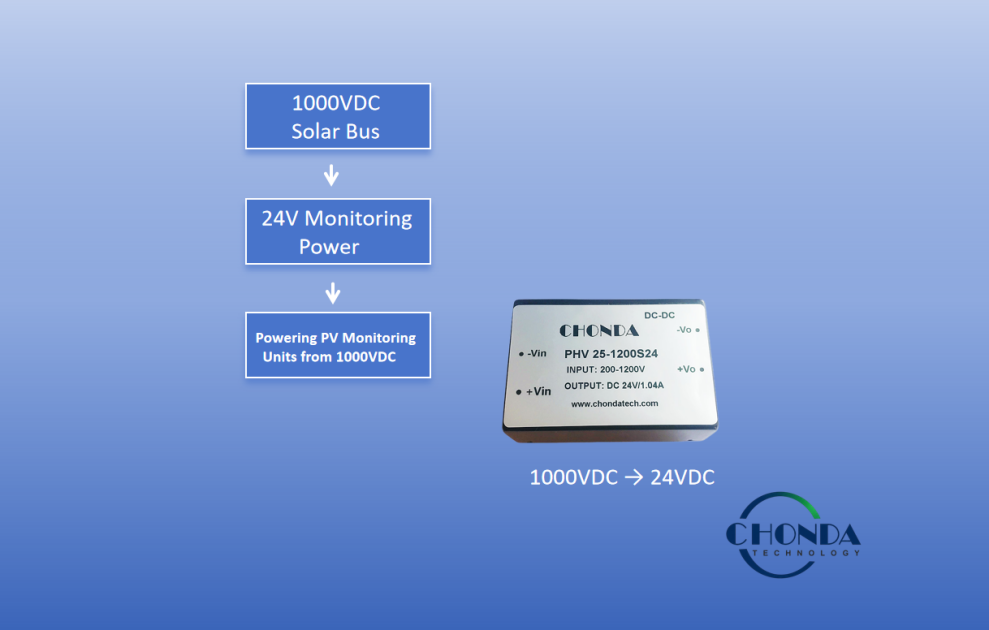
In this architecture, the high-voltage DC bus (up to 1000VDC) provides the primary energy source, while the DC-DC converter acts as the key interface that steps down and isolates the voltage to a safe 24VDC level.
This 24VDC output is then distributed to essential system components such as PLC controllers, communication gateways, and monitoring sensors, ensuring stable and reliable operation across the entire PV monitoring system.
By isolating the high-voltage input from low-voltage electronics, the DC-DC converter plays a critical role in system safety, stability, and long-term reliability. To better understand how 24VDC power is generated from a 1000VDC solar bus, please refer to our detailed guide: “How to Power a PV String Monitoring Unit from a 1000VDC Solar Bus“
4. Why Isolated DC-DC Converter is Required
In PV string monitoring systems, isolation is a fundamental requirement when converting power from a high-voltage DC bus (up to 1000VDC) to low-voltage electronics such as 24VDC control and communication circuits.
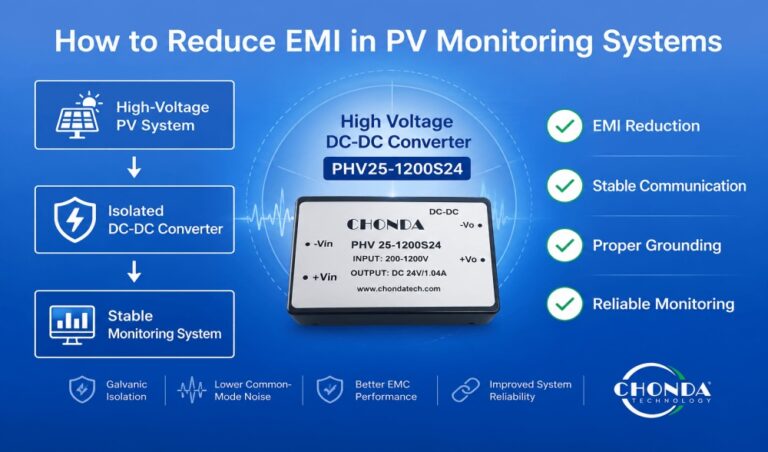
Isolation is required to ensure a safe separation between the high-voltage solar input and sensitive monitoring equipment. Without proper isolation, voltage spikes, ground potential differences, or transient surges from the PV string can directly damage PLCs, sensors, and communication modules.
In addition, isolated DC-DC converters significantly improve system reliability. They reduce electrical noise interference and help maintain stable operation in harsh outdoor photovoltaic environments where voltage fluctuations and surges are common.
For more detailed discussions on the importance of isolation in PV power systems, please refer to:
- https://chondatechnology.com/how-isolated-dc-dc-converters-improve-pv-monitoring-reliability/
- https://chondatechnology.com/pv-monitoring-isolated-power-supply/
5. Recommended DC-DC Converter Solution
To reliably generate a stable 24VDC supply from high-voltage PV string systems, an isolated high-voltage DC-DC converter is required. The PHV series is specifically designed for this type of photovoltaic monitoring application, offering stable performance under wide input voltage conditions.
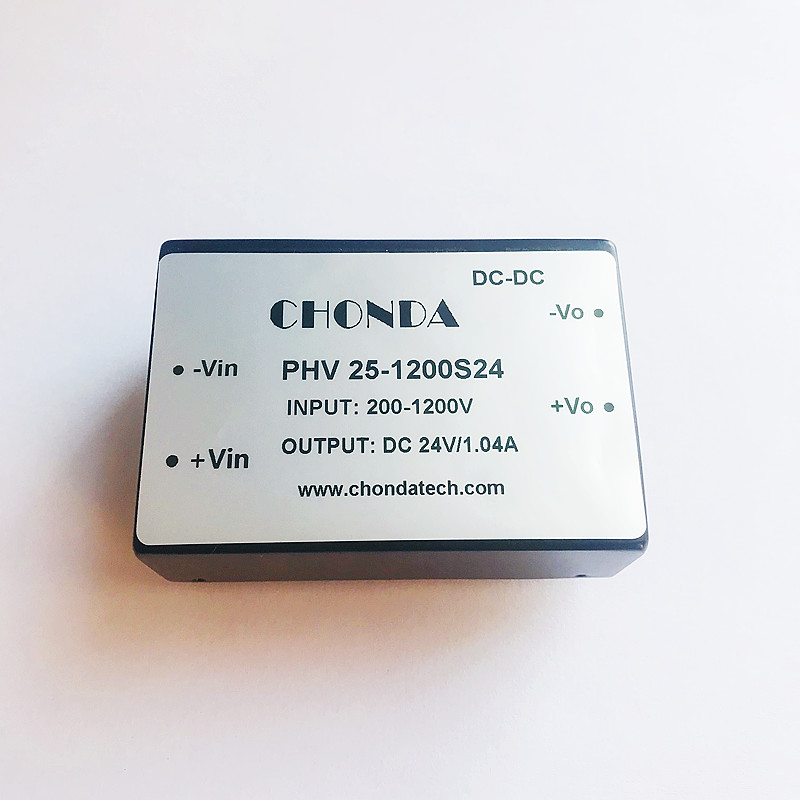
Key specifications include:
- Wide input range: 100–1000VDC suitable for PV string monitoring systems
- Stable 24VDC output for PLCs, sensors, and communication modules
- Power range from 5W to 50W supporting different monitoring system loads
- Fully isolated design ensuring safety, reliability, and noise immunity in high-voltage environments
The PHV series is widely used in PV combiner box monitoring systems and photovoltaic string monitoring units, where stable auxiliary power and electrical isolation are critical for long-term system reliability.
6. Applications
A reliable 24VDC power supply is essential for a wide range of photovoltaic monitoring and industrial control applications. High-voltage isolated DC-DC converters are commonly used to provide stable auxiliary power for the following systems:
- PV String Monitoring – Supplying power to monitoring units that measure string voltage, current, and operating status in large-scale solar installations.
- PV Combiner Box Monitoring – Powering communication modules, controllers, and protection circuits installed inside photovoltaic combiner boxes.
- SCADA Systems – Providing stable 24VDC power for remote monitoring, data communication, and centralized supervision of photovoltaic power plants.
- Data Acquisition Systems – Supporting sensors, data loggers, and monitoring equipment that continuously collect and transmit operational data for system analysis and maintenance.
7. Conclusion
A stable and isolated 24VDC power supply is a fundamental requirement for reliable PV string monitoring systems. By converting high-voltage DC bus power into a safe and dependable low-voltage output, isolated DC-DC converters help ensure continuous operation of PLCs, communication modules, sensors, and SCADA equipment. Selecting the right high-voltage DC-DC converter not only improves system safety and reliability but also supports the long-term performance of modern photovoltaic monitoring applications.
🔵 Related Technical Articles
How Isolated DC-DC Converters Improve PV Monitoring Reliability
Why PV Monitoring Systems Need Isolated Power Supplies
How to Select a DC-DC Converter for PV Monitoring Applications
Why High Voltage DC-DC Converters Are Essential for PV Monitoring Systems