We help the world since 2012

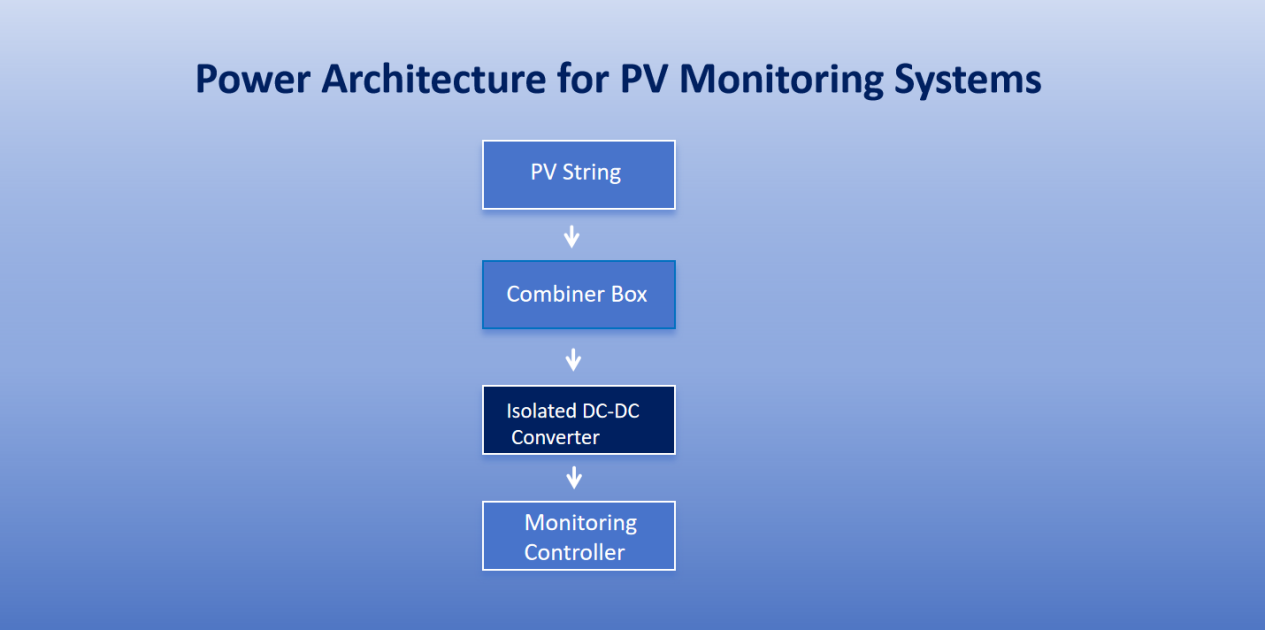
Why PV Monitoring Systems Need Isolated Power Supplies
PV monitoring systems are widely used in utility-scale solar plants, commercial PV installations, and smart combiner box applications.
While engineers often focus on sensors, communication protocols, and monitoring software, the power supply architecture behind the monitoring equipment is equally important.
In many solar installations, monitoring devices operate in harsh electrical environments with high DC voltages, lightning exposure, ground potential differences, and electromagnetic interference.
For this reason, isolated DC-DC converters have become a standard solution for powering PV monitoring equipment reliably and safely.
This article explains why isolation is critical in PV monitoring systems and how it improves long-term operational reliability.
1. Common Power Challenges in PV Monitoring Systems
PV monitoring devices are often installed in electrically demanding environments. Unlike office electronics, monitoring equipment in solar power plants must operate continuously under high voltage, outdoor exposure, and varying environmental conditions.
Several power-related challenges can affect the reliability of monitoring systems.
High Voltage Environment
Modern solar installations commonly operate at 600VDC, 1000VDC, or even 1500VDC string voltages. Monitoring devices connected to these systems must safely handle high-voltage environments while protecting low-voltage electronics from potential faults.
Ground Potential Differences
Monitoring equipment may be distributed across large solar fields. Different installation points can experience varying ground potentials, which may create unwanted currents, measurement errors, or communication issues between devices.
Electrical Noise and Transients
Lightning strikes, inverter switching operations, and long cable runs can introduce electrical noise and transient voltages into monitoring circuits. Without proper isolation, these disturbances may affect system performance or even damage sensitive electronics.
2. What Is an Isolated Power Supply?
An isolated power supply transfers energy through a transformer while maintaining electrical separation between the input and output circuits.
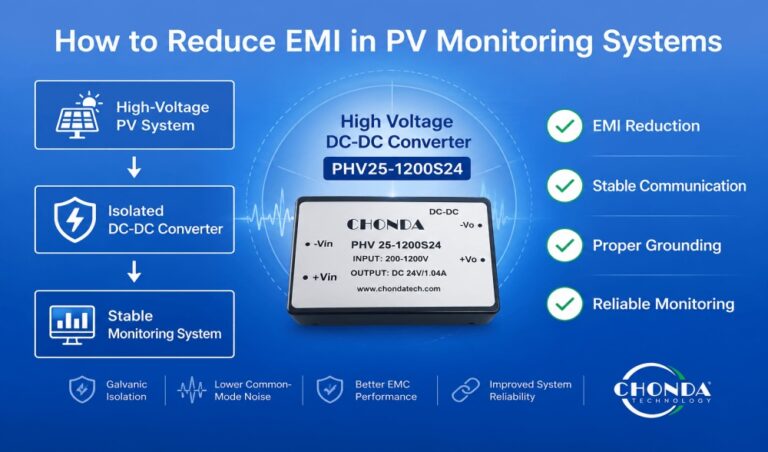
Unlike non-isolated converters, isolated DC-DC converters provide galvanic isolation, helping protect monitoring electronics from high-voltage faults and electrical noise.
3. Why Isolation Improves PV Monitoring Reliability
Electrical isolation is one of the most effective methods for improving the long-term reliability of PV monitoring systems.
Protects Monitoring Electronics
Isolated DC-DC converters create a galvanic barrier between the high-voltage PV side and the low-voltage monitoring circuitry. This separation helps prevent damage caused by voltage spikes, insulation failures, or accidental faults within the system.
Improves Measurement Accuracy
Accurate current and voltage measurement is essential for detecting underperforming strings and identifying maintenance issues. Isolation helps reduce common-mode interference and ground loop effects, resulting in more stable measurement signals.
Reduces Communication Failures
Most monitoring controllers communicate through industrial protocols such as RS485 and Modbus. Ground potential differences and electrical noise can interfere with these communication networks.
By using isolated power supplies, engineers can improve communication stability and reduce unexpected data transmission errors.
Enhances System Safety
Electrical isolation increases overall system safety by limiting fault propagation between different sections of the monitoring network. This additional protection is particularly important in utility-scale solar plants operating at high DC voltages.
4. Typical Application Example
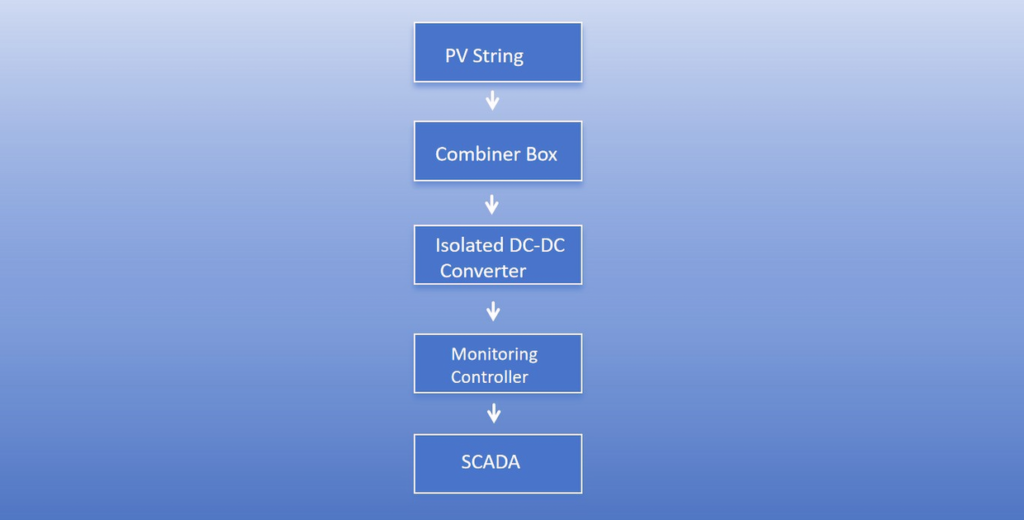
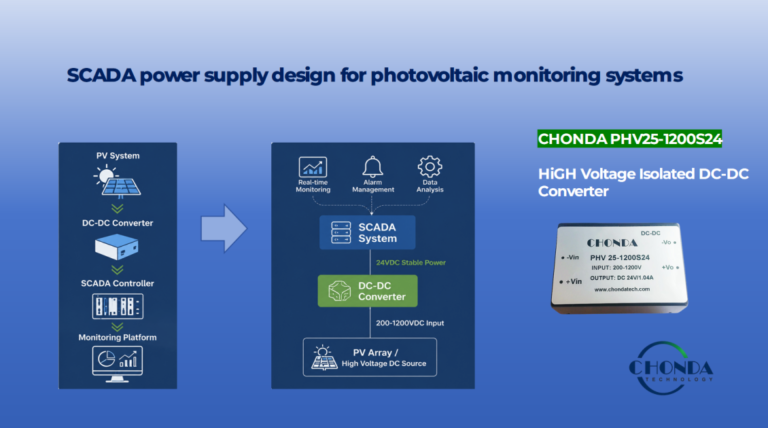
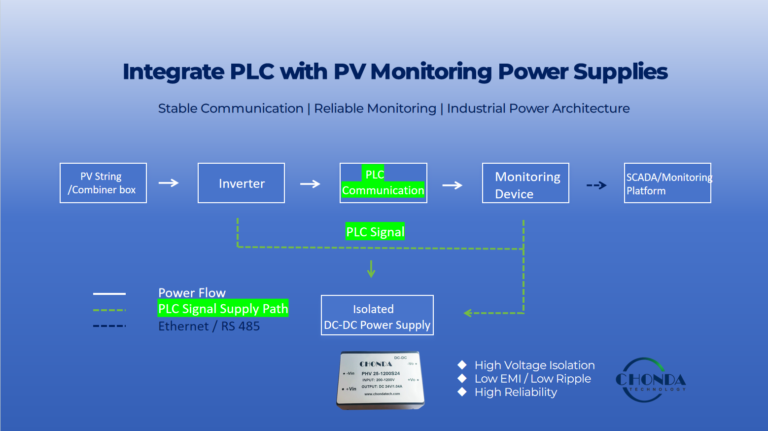
Figure 1. Typical Power Architecture for PV Monitoring Systems
In a typical PV monitoring architecture, field data from individual PV strings is collected within the combiner box and transmitted to monitoring controllers.
The isolated DC-DC converter serves as the power interface between the high-voltage PV environment and the low-voltage monitoring electronics. By providing stable and isolated power, the converter helps ensure reliable operation of sensors, communication modules, and data acquisition systems.
For utility-scale solar projects, isolated DC-DC converters with wide input voltage ranges and high isolation ratings are commonly used to support long-term system reliability.
Example Solution for PV Monitoring Applications
CHONDA’s isolated high-voltage DC-DC converters support input voltages up to 1000VDC and are designed for solar monitoring, combiner box monitoring, and industrial communication systems. Their compact design, high isolation capability, and reliable performance make them suitable for demanding PV monitoring environments.
5. Selecting an Isolated DC-DC Converter for PV Monitoring
When selecting a DC-DC converter for PV monitoring applications, engineers should evaluate several key parameters.
Input Voltage Range
The converter should support the operating voltage of the solar installation. Common options include 600VDC, 1000VDC, and 1500VDC systems.
Isolation Voltage
Isolation rating is one of the most important specifications. Higher isolation voltage provides better protection against electrical faults and transient events.
Operating Temperature
Outdoor monitoring equipment may experience extreme environmental conditions. The converter should maintain reliable performance across a wide temperature range.
Efficiency
Higher efficiency reduces power loss and heat generation, improving overall system performance and reliability.
EMC Performance
Good electromagnetic compatibility (EMC) helps minimize interference with monitoring electronics and communication networks, particularly in large-scale solar installations.
6. Conclusion
As solar monitoring systems become more intelligent and distributed, power supply design plays a critical role in system reliability.
Isolated DC-DC converters help protect monitoring equipment, improve communication stability, reduce maintenance costs, and enhance overall system safety.
For PV monitoring applications operating in high-voltage environments, isolated power supplies are often a necessary part of a reliable monitoring architecture.
🔵 Continue Exploring PV Monitoring Systems
👉 What Is PV String Monitoring?
Start with the fundamentals of string-level monitoring.
👉 How PV String Monitoring Works in Solar Power Systems
Learn how monitoring data is collected and processed.
👉 PV String Monitoring System Architecture Explained
Understand the complete monitoring architecture.
👉 How Isolated DC-DC Converters Improve PV Monitoring Reliability
Discover how isolation improves system stability, measurement accuracy, and long-term monitoring reliability.
👉 Power Supply Design for PV Combiner Box Monitoring Systems
Explore power design considerations inside combiner boxes.
👉 Explore PV Monitoring Power Supply Solutions