We help the world since 2012

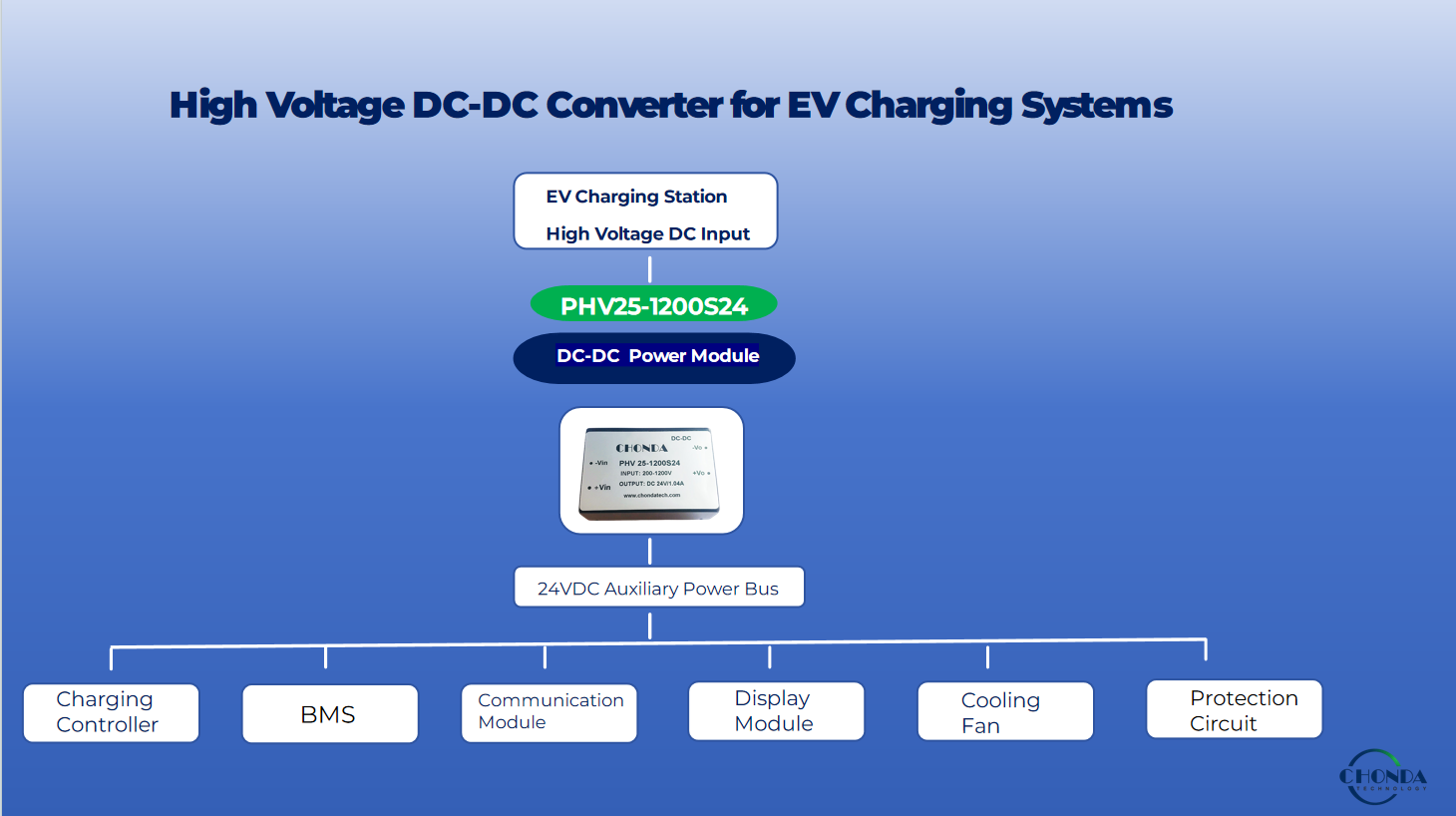
High Voltage DC-DC Converter for EV Charging Systems
As electric vehicles continue to expand worldwide, EV charging infrastructure has become a critical part of modern power systems. Fast chargers, DC charging stations, battery management systems, and charging controllers all require reliable auxiliary power to support monitoring, communication, protection, and system control.
A high voltage DC-DC converter provides isolated low-voltage power from the high-voltage DC bus inside EV charging equipment, ensuring stable operation of electronic subsystems while improving electrical safety and system reliability.
This article explains the role of high voltage DC-DC converters in EV charging systems, discusses key design requirements, and introduces CHONDA’s isolated DC-DC converter solutions for modern EV charging applications.
1. What Is an EV Charging System?
An EV charging system is an electrical infrastructure that delivers power from the utility grid or an energy storage system to recharge electric vehicle batteries. Modern charging systems contain both high-voltage power conversion stages and low-voltage electronic control circuits that work together to ensure safe, efficient, and reliable charging.
Inside a typical DC fast charging station, high-voltage DC power is distributed to multiple subsystems, including charging controllers, battery management interfaces (BMS), communication modules, display units, cooling systems, and protection circuits. These electronic subsystems require stable isolated low-voltage auxiliary power to operate correctly.
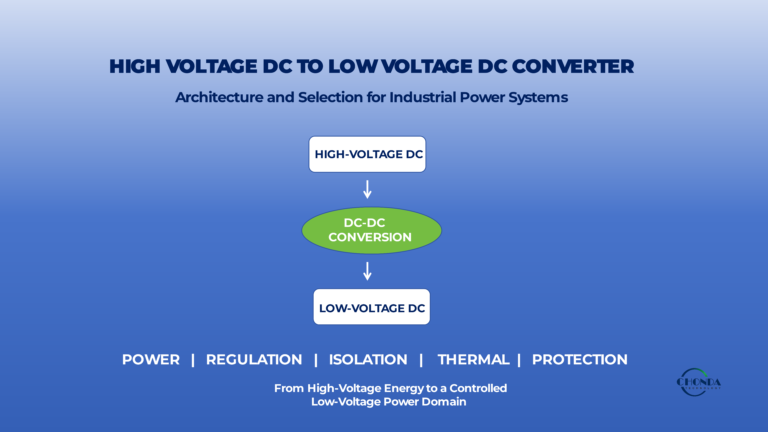
High voltage DC-DC converters play a critical role by converting the high-voltage DC bus into isolated auxiliary power, allowing the charging station to maintain reliable system control, communication, monitoring, and protection while electrically separating sensitive electronics from the primary power source.
2. Why High Voltage DC-DC Converters Are Required in EV Charging Systems
An EV charging system contains both high-power energy conversion circuits and low-voltage electronic control systems. While the main charging circuit transfers energy to the vehicle battery, numerous electronic subsystems require stable isolated auxiliary power to ensure safe and reliable operation.
A high voltage DC-DC converter converts the high-voltage DC bus into isolated low-voltage DC power, allowing critical electronic modules to operate independently from the primary power stage. This isolation improves electrical safety, reduces electromagnetic interference, and helps protect sensitive control circuits from voltage fluctuations on the main DC bus.
The diagram below illustrates how a high voltage DC-DC converter supplies isolated auxiliary power to the electronic control systems inside a typical EV charging station.
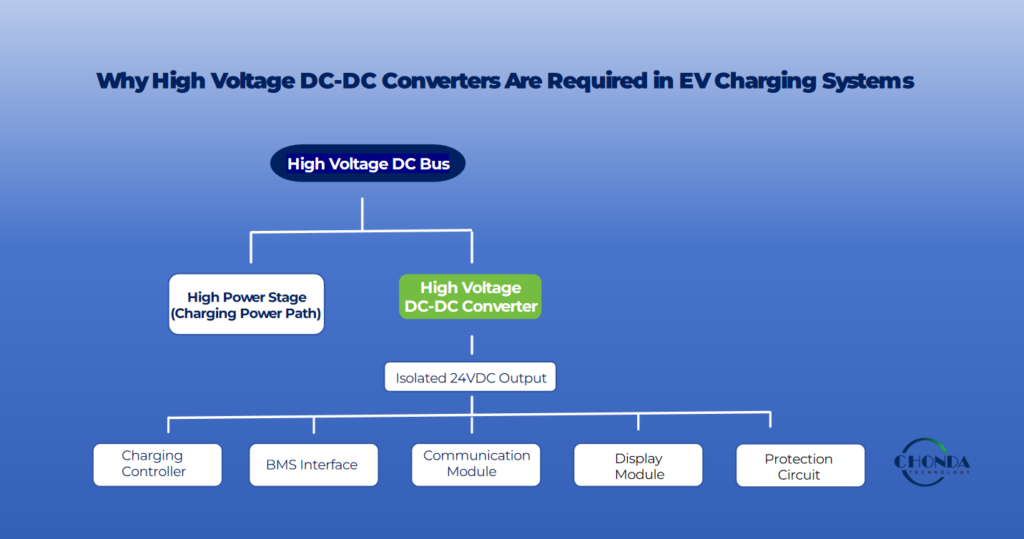
High voltage DC-DC converter supplying isolated auxiliary power in EV charging systems
As shown above, the DC-DC converter provides stable isolated 24VDC auxiliary power for charging controllers, battery management interfaces (BMS), communication modules, display systems, and protection circuits. By separating low-voltage electronics from the high-voltage power bus, the converter improves overall system reliability, operational safety, and long-term charging performance.
3. Key Requirements for High Voltage DC-DC Converters in EV Charging Systems
EV charging systems operate under demanding electrical conditions where high voltage, continuous operation, and outdoor installation require power converters to deliver stable and reliable auxiliary power. In addition to supplying low-voltage electronics, the DC-DC converter must support safe system operation throughout the entire charging process.
A high voltage DC-DC converter designed for EV charging systems should satisfy the following key requirements.
3.1.Wide High-Voltage Input Range
The converter should support a wide DC input voltage range to accommodate different charging system architectures and battery voltage fluctuations. A wide input range also improves system compatibility and simplifies power supply design across multiple charger platforms.
3.2.Reinforced Electrical Isolation
Electrical isolation is essential for protecting low-voltage control electronics from the high-voltage charging bus. Reinforced isolation helps improve system safety, minimizes electrical interference, and supports reliable long-term operation in high-power charging environments.
3.3.High Reliability for Continuous Operation
Public charging stations are expected to operate continuously with minimal downtime. The auxiliary power supply should maintain stable output voltage under varying load conditions while delivering dependable long-term performance in demanding operating environments.
3.4.Low EMI Performance
Charging stations contain communication modules, digital controllers, and measurement circuits that are sensitive to electromagnetic interference. A low-EMI converter design helps reduce electrical noise, improving communication stability and overall charging system reliability.
3.5.Compact and High-Efficiency Design
Modern EV charging equipment requires compact auxiliary power solutions that maximize efficiency while minimizing heat generation. High conversion efficiency helps reduce thermal stress, improve system reliability, and simplify enclosure cooling requirements.
4. Key Design Challenges for Auxiliary Power in EV Charging Systems
Designing the auxiliary power architecture of an EV charging system involves more than simply selecting a DC-DC converter. Engineers must ensure that the control electronics remain stable while the charging station operates under widely changing electrical conditions.
The following design challenges are commonly encountered in modern EV charging equipment.
4.1.Maintaining Stable Control Power During Wide DC Bus Fluctuations
Unlike many industrial systems with relatively stable input voltages, EV charging stations may experience significant DC bus variations during startup, charging, standby, and fault conditions.
The auxiliary power supply must continue providing stable output despite these voltage changes to prevent controller resets, communication interruptions, or charging failures.
4.2.Powering Multiple Electronic Subsystems Simultaneously
A single auxiliary power supply often supports several electronic modules operating at the same time, including the charging controller, BMS interface, communication module, display, protection logic, and cooling system.
These devices have different operating characteristics, making stable power distribution essential for reliable charger performance.
4.3.educing Electrical Noise Around Sensitive Electronics
Fast switching inside high-power charging circuits can generate electromagnetic interference that affects communication and signal processing.
An isolated DC-DC converter with good EMI performance helps separate sensitive low-voltage electronics from the high-power charging stage, improving communication reliability and measurement accuracy.
4.4.Supporting Reliable Outdoor Operation
Many EV charging stations operate continuously in outdoor environments where temperature, humidity, dust, and vibration can affect electronic components.
A robust auxiliary power design helps ensure stable operation under these demanding conditions while reducing maintenance requirements throughout the equipment’s service life.
4.5.Simplifying Future Platform Expansion
Modern charging stations continue to integrate new communication protocols, smart energy management functions, remote diagnostics, and software updates.
A reliable isolated auxiliary power architecture provides a stable foundation that allows additional electronic functions to be incorporated without redesigning the entire power system.
5. CHONDA High Voltage DC-DC Converter Solution for EV Charging Systems
Modern EV charging stations contain two completely different power domains.
The primary charging stage transfers high-voltage energy to the electric vehicle battery, while the auxiliary power system supplies stable low-voltage power for monitoring, communication, protection, and system control.
These two power domains require complete electrical isolation to improve safety, reduce interference, and ensure reliable charger operation.
CHONDA’s high voltage DC-DC converter modules are specifically designed to provide isolated auxiliary power for these low-voltage electronic subsystems while operating directly from high-voltage DC sources.
5.1.Why PHV25-1200S24 Fits EV Charging Systems
The PHV25-1200S24 is designed for high-voltage auxiliary power applications where electrical isolation, long-term reliability, and stable low-voltage output are essential.
Its wide DC input range allows engineers to integrate the converter into various EV charging architectures without requiring additional front-end power stages. Reinforced isolation protects sensitive control electronics from disturbances on the high-voltage charging bus, while the regulated 24VDC output supplies reliable power for controllers, communication modules, displays, and protection circuits.
For charging equipment operating continuously in public or industrial environments, the converter also offers excellent long-term stability and industrial-grade reliability.
5.2.Typical EV Charging Applications
Within an EV charging station, isolated auxiliary power is required by multiple electronic subsystems. A high voltage DC-DC converter can be integrated into applications such as:
- DC fast charging stations
- Battery energy storage integrated chargers
- AC charging infrastructure
- Charging controller power supplies
- BMS communication interfaces
- Human-machine interface (HMI) displays
- Remote communication modules
- Protection and monitoring circuits
By supplying isolated auxiliary power to these electronic systems, the converter helps maintain stable charger operation while improving electrical safety and system reliability.
5.3.Custom High Voltage DC-DC Converter Solutions
Every EV charging platform has different electrical architectures, installation constraints, and auxiliary power requirements.
CHONDA supports OEM customization for high voltage DC-DC converters, including:
- Wider input voltage ranges
- Different output voltages
- Multiple output power levels
- Enhanced isolation requirements
- Mechanical customization
- Connector and wiring options
Whether developing AC chargers, DC fast chargers, or integrated energy storage charging systems, our engineering team can help customize auxiliary power solutions that match your system architecture.
6. Conclusion
High voltage DC-DC converters have become an essential part of modern EV charging systems by providing stable, isolated auxiliary power for the electronic subsystems that control, monitor, and protect the charging process.
Unlike the primary power stage, the auxiliary power system directly supports charging controllers, battery management interfaces, communication modules, displays, and protection circuits. Selecting a reliable isolated DC-DC converter helps improve electrical safety, reduce electromagnetic interference, and ensure stable long-term operation under demanding charging conditions.
CHONDA’s high voltage DC-DC converter solutions are designed to deliver dependable auxiliary power for EV charging infrastructure while supporting customized OEM requirements for different charger architectures, input voltage ranges, and application environments.
Related Articles
High Voltage DC-DC Converter Applications

High Voltage DC-DC Converter for Medical Equipment

Medical Auxiliary Power Supply Design

DC-DC Converter for Patient Monitoring Systems

High Voltage DC-DC Converter for Railway Applications

Custom High Voltage DC-DC Converter OEM