We help the world since 2012

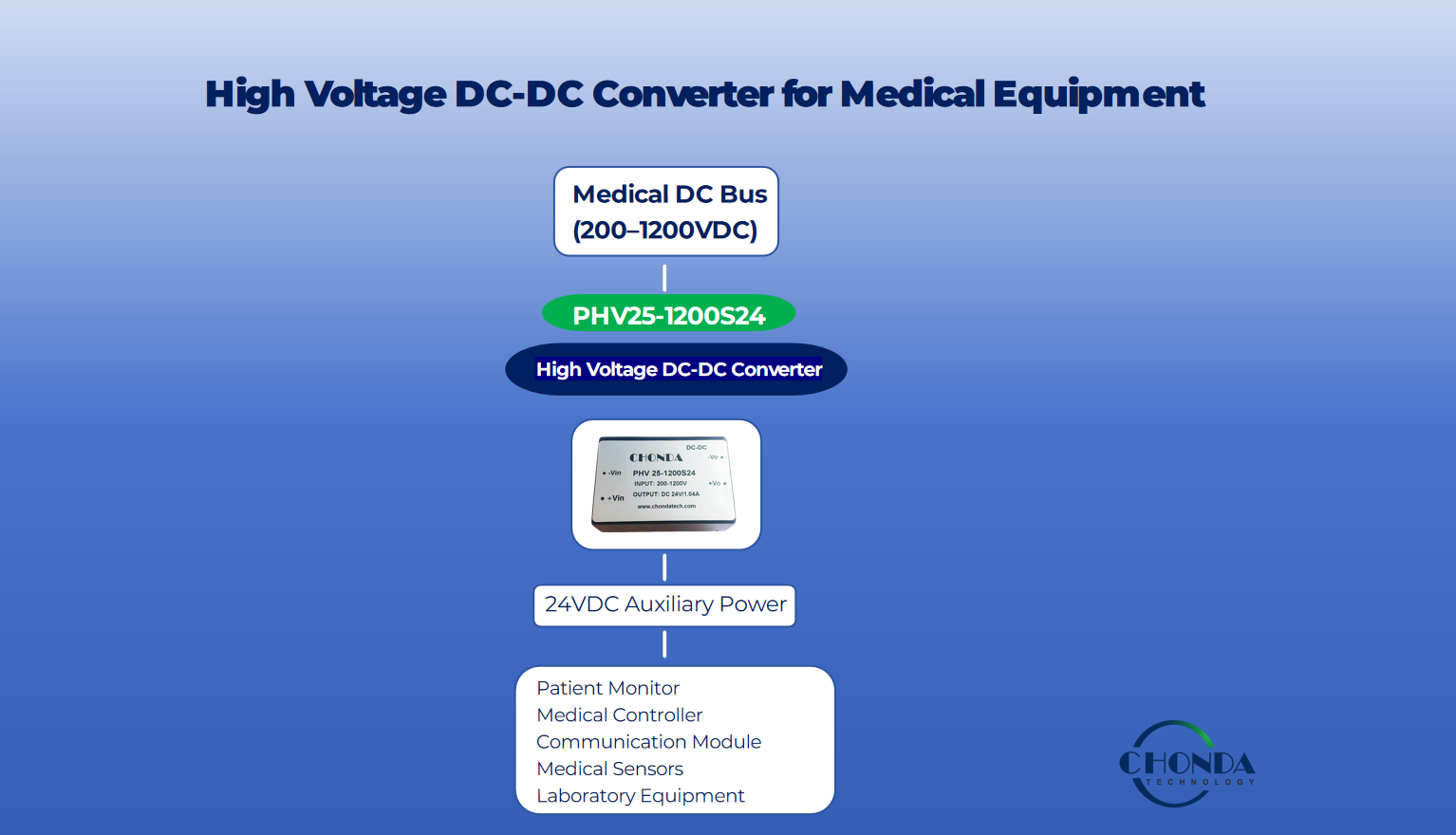
High Voltage DC-DC Converter for Medical Equipment
Modern medical equipment increasingly relies on stable and isolated power supplies to support sensitive electronic systems. Medical imaging devices, diagnostic instruments, patient monitoring systems, and laboratory equipment often require reliable auxiliary power to ensure accurate operation and continuous performance.
High voltage DC-DC converters provide an efficient solution by converting high-voltage DC input into stable isolated low-voltage outputs for medical control electronics, communication modules, sensors, and embedded systems.
This article explains why high voltage DC-DC converters are essential in medical equipment and discusses the key design requirements for reliable medical power conversion.
1. What Is Medical Equipment Power Architecture?
Medical equipment power architecture refers to the electrical power distribution system that delivers stable and isolated power from the primary power source to various medical electronic subsystems. Modern medical devices require multiple voltage rails to support processors, communication modules, sensors, displays, and control electronics while meeting strict safety and reliability standards.
Unlike ordinary industrial electronics, medical equipment must comply with stringent electrical safety requirements because it often operates in direct contact with patients or in critical diagnostic and treatment environments. Stable auxiliary power with high electrical isolation is therefore an essential part of the overall system architecture.
1.1.Primary High Voltage Power Source
Many modern medical systems are powered from centralized DC power supplies, battery systems, or high-voltage AC/DC front-end power stages. These power sources often provide several hundred volts DC before the energy is distributed to different functional modules.
Typical examples include:
- Medical imaging systems
- Laboratory analyzers
- Portable diagnostic equipment
- Surgical systems
- Hospital power distribution equipment
The primary power bus provides sufficient energy for the entire system, while isolated DC-DC converters generate the lower auxiliary voltages required by electronic subsystems.
1.2.Auxiliary Power for Medical Electronics
Medical electronic equipment requires multiple stable low-voltage power rails to operate sensitive electronic circuits.
Typical auxiliary-powered components include:
- Medical controllers
- Patient monitoring modules
- Communication interfaces
- Sensors
- Human-machine interface (HMI)
- Laboratory measurement electronics
These circuits typically operate from isolated 24VDC, 12VDC, or 5VDC auxiliary supplies generated from the high-voltage input bus.
1.3.Why Isolation Matters in Medical Equipment
Electrical isolation is one of the most important design requirements in medical power systems. Proper isolation helps separate hazardous high-voltage power from patient-accessible electronics while reducing electrical noise between different functional circuits.
An isolated high voltage DC-DC converter provides several important advantages:
- Improves patient electrical safety
- Protects sensitive electronic circuits
- Reduces common-mode noise
- Improves EMC performance
- Enhances long-term system reliability
For this reason, isolated high voltage DC-DC converters have become a standard building block in modern medical equipment power architectures.
2. Why High Voltage DC-DC Converters Are Required in Medical Equipment
Modern medical equipment contains numerous electronic subsystems that operate at different voltage levels while requiring exceptional stability, safety, and electromagnetic compatibility. High voltage DC-DC converters serve as the bridge between the primary high-voltage power source and the isolated low-voltage electronics used throughout medical systems.
By converting several hundred volts DC into isolated 24VDC auxiliary power, these converters ensure reliable operation of sensitive medical electronics while helping meet demanding safety requirements.
2.1.Providing Stable Auxiliary Power for Medical Electronics
Medical devices often integrate multiple electronic modules that require continuous and stable power.
Typical auxiliary-powered systems include:
- Patient monitoring units
- Embedded controllers
- Communication interfaces
- Touchscreen displays
- Medical sensors
- Laboratory measurement circuits
A high voltage DC-DC converter supplies regulated auxiliary power, allowing these critical subsystems to operate reliably even when the primary bus voltage fluctuates.
2.2.Ensuring Electrical Isolation for Patient Safety
Electrical isolation is one of the defining requirements of medical power design.
Because many medical devices interact directly with patients, low-voltage control circuits must remain electrically isolated from high-voltage power systems. Proper isolation helps prevent hazardous leakage currents while improving overall system safety.
An isolated high voltage DC-DC converter helps:
- Separate hazardous voltages from patient-accessible electronics
- Reduce leakage current risks
- Improve equipment safety
- Support compliance with medical electrical safety standards
2.3.Reducing Electrical Noise in Sensitive Medical Systems
Many medical instruments rely on extremely accurate signal acquisition and communication. Electromagnetic interference (EMI) generated by power electronics can reduce measurement accuracy or affect communication reliability.
A properly designed high voltage DC-DC converter minimizes conducted and radiated noise while delivering stable output voltage for:
- Medical imaging systems
- Diagnostic equipment
- Precision laboratory analyzers
- Monitoring systems
- Communication modules
Low-noise power conversion contributes to improved measurement stability and long-term equipment performance.
3. Key Requirements for High Voltage DC-DC Converters in Medical Equipment
Medical equipment places some of the most demanding requirements on power conversion systems. In addition to stable voltage regulation, high voltage DC-DC converters must provide excellent electrical isolation, low electromagnetic interference, and long-term reliability to support critical healthcare applications.
The following characteristics are essential when selecting a high voltage DC-DC converter for medical equipment.
3.1.Wide Input Voltage Range
Medical equipment may operate from centralized DC buses, battery systems, or various front-end power supplies whose voltage can fluctuate during operation.
A wide input voltage range allows the converter to maintain stable auxiliary power despite changes in the primary DC bus, improving overall system stability and simplifying power system design.
Typical benefits include:
- Stable operation across varying DC input voltages
- Improved compatibility with different medical platforms
- Reduced need for additional voltage regulation stages
- Increased design flexibility
3.2.High Electrical Isolation
Isolation is one of the most critical requirements in medical electronics.
High electrical isolation separates hazardous high-voltage circuits from patient-accessible electronics, helping protect both equipment and users while improving system safety.
A properly isolated converter helps:
- Improve patient electrical safety
- Protect sensitive control electronics
- Reduce common-mode interference
- Increase system reliability
3.3.Low Electromagnetic Interference (EMI)
Medical instruments often process extremely small electrical signals. Excessive electromagnetic noise may reduce measurement accuracy or interfere with communication between electronic modules.
A low-EMI converter helps maintain stable operation for:
- Patient monitoring systems
- Diagnostic equipment
- Medical imaging electronics
- Laboratory instruments
- Communication interfaces
Lower conducted and radiated emissions also simplify EMC compliance during equipment development.
3.4.High Conversion Efficiency
Efficient power conversion minimizes energy loss and reduces heat generation inside medical equipment.
Higher efficiency contributes to:
- Lower operating temperatures
- Improved long-term reliability
- Reduced cooling requirements
- Higher overall system efficiency
This is particularly important for compact medical devices where thermal management is limited.
3.5.Long-Term Industrial Reliability
Many medical systems operate continuously for extended periods with minimal downtime. High voltage DC-DC converters therefore must deliver consistent performance under demanding environmental conditions.
Reliable converters help provide:
- Stable long-term operation
- High-quality voltage regulation
- Protection against abnormal operating conditions
- Reduced maintenance requirements
- Extended equipment service life
Industrial-grade reliability ensures dependable auxiliary power throughout the lifecycle of the medical equipment.
4. CHONDA High Voltage DC-DC Converter Solution for Medical Equipment
For medical equipment applications, CHONDA provides high voltage DC-DC converter solutions designed to deliver stable auxiliary power from high-voltage DC buses to sensitive medical electronic systems.
In a typical medical power architecture, the converter operates between the primary high-voltage DC input and isolated low-voltage electronic modules, supplying reliable 24VDC auxiliary power for patient monitoring systems, controllers, communication interfaces, laboratory instruments, and sensors.
CHONDA PHV25-1200S24 is designed for applications requiring wide input voltage capability, excellent electrical isolation, low electromagnetic interference, and long-term industrial reliability.
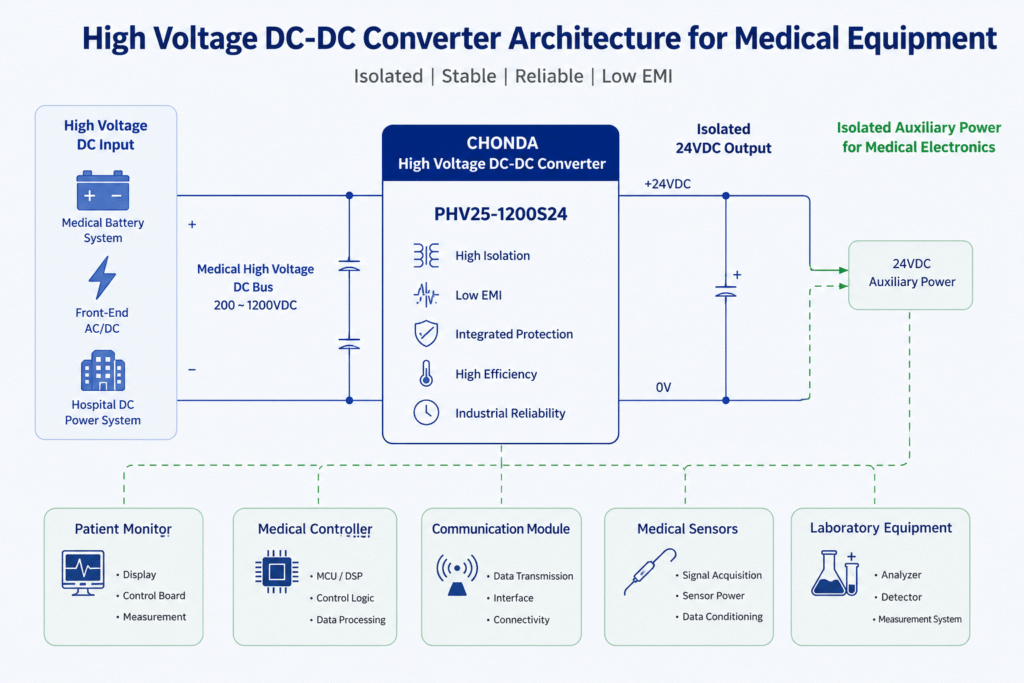
The following diagram illustrates how a high voltage DC-DC converter supplies isolated auxiliary power for medical electronic equipment.
As shown above, the converter electrically isolates the medical DC bus from sensitive low-voltage electronics while providing stable 24VDC auxiliary power for patient monitoring systems, communication modules, laboratory equipment, medical controllers, and sensors.
4.1.PHV25-1200S24 Key Features for Medical Equipment
PHV25-1200S24 is one of CHONDA’s high voltage DC-DC converter modules developed for industrial and high-voltage auxiliary power applications.
Key specifications include:
- Wide input voltage: 200–1200VDC
- Regulated output: 24VDC
- High electrical isolation
- Low EMI design
- Integrated protection functions
- Industrial-grade reliability
- Compact encapsulated package
- Suitable for continuous operation
These characteristics make the module suitable for medical equipment requiring reliable isolated auxiliary power while maintaining stable long-term operation.
4.2.Custom High Voltage DC-DC Converter OEM
Different medical equipment often requires different:
- Input voltage ranges
- Output voltages
- Isolation specifications
- Mechanical dimensions
- Certification requirements
CHONDA also provides custom high voltage DC-DC converter OEM solutions to support medical equipment manufacturers with application-specific power designs.
👉 Explore our Custom High Voltage DC-DC Converter OEM solutions.
You can also browse our complete High Voltage DC-DC Modules product series for additional input and output configurations suitable for industrial, railway, renewable energy, and medical applications.
5. Conclusion
Medical electronic systems rely on stable isolated auxiliary power to ensure reliable operation of controllers, monitoring systems, communication modules, and sensors.
A high voltage DC-DC converter serves as the bridge between high voltage DC power sources and low-voltage medical electronics, providing safe electrical isolation, high efficiency, and long-term reliability.
CHONDA’s PHV25-1200S24 offers a compact and reliable solution for medical equipment requiring wide input voltage capability, reinforced isolation, low EMI, and industrial-grade performance.
Related Articles
- What Is High Voltage DC-DC Converter
- High Voltage DC-DC Converter for Industrial Automation
- High Voltage DC-DC Converter for Railway Applications
- High Voltage DC-DC Converter for PV Monitoring Systems
- High Voltage DC-DC Converter for Battery Energy Storage Systems
- Custom High Voltage DC-DC Converter OEM
- High Voltage DC-DC Modules