We help the world since 2012

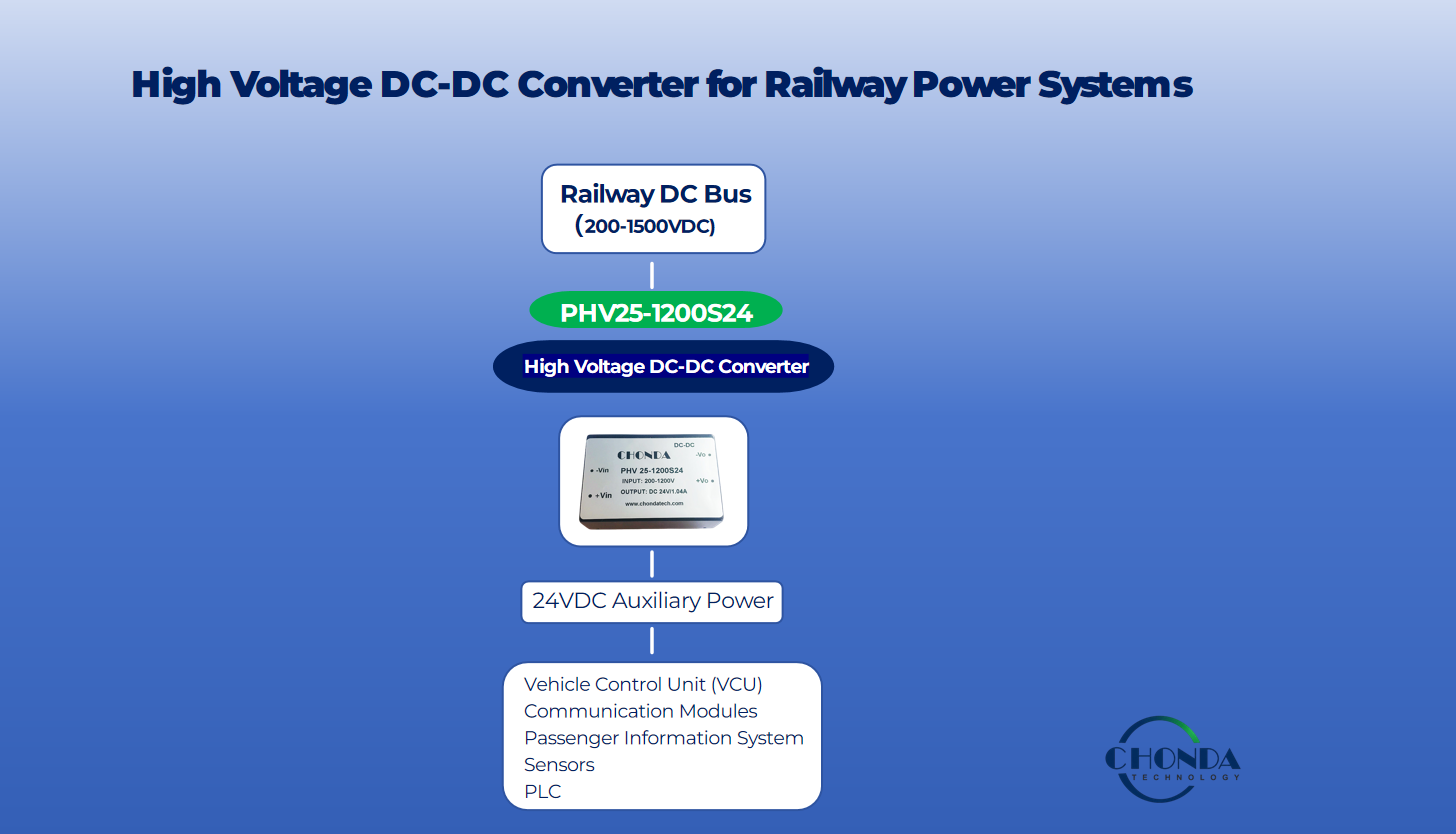
High Voltage DC-DC Converter for Railway Applications: Power, Isolation, and Reliability Considerations
Railway equipment contains many electronic subsystems that require stable low-voltage power while operating within a demanding electrical and environmental environment.
A high voltage DC-DC converter can be used to convert a railway DC supply into regulated auxiliary power for systems such as vehicle control units, communication equipment, monitoring electronics, passenger information systems, and other onboard devices.
However, railway converter selection cannot be based on nominal input and output voltage alone. The actual application may also require consideration of input-voltage variation, electrical transients, isolation, EMC performance, temperature conditions, vibration, mechanical integration, and long-term reliability.
The appropriate converter should therefore be evaluated against the requirements of the specific railway subsystem and its installation environment.
This article focuses on the main considerations when selecting and integrating a high voltage DC-DC converter for railway applications.
1. Where High Voltage DC-DC Conversion Fits in Railway Systems
Railway equipment typically contains several electrical domains.
A higher-voltage DC supply may be available at the system or vehicle level, while individual electronic subsystems require lower regulated voltages.
The DC-DC converter provides the interface between these power domains.
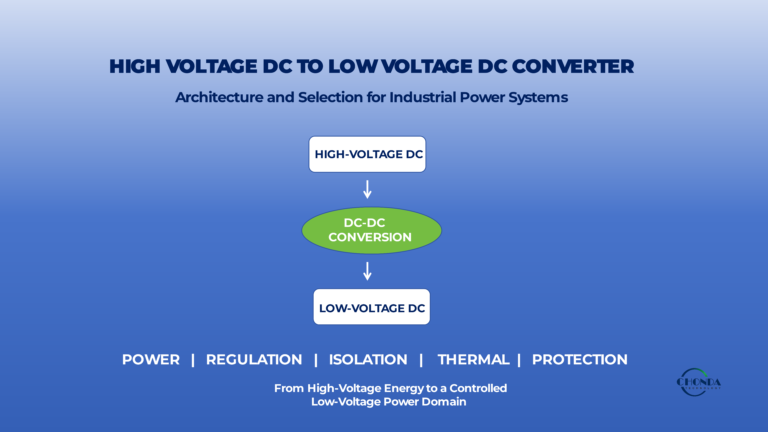
A simplified architecture is:
Railway DC Supply
↓
High Voltage DC-DC Converter
↓
Isolated Low-Voltage Auxiliary Power
↓
Control / Communication / Monitoring Electronics
The exact power architecture varies by railway equipment and subsystem, but the converter is typically selected to provide a stable and electrically appropriate power source for the downstream electronics.
1.1 High-Voltage DC Input
The converter input must be compatible with the actual DC supply range of the application.
The design should consider not only the nominal voltage but also the expected operating range and transient conditions.
1.2 Low-Voltage Auxiliary Loads
The downstream loads may include:
- Vehicle control units
- PLCs
- Communication equipment
- Monitoring electronics
- Sensors
- Passenger information systems
Different loads may have different power, regulation, isolation, and transient requirements.
1.3 The Converter as an Interface Between Power Domains
The converter should therefore be evaluated as an interface between the railway DC supply and the low-voltage electronic subsystem.
This makes the following characteristics particularly important:
Input Range + Isolation + Regulation + EMC + Thermal Performance + Reliability
2. Key Requirements for High Voltage DC-DC Converters in Railway Power Systems
Railway applications place extremely high demands on power converters because onboard electronic systems must operate continuously under vibration, temperature variation, electrical transients, and long service life requirements. Selecting the right high voltage DC-DC converter helps ensure stable auxiliary power while improving operational safety and reducing maintenance throughout the railway system lifecycle.
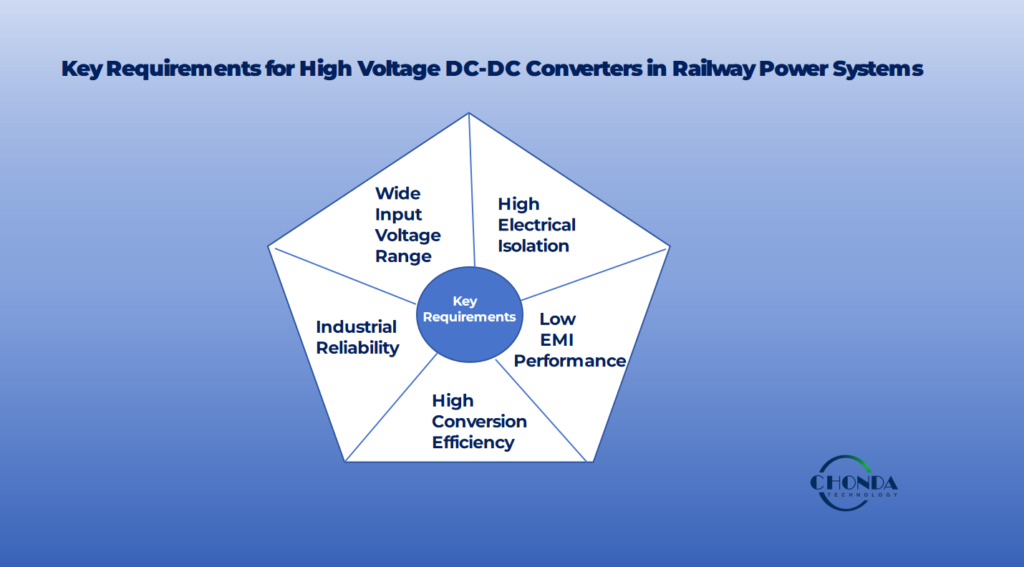
2.1 Input Voltage and Transient Conditions
The converter should be selected according to the actual railway DC input range rather than the nominal voltage alone.
The input specification should consider:
- Normal operating voltage
- Expected voltage variation
- Transient conditions
- Start-up and shutdown conditions
- Regenerative or system-dependent voltage events where applicable
The important question is therefore:
What input-voltage and transient environment must the converter tolerate during actual operation?
A wide input range can simplify system integration, but the specified range should always be evaluated against the actual railway power environment.
2.2 High Electrical Isolation
Railway auxiliary electronics must be electrically isolated from high-voltage traction power.
High isolation voltage protects control equipment from hazardous DC bus voltages, reduces common-mode interference, and improves passenger safety while helping railway systems comply with industrial transportation standards. The required level of isolation depends on the complete electrical architecture.
2.3 Environmental and Mechanical Conditions
Railway equipment may operate under temperature variation, mechanical vibration, shock, and long operating periods.
The converter should therefore be evaluated for:
- Operating temperature
- Storage or transportation conditions where relevant
- Vibration environment
- Mechanical mounting
- Connector and lead integrity
The required environmental performance depends on the specific railway application and applicable equipment requirements.
2.4 High Conversion Efficiency
Efficient power conversion reduces internal energy loss and heat generation inside railway electronic equipment.
Higher efficiency lowers cooling requirements, improves thermal management, and contributes to longer operating life for continuously powered railway systems.
2.5 Industrial Reliability
Railway power supplies are expected to operate reliably for many years under harsh environmental conditions.
Industrial-grade converters featuring wide operating temperature capability, comprehensive protection functions, and robust mechanical design help ensure continuous operation while minimizing maintenance and system downtime.
2.6 Mechanical Integration
The converter must also fit the physical architecture of the railway equipment.
Important considerations include:
- Available installation space
- Mounting method
- Cooling conditions
- Connector orientation
- Cable routing
- Accessibility for maintenance
Mechanical integration should be checked together with electrical and thermal requirements rather than treated as a separate final-stage task.
3. Example: Evaluating a High Voltage DC-DC Converter for Railway Applications
Railway electronic systems require stable auxiliary power that can operate reliably under high-voltage DC bus conditions while meeting demanding industrial transportation requirements.
CHONDA provides high voltage DC-DC converter solutions designed to convert high-voltage railway DC bus power into stable isolated 24VDC auxiliary power for onboard control and monitoring equipment.
The following diagram illustrates a typical railway power architecture using a high voltage DC-DC converter to supply reliable auxiliary power for railway electronic systems.
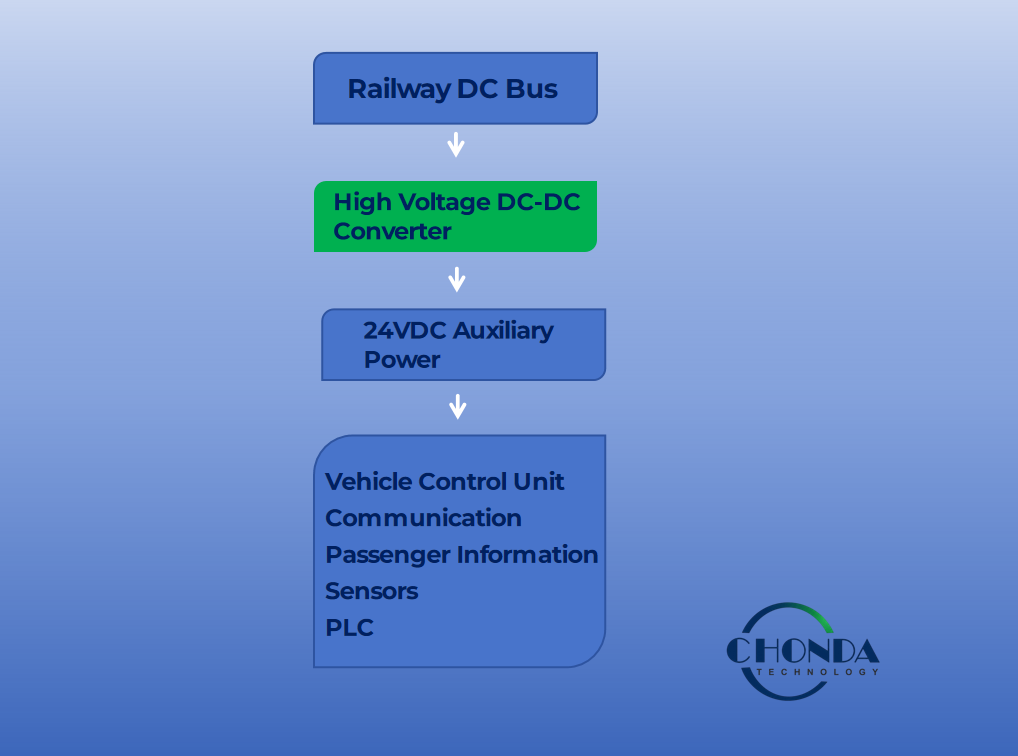
As shown above, the high voltage DC-DC converter isolates the railway DC bus from low-voltage electronic equipment while providing stable 24VDC auxiliary power for vehicle control units, communication systems, passenger information systems, PLCs, and sensors.
3.1 Example Converter: PHV25-1200S24
For applications requiring a wide DC input range and regulated low-voltage auxiliary power, the PHV25-1200S24 can be evaluated against the railway equipment requirements.
Its relevant characteristics include:
- 200–1200VDC input range
- Regulated 24VDC output
- Electrical isolation
- Compact DC-DC conversion architecture
- Protection features for industrial power applications
For a railway project, these characteristics should still be evaluated together with the complete system requirements, including transient conditions, environmental requirements, EMC, mechanical integration, and applicable standards.
3.2 Typical Features
- Ultra-wide 200–1200VDC input range
- Stable 24VDC regulated output
- High electrical isolation for onboard safety
- Low EMI design for communication reliability
- Comprehensive protection functions
- Industrial-grade reliability for continuous railway operation
These features make the PHV25-1200S24 suitable for a wide variety of railway applications, including:
- Railway vehicle control systems
- Communication equipment
- Passenger information systems
- Industrial PLCs
- Railway monitoring electronics
- Intelligent sensor networks
For projects requiring different input voltage ranges, output voltages, mechanical configurations, or application-specific requirements, CHONDA also provides custom high voltage DC-DC converter OEM solutions for railway and other industrial applications.
👉 Learn more about our Custom High Voltage DC-DC Converter OEM Solutions.
4. Conclusion
Railway power systems operate in demanding environments where reliability, electrical safety, and continuous operation are essential. High voltage DC-DC converters play a critical role by converting high-voltage railway DC bus power into stable low-voltage auxiliary power for onboard electronic equipment.
With wide input voltage capability, reinforced isolation, low EMI performance, and industrial-grade reliability, the PHV25-1200S24 provides an efficient solution for railway communication systems, vehicle control units, passenger information systems, PLCs, and other auxiliary electronics.
For projects requiring customized input voltage ranges, output voltages, package dimensions, or application-specific requirements, CHONDA also provides custom high voltage DC-DC converter OEM solutions for industrial and railway applications.
Related Articles