We help the world since 2012

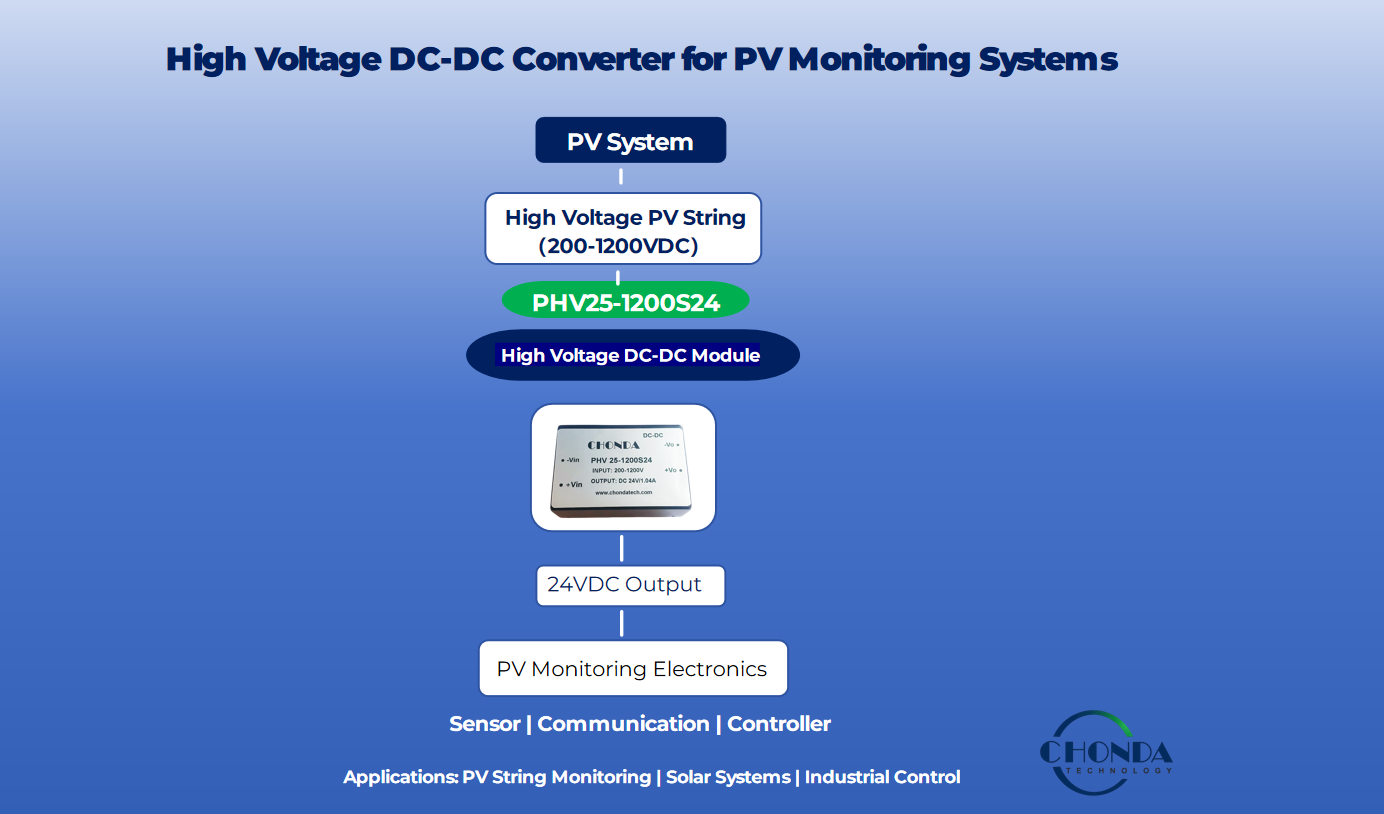
High Voltage DC-DC Converter Applications in Photovoltaic Monitoring Systems
Photovoltaic (PV) systems are increasingly deployed in utility-scale solar farms and industrial renewable energy installations. As solar power systems continue to increase in voltage levels, reliable power solutions are required to support monitoring equipment, communication systems, and control electronics.
Modern PV monitoring systems often operate alongside high-voltage DC strings that may reach several hundred volts or even exceed 1000VDC. However, the electronic devices responsible for monitoring voltage, current, temperature, and system status typically require stable low-voltage DC power.
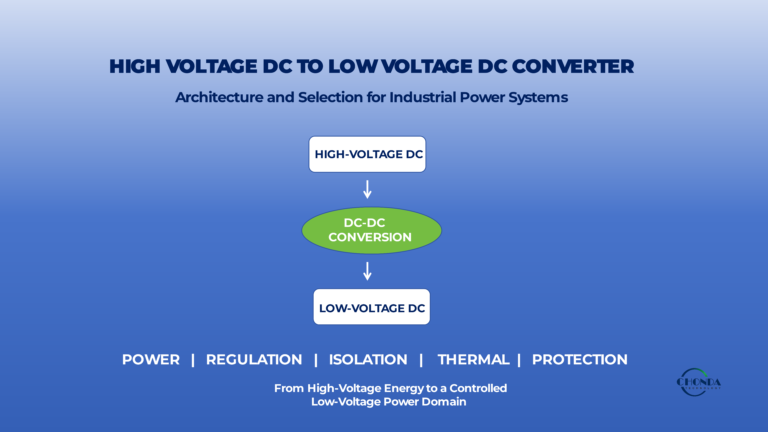
A high voltage DC-DC converter provides the essential connection between the PV high-voltage power source and low-voltage monitoring equipment. By converting high DC input voltage into regulated output power while maintaining electrical isolation and reliability, the converter helps ensure continuous and accurate operation of photovoltaic monitoring systems.
This article explains the role of high voltage DC-DC converters in PV monitoring applications, key design requirements, and how engineers can select suitable converter solutions for industrial solar systems.
1. What Is a Photovoltaic Monitoring System?
A Photovoltaic (PV) Monitoring System is an integrated solution used to collect, analyze, and communicate operating data from solar power installations. By continuously monitoring electrical and environmental parameters, these systems help engineers evaluate PV performance, identify abnormal conditions, and improve the reliability of solar energy generation.
Modern PV monitoring systems rely on various electronic devices installed across solar arrays, including string monitoring units, sensors, communication modules, and industrial controllers. Since many of these devices require stable low-voltage DC power while being connected to high-voltage PV sources, reliable power conversion becomes an essential part of the monitoring architecture.
1.1.PV String Monitoring
PV string monitoring is a key function in large-scale photovoltaic systems, allowing engineers to monitor the performance of individual solar strings rather than only measuring the output of the entire solar array.
By measuring parameters such as string voltage, current, and operating status, monitoring systems can quickly identify issues including abnormal current levels, shading effects, connection problems, or potential equipment failures.
Because PV strings often operate at high DC voltages, the monitoring electronics require a reliable low-voltage power supply. A high voltage DC-DC converter provides the necessary voltage conversion while maintaining stable operation under changing solar conditions.
1.2.Voltage and Current Measurement
Accurate voltage and current measurement is essential for evaluating photovoltaic system performance and maximizing energy output.
PV monitoring devices use sensors and measurement circuits to collect real-time electrical data from solar strings and power conversion equipment. These measurements help operators understand system efficiency, detect abnormal operating conditions, and perform preventive maintenance.
A stable DC power supply is critical for measurement accuracy. High voltage DC-DC converters ensure that monitoring circuits receive regulated power even when PV input voltage changes due to sunlight intensity, temperature variations, and system operating conditions.
1.3.Communication and Control Systems
Modern photovoltaic installations depend on reliable communication and control systems to transmit monitoring data and support remote operation.
Communication modules, industrial controllers, and data acquisition devices must operate continuously to provide real-time information from distributed solar equipment. Any interruption in power supply may affect data transmission, system visibility, and maintenance decisions.
A reliable high voltage DC-DC converter provides stable power for these low-voltage electronic systems while supporting long-term operation in industrial solar environments.
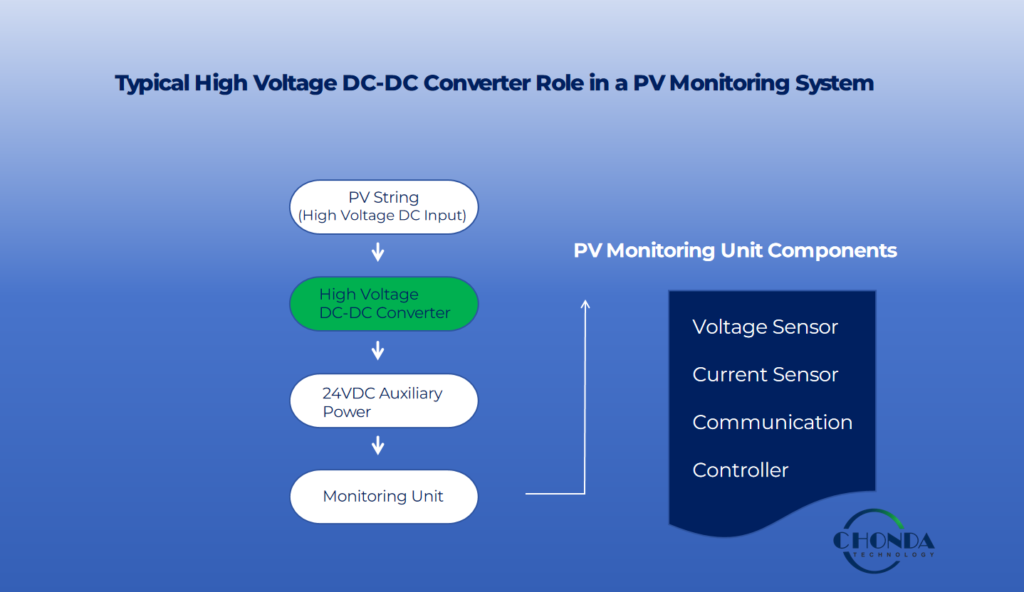
A typical PV monitoring architecture is shown below, where a high voltage DC-DC converter converts the PV string voltage into a stable 24VDC auxiliary power supply for monitoring and communication devices.
This article focuses on the power conversion requirements inside PV monitoring systems. For more information about PV string monitoring solutions, visit our PV String Monitoring Hub.
2. Why High Voltage DC-DC Converters Are Required in PV Monitoring Systems
Photovoltaic monitoring systems are typically connected directly to high voltage PV strings, where the DC voltage can vary significantly depending on the number of panels, environmental conditions, and system operating states.
However, monitoring devices such as sensors, communication modules, controllers, and data acquisition units usually require stable low-voltage power supplies, commonly 24VDC.
A high voltage DC-DC converter provides the necessary voltage conversion, electrical isolation, and power stability required to operate these monitoring components safely and reliably in photovoltaic applications.
2.1.High Voltage Input Adaptation
PV string voltages can range from several hundred volts to over 1000VDC in modern photovoltaic systems.
A dedicated high voltage DC-DC converter allows monitoring equipment to obtain power directly from the PV high voltage side without requiring additional low-voltage power sources.
This simplifies system architecture, reduces wiring complexity, and improves installation flexibility.
2.2.Stable 24VDC Power Supply
PV monitoring devices including sensors, communication modules, and industrial controllers require stable auxiliary power to ensure accurate measurement and reliable data transmission.
A high voltage DC-DC converter converts fluctuating PV voltage into a regulated 24VDC output, providing consistent power for monitoring and control systems.
Stable auxiliary power helps prevent communication interruptions and improves overall system availability.
2.3.Electrical Isolation and System Safety
High voltage PV systems involve potentially hazardous DC voltages that must be separated from low-voltage monitoring electronics.
A converter with proper electrical isolation protects sensitive control circuits while improving operator safety and reducing the impact of electrical noise.
This isolation capability is especially important in industrial photovoltaic installations where long-term reliability and safety are critical.
3. Key Requirements for High Voltage DC-DC Converters in PV Monitoring Systems
A reliable PV monitoring system depends on stable auxiliary power to support sensors, communication modules, and control electronics.
Since photovoltaic strings operate at high DC voltages with continuously changing output conditions, the DC-DC converter used in monitoring applications must provide reliable voltage conversion, electrical isolation, and long-term industrial performance.
The following key parameters should be considered when selecting a high voltage DC-DC converter for PV monitoring systems.
3.1.Wide Input Voltage Range
PV string voltage varies depending on the number of connected modules, solar conditions, temperature changes, and system operating states.
A high voltage DC-DC converter with a wide input voltage range can maintain stable operation across different PV voltage conditions without requiring additional voltage regulation stages.
This improves system flexibility and allows the same converter platform to support different photovoltaic monitoring applications.
3.2.High Electrical Isolation
PV monitoring systems are directly connected to high voltage DC sources, while monitoring electronics usually operate at low voltage levels.
High electrical isolation protects sensors, communication circuits, and control devices from hazardous voltage exposure while improving overall system safety.
Proper isolation also helps reduce electrical interference and supports reliable operation in industrial photovoltaic environments.
3.3.Low EMI Performance
PV monitoring systems rely on accurate measurement and stable communication between sensors, controllers, and monitoring platforms.
Electromagnetic interference generated by power conversion circuits may affect signal integrity and communication reliability.
A low-EMI high voltage DC-DC converter helps minimize conducted and radiated noise, ensuring stable data transmission and reliable monitoring performance.
3.4.High Conversion Efficiency
High efficiency is important for PV monitoring systems that operate continuously throughout the service life of photovoltaic installations.
Efficient power conversion reduces energy loss and heat generation, allowing the converter to maintain stable operation while simplifying thermal management requirements.
This helps improve system reliability and reduces maintenance requirements for long-term deployments.
3.5.Industrial Reliability
PV monitoring equipment is often installed in outdoor or industrial environments where long-term reliability is essential.
A high voltage DC-DC converter should provide wide temperature operation, robust protection features, and durable electrical performance to support continuous system operation.
Reliable power conversion ensures that monitoring and communication functions remain available throughout the lifetime of the photovoltaic system.
4. CHONDA PHV25-1200S24 for PV Monitoring Systems
For photovoltaic monitoring applications, CHONDA provides high voltage DC-DC converter solutions designed to deliver stable auxiliary power from high voltage PV strings to monitoring and control electronics.
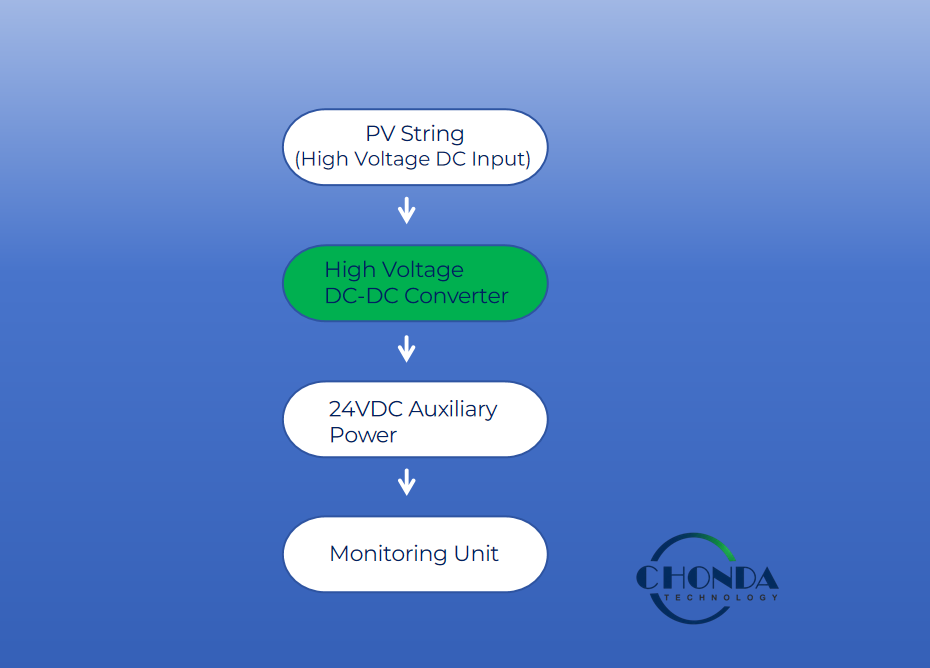
In a typical PV monitoring system, the converter operates between the high voltage DC input side and low voltage monitoring devices, providing reliable 24VDC power for sensors, communication modules, and industrial controllers.
CHONDA PHV25-1200S24 is designed for applications requiring wide input voltage capability, electrical isolation, low EMI performance, and reliable operation in industrial environments.
4.1.PHV25-1200S24 Key Features for PV Monitoring Applications
4.1.1.Wide Input Voltage Capability
The PHV25-1200S24 supports a wide input voltage range from 200VDC to 1200VDC, making it suitable for different PV string voltage configurations.
This flexibility allows system designers to simplify power architecture and adapt the same converter platform across various photovoltaic monitoring applications.
4.1.2.Stable 24VDC Auxiliary Power
PV monitoring systems require stable power for sensors, communication interfaces, and control units.
The PHV25-1200S24 provides regulated 24VDC output power, ensuring consistent operation of monitoring devices even under changing PV operating conditions.
4.1.3.Electrical Isolation and Safety
High voltage PV systems require effective separation between the high voltage input side and low voltage electronics.
The converter provides electrical isolation to improve system safety, protect sensitive monitoring circuits, and support reliable operation in industrial photovoltaic environments.
4.1.4.Low EMI and Industrial Reliability
PV monitoring systems depend on accurate measurements and reliable communication.
With low electromagnetic interference performance and integrated protection features, the PHV25-1200S24 helps maintain stable communication and long-term system reliability.
5. Conclusion
Selecting a high voltage DC-DC converter for photovoltaic monitoring systems requires careful consideration of voltage range, electrical isolation, EMI performance, efficiency, and long-term reliability.
A properly designed converter ensures stable auxiliary power for sensors, communication modules, and control electronics, helping PV monitoring systems maintain accurate measurement and reliable operation under changing photovoltaic conditions.
CHONDA provides high voltage DC-DC converter solutions designed for industrial applications, including PV monitoring systems, battery energy storage systems, and other high voltage power conversion requirements.
For customized voltage ranges, mechanical designs, or application-specific requirements, CHONDA also supports custom high voltage DC-DC converter OEM solutions.
Related Articles
High Voltage DC-DC Converter Thermal Management: Design Considerations and Best Practices
High Voltage DC-DC Converter Protection Features for Industrial Applications
High Voltage DC-DC Converter for Battery Energy Storage Systems (BESS)
How to Select a High Voltage DC-DC Converter Module for Industrial Applications