We help the world since 2012

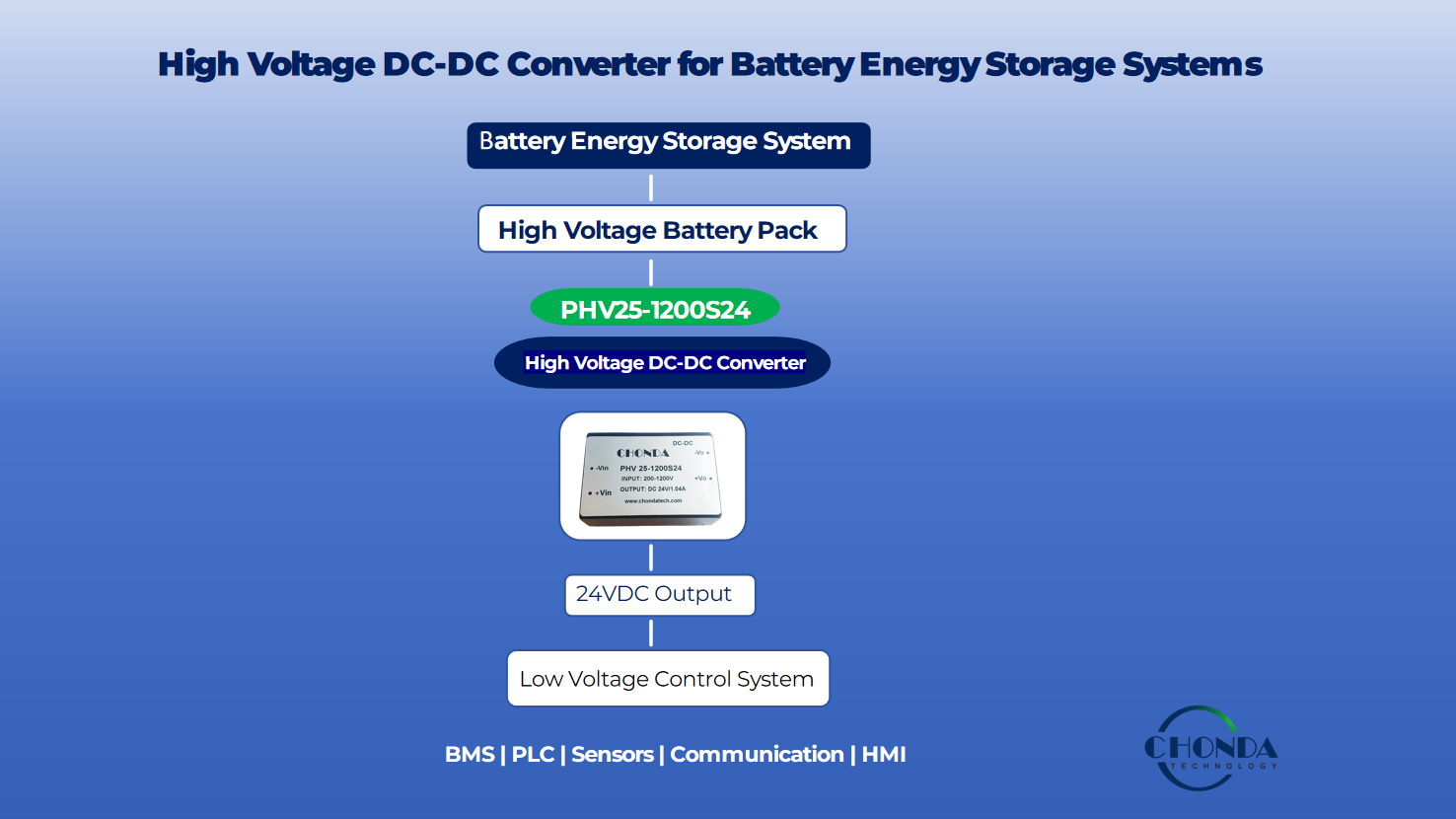
High Voltage DC-DC Converter Applications in Battery Energy Storage Systems (BESS)
Battery Energy Storage Systems (BESS) have become an essential part of modern renewable energy infrastructure, helping balance power generation, improve grid stability, and support the growing adoption of solar and wind energy.
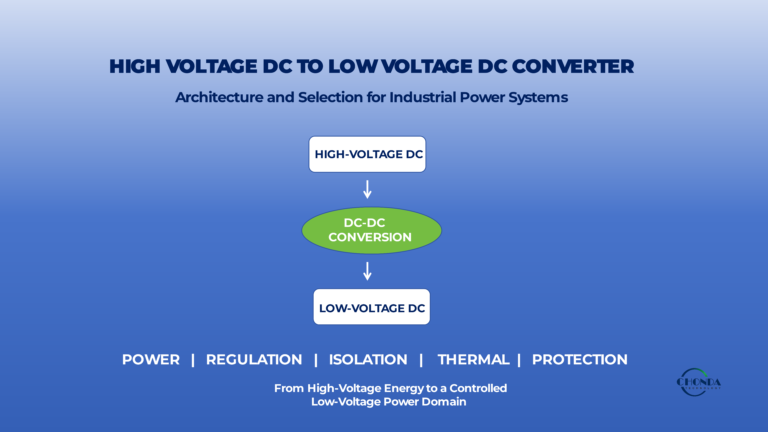
Most utility-scale and industrial energy storage systems operate with high-voltage battery packs ranging from several hundred volts to over 1000VDC. However, the control electronics inside these systems—including Battery Management Systems (BMS), PLC controllers, sensors, communication modules, and monitoring equipment—typically require stable low-voltage DC power such as 24VDC.
A high voltage DC-DC converter provides the critical interface between the high-voltage battery system and these low-voltage control circuits. By converting high DC input voltages into regulated low-voltage outputs while maintaining electrical isolation, the converter ensures safe, reliable, and efficient operation throughout the entire energy storage system.
This article explains how high voltage DC-DC converters are used in Battery Energy Storage Systems, the key design requirements for BESS applications, and the factors engineers should consider when selecting an appropriate converter solution.
1. What Is a Battery Energy Storage System (BESS)?
Battery Energy Storage Systems (BESS) integrate multiple electrical and electronic subsystems to safely store and deliver energy. Understanding the overall system architecture helps explain where high voltage DC-DC converters are installed and why they are essential for supplying stable low-voltage power to monitoring, communication, and control equipment.
1.1.Basic Architecture
A Battery Energy Storage System (BESS) is an integrated energy storage solution that stores electrical energy in rechargeable battery packs and releases it when power is needed. BESS is widely used in renewable energy systems, industrial facilities, commercial buildings, and utility-scale power grids to improve energy efficiency and grid stability.
A typical Battery Energy Storage System consists of several major subsystems, including battery packs, battery management systems (BMS), power conversion systems (PCS), monitoring equipment, communication devices, and industrial controllers. These components work together to manage energy storage, charging, discharging, and system protection.
1.2.High Voltage Battery Packs
Modern Battery Energy Storage Systems commonly operate with high-voltage battery packs ranging from 200VDC to over 1000VDC. Higher operating voltages reduce transmission losses, improve overall system efficiency, and enable large-scale energy storage applications.
However, while the battery pack operates at high voltage, many electronic control devices inside the system cannot operate directly from these voltage levels.
1.3.Low Voltage Control Systems
Industrial control equipment such as Battery Management Systems (BMS), PLC controllers, sensors, communication modules, and monitoring devices typically require stable low-voltage DC power, most commonly 24VDC or 12VDC.
A high voltage DC-DC converter bridges this voltage gap by converting the high-voltage battery input into an isolated and regulated low-voltage output. This enables reliable operation of control electronics while maintaining electrical safety between the high-voltage battery system and sensitive electronic circuits.
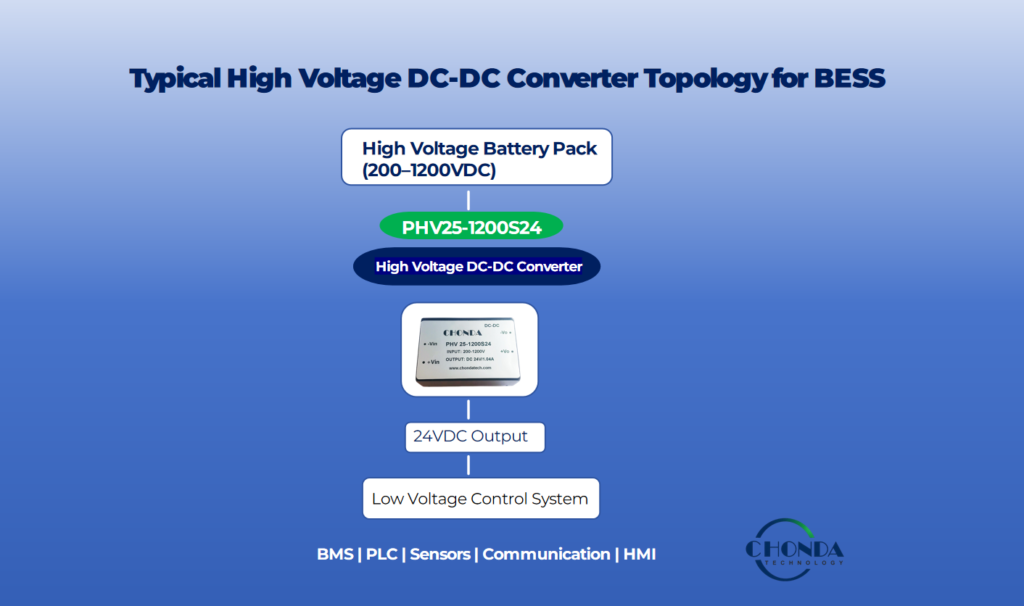
2. Why High Voltage DC-DC Converters Are Required in BESS
Although Battery Energy Storage Systems operate with high-voltage battery packs, most monitoring, communication, and control electronics cannot be powered directly from these voltage levels. A dedicated high voltage DC-DC converter is therefore required to provide safe, isolated, and regulated low-voltage power for the entire control system.
2.1.Supplying Stable Low-Voltage Power
The primary function of a high voltage DC-DC converter in a Battery Energy Storage System is to convert high-voltage battery power into a stable low-voltage DC supply.
Typical industrial control equipment—including Battery Management Systems (BMS), PLC controllers, communication modules, sensors, and monitoring devices—commonly require regulated 24VDC or 12VDC power supplies. A high voltage DC-DC converter continuously delivers this stable output even when the battery voltage varies during charging and discharging cycles.
2.2.Providing Electrical Isolation
Electrical isolation is one of the most important safety requirements in Battery Energy Storage Systems.
The high-voltage battery pack may operate at several hundred volts or even exceed 1000VDC, while low-voltage control electronics must remain electrically isolated from hazardous voltages. An isolated high voltage DC-DC converter creates a safe electrical barrier between the battery system and sensitive control circuits, helping protect personnel, equipment, and communication interfaces.
2.3.Supporting Reliable System Operation
A reliable DC-DC converter contributes directly to the long-term stability of the entire Battery Energy Storage System.
Stable output voltage, low electromagnetic interference (EMI), high conversion efficiency, and integrated protection features help ensure continuous operation of monitoring and control equipment under demanding industrial conditions. This improves overall system reliability while reducing maintenance requirements and unexpected downtime.
3. Key Requirements for High Voltage DC-DC Converters in BESS
Battery Energy Storage Systems often operate in demanding industrial environments where converters are expected to deliver stable performance for many years. Selecting a high voltage DC-DC converter requires evaluating several key technical characteristics beyond basic voltage conversion.
3.1.Wide Input Voltage Range
One of the first considerations when selecting a high voltage DC-DC converter for a Battery Energy Storage System is its input voltage range.
Battery voltage continuously changes during charging, discharging, and different state-of-charge conditions. Depending on the battery chemistry and system configuration, the input voltage may vary significantly throughout normal operation.
A converter with a wide input voltage range can operate reliably across these voltage fluctuations without requiring additional power conditioning equipment. This simplifies system design while improving flexibility and long-term operating stability.
3.2.High Electrical Isolation
Electrical isolation is a fundamental safety requirement in every Battery Energy Storage System.
The high-voltage battery pack may operate at several hundred volts or even exceed 1000VDC, while monitoring devices, PLC controllers, sensors, and communication modules typically operate at low-voltage levels. These two electrical domains must remain safely separated.
A properly isolated high voltage DC-DC converter provides a reliable electrical barrier that protects sensitive electronics, improves system safety, reduces common-mode noise, and helps meet industrial safety standards.
3.3.Low EMI Performance
Modern Battery Energy Storage Systems rely on digital communication networks, intelligent controllers, and precision monitoring equipment that are highly sensitive to electromagnetic interference.
High-frequency switching inside power converters can generate both conducted and radiated EMI, which may affect communication stability, measurement accuracy, and overall system performance if not properly controlled.
A low-EMI DC-DC converter minimizes electrical noise through optimized circuit design, helping ensure reliable communication and stable operation throughout the entire Battery Energy Storage System.
3.4.High Conversion Efficiency
Power conversion efficiency has a direct impact on both thermal performance and overall system reliability.
Every percentage of efficiency gained reduces power loss inside the converter. Lower power loss means less heat generation, allowing the converter to operate at lower temperatures while reducing cooling requirements.
High-efficiency DC-DC converters therefore improve energy utilization, extend component lifetime, and contribute to the long-term reliability of Battery Energy Storage Systems operating continuously in industrial environments.
3.5.Industrial Reliability
Battery Energy Storage Systems are expected to operate continuously for many years with minimal maintenance.
DC-DC converters used in these applications must withstand wide temperature variations, electrical disturbances, and long operating hours without performance degradation.
Industrial-grade designs featuring robust protection functions, wide operating temperature capability, and high-quality components help ensure stable performance, reduce maintenance costs, and improve the overall availability of the energy storage system.
4. CHONDA High Voltage DC-DC Converter Solution for Battery Energy Storage Systems
Battery Energy Storage Systems require DC-DC converters that combine wide input voltage capability, reliable electrical isolation, stable output regulation, and long-term industrial reliability. Selecting a converter that meets these requirements helps ensure continuous operation of monitoring, communication, and control equipment throughout the entire energy storage system.
4.1.Example: PHV25-1200S24
The PHV25-1200S24 is designed for industrial applications that require reliable power conversion from high-voltage DC sources to regulated low-voltage outputs.
With its 200–1200VDC ultra-wide input range, regulated 24VDC / 25W output, electrical isolation, and industrial-grade design, the module is well suited for Battery Energy Storage Systems operating under varying battery voltages.
Typical BESS applications include:
- Battery Management Systems (BMS)
- Industrial PLC controllers
- Monitoring equipment
- Communication modules
- Auxiliary control circuits
Its stable output performance helps ensure reliable operation of low-voltage electronics while simplifying the overall system power architecture.
4.2.Custom High Voltage DC-DC Converter Solutions
Different Battery Energy Storage Systems often require customized electrical specifications, protection strategies, mechanical dimensions, or installation methods.
CHONDA therefore provides custom high voltage DC-DC converter solutions to support customer-specific industrial applications, including customized input voltage ranges, output voltages, isolation levels, protection features, and thermal design.
Our engineering team works closely with customers to develop reliable DC-DC converter modules that meet the performance and safety requirements of modern Battery Energy Storage Systems.
5. Conclusion
Battery Energy Storage Systems require reliable auxiliary power supplies to ensure the stable operation of monitoring, communication, and control equipment. A high voltage DC-DC converter plays a critical role by converting high-voltage battery power into safe and regulated low-voltage DC power while providing electrical isolation, high efficiency, and comprehensive protection.
When selecting a high voltage DC-DC converter for BESS applications, engineers should carefully evaluate factors such as input voltage range, electrical isolation, EMI performance, thermal management, protection features, and long-term industrial reliability. Choosing the right converter helps improve overall system stability while reducing maintenance requirements and unexpected downtime.
For engineers looking to better understand the complete selection process, our article DC-DC Converter Selection Guide: Key Parameters for High Voltage Applications provides a comprehensive overview of the most important technical considerations when choosing a high voltage DC-DC converter.
Related Articles
High Voltage DC-DC Converter Protection Features
What Is a High Voltage DC-DC Converter? Design Principles and Applications
High Voltage DC-DC Converter Isolation Design: Principles and Applications
DC-DC Converter Selection Guide: Key Parameters for High Voltage Applications