We help the world since 2012

High Voltage DC-DC Converter EMI Design Considerations
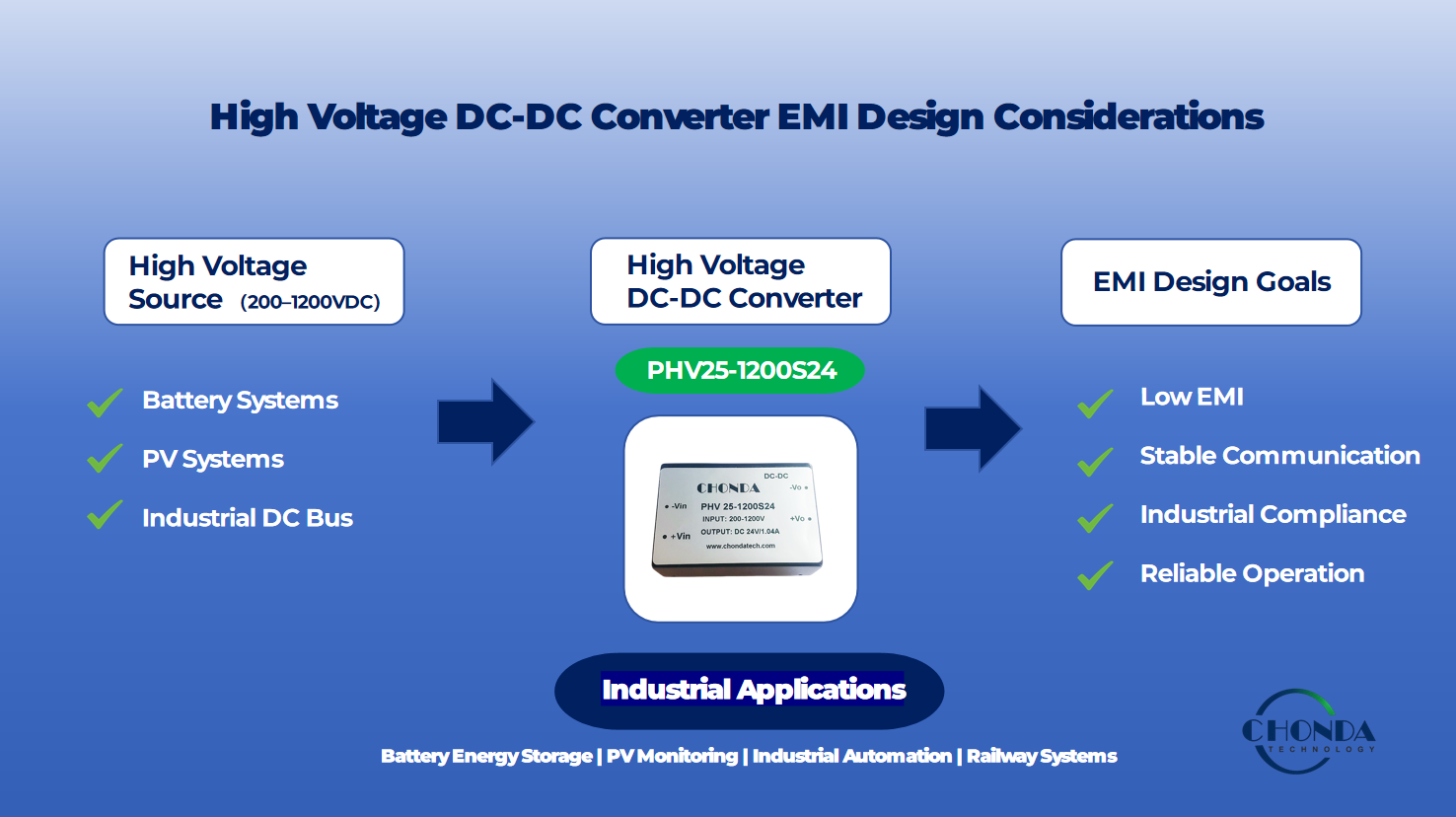
Electromagnetic interference (EMI) is one of the most important design challenges in high voltage DC-DC converter applications. Improper EMI control can affect system stability, communication performance, and compliance with industrial standards.
High voltage DC-DC converter modules must not only provide efficient power conversion but also minimize both conducted and radiated emissions while maintaining reliable operation in demanding industrial environments.
This article explains the major sources of EMI, practical suppression methods, and the key design considerations engineers should evaluate when selecting high voltage DC-DC converter modules.
What Causes EMI in High Voltage DC-DC Converters?
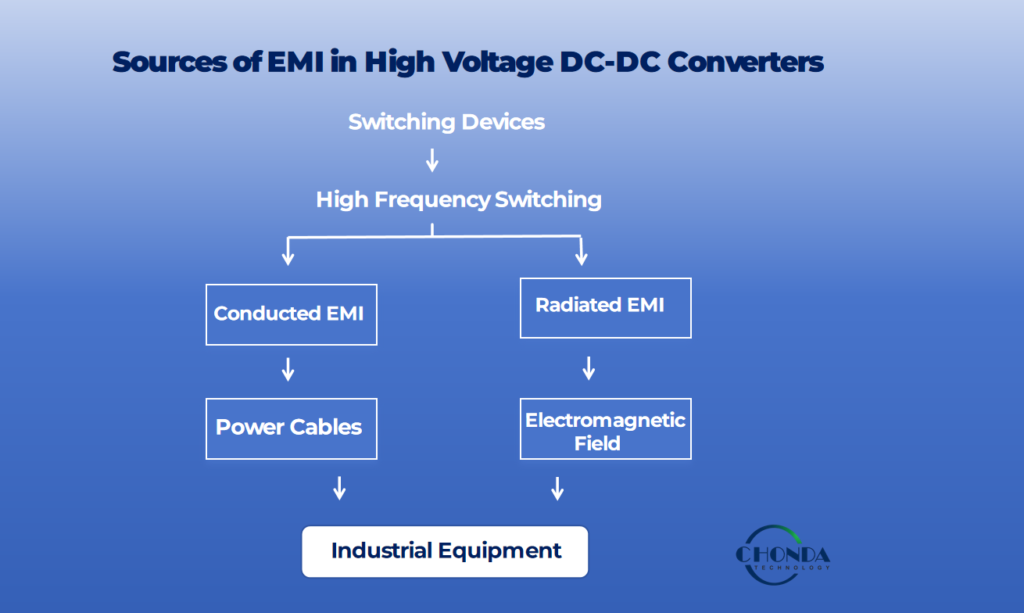
High voltage DC-DC converters operate by switching electrical energy at high frequencies. Although this enables efficient power conversion, it also generates electromagnetic interference (EMI), which may affect nearby electronic equipment if not properly controlled.
Understanding the primary sources of EMI is the first step toward selecting or designing reliable high voltage DC-DC converter modules for industrial applications.
High Switching Frequency
Most modern high voltage DC-DC converter modules rely on high-frequency switching technology to achieve compact size and high conversion efficiency.
During operation, semiconductor switching devices rapidly turn on and off, creating fast voltage and current transitions (high dv/dt and di/dt).
These rapid switching events become the primary source of electromagnetic noise inside the converter.
While higher switching frequencies improve efficiency and reduce transformer size, they also increase the likelihood of EMI generation if the converter is not properly designed.
Therefore, switching frequency is one of the most important factors affecting EMI performance in high voltage DC-DC converters.
Conducted EMI
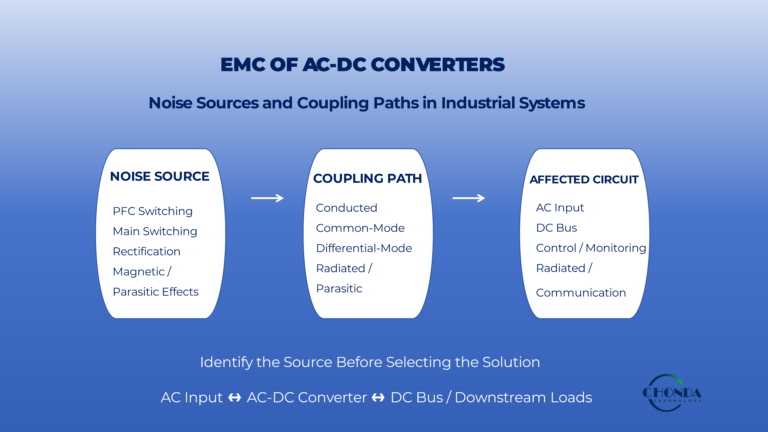
Conducted EMI refers to unwanted electrical noise that travels through conductive paths such as power cables, PCB traces, and system wiring.
In high voltage DC-DC converters, switching currents can propagate back toward the input source or forward to the output circuits through power lines.
Excessive conducted EMI may interfere with:
- Industrial controllers
- Battery monitoring systems
- Communication equipment
- Sensitive measurement circuits
To reduce conducted EMI, designers commonly use:
- Input EMI filters
- Output filters
- Proper PCB layout
- Low-noise transformer design
Effective conducted EMI suppression improves overall system stability and helps products meet EMC compliance requirements.
Radiated EMI
Radiated EMI is electromagnetic energy emitted into the surrounding environment through electric and magnetic fields.
High-frequency switching loops, transformer leakage flux, PCB routing, and wiring layouts can all become sources of radiated emissions.
In industrial environments, excessive radiated EMI may affect:
- Wireless communication
- Industrial sensors
- PLC controllers
- Monitoring devices
Reducing radiated EMI typically involves:
- Optimized PCB layout
- Minimizing switching loop area
- Shielding techniques
- Transformer optimization
- Proper grounding strategy
Good radiated EMI design not only improves converter performance but also minimizes interference with nearby electronic equipment.
How to Reduce EMI in High Voltage DC-DC Converter Design
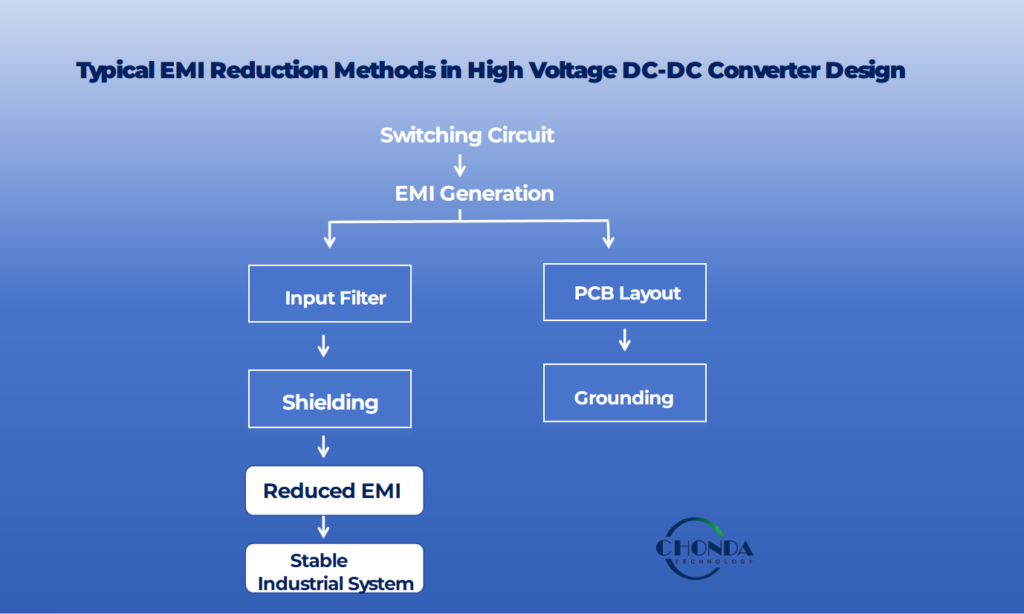
Although EMI cannot be completely eliminated in high voltage DC-DC converters, proper design techniques can significantly reduce both conducted and radiated emissions. Effective EMI suppression improves system stability, enhances communication reliability, and helps industrial equipment comply with EMC standards.
The following design considerations are commonly adopted in modern high voltage DC-DC converter modules.
Input Filtering
Input filtering is one of the most effective methods for suppressing conducted EMI.
High-frequency switching currents generated inside the converter can travel back through the input power lines, affecting other equipment connected to the same DC bus.
An input EMI filter typically consists of:
- Common-mode chokes
- Differential inductors
- X capacitors
- Y capacitors
Properly designed input filters reduce conducted emissions while improving overall power quality in industrial systems.
A well-designed input filter helps prevent switching noise from propagating throughout the power distribution network.
PCB Layout Optimization
PCB layout has a significant influence on EMI performance.
Poor routing, excessive loop areas, and improper grounding can increase electromagnetic emissions even when high-quality components are used.
Engineers should follow several best practices:
- Keep high-current switching loops as short as possible.
- Separate power circuits from signal circuits.
- Use continuous ground planes whenever possible.
- Minimize parasitic inductance in high-frequency paths.
Careful PCB layout improves both conducted and radiated EMI performance while increasing overall converter reliability.
Shielding and Grounding
Shielding and grounding provide additional protection against radiated EMI.
Metal enclosures, shielded transformers, and appropriate cable shielding help prevent electromagnetic fields from affecting nearby electronic devices.
Proper grounding is equally important. A well-designed grounding strategy reduces common-mode noise and improves system stability.
In industrial applications, shielding and grounding are often combined with filtering techniques to achieve optimal EMC performance.
Effective shielding and grounding contribute to stable long-term operation in electrically noisy industrial environments.
EMI Standards for Industrial Applications
In addition to reducing electromagnetic interference through good circuit design, high voltage DC-DC converter modules must also comply with internationally recognized electromagnetic compatibility (EMC) standards.
These standards ensure that power converters operate reliably without causing unacceptable interference to surrounding electronic equipment.
CISPR Standards
CISPR (International Special Committee on Radio Interference) establishes internationally recognized limits for electromagnetic emissions generated by electrical and electronic equipment.
For industrial power supplies and DC-DC converters, CISPR standards primarily define acceptable levels of:
- Conducted emissions
- Radiated emissions
Compliance with CISPR requirements helps ensure that high voltage DC-DC converters do not interfere with nearby communication equipment, industrial control systems, or sensitive electronic devices.
Manufacturers often perform EMC testing during product development to verify that conducted and radiated emissions remain within specified limits.
Selecting converter modules designed with EMC compliance in mind can simplify overall system certification.
IEC Standards
The International Electrotechnical Commission (IEC) publishes a wide range of standards covering electrical safety, insulation, reliability, and electromagnetic compatibility.
Depending on the application, high voltage DC-DC converter modules may be designed to support compliance with relevant IEC standards related to:
- Electrical insulation
- Safety requirements
- EMC performance
- Industrial equipment
Following internationally recognized IEC requirements improves product reliability while supporting deployment in global industrial markets.
For engineers designing industrial power systems, understanding applicable IEC standards is an important part of converter selection.
Why EMC Compliance Matters
EMC compliance is not simply a certification requirement—it directly affects system performance and long-term reliability.
Poor EMI control may lead to:
- Communication failures
- Sensor interference
- PLC malfunction
- Unstable monitoring systems
- Unexpected equipment shutdown
Choosing high voltage DC-DC converter modules with optimized EMI performance reduces engineering risk while improving overall system stability.
This is particularly important for battery energy storage systems (BESS), photovoltaic monitoring systems, railway electronics, and industrial automation equipment operating in electrically noisy environments.
CHONDA High Voltage DC-DC Converter Solution
High-voltage DC-DC converter modules used in industrial applications must achieve a balance between electrical isolation, EMI control, conversion efficiency, and long-term reliability.
CHONDA develops high voltage DC-DC converter modules for demanding industrial environments, with designs optimized for battery energy storage systems (BESS), photovoltaic monitoring equipment, industrial automation, railway electronics, and other high-voltage DC applications.
Typical design features include:
- Wide input voltage ranges up to 200–1200VDC
- Stable regulated 24VDC output
- High electrical isolation
- Low EMI design
- Compact industrial module structure
- Reliable long-term operation
These features help engineers simplify system integration while maintaining stable power delivery in high-voltage environments.
For applications with special electrical or mechanical requirements, CHONDA also provides custom high voltage DC-DC converter solutions tailored to industrial power conversion projects.
Example: PHV25-1200S24
The PHV25-1200S24 high voltage DC-DC converter module combines a wide 200–1200VDC input range with a regulated 24VDC / 25W output, making it suitable for powering low-voltage electronics inside high-voltage systems.
Typical applications include:
- Battery Energy Storage Systems (BESS)
- PV String Monitoring Systems
- Industrial Automation Equipment
- Railway Electronics
- High Voltage DC Control Systems
Designed with electrical isolation and low EMI characteristics, the PHV25-1200S24 helps improve system stability while reducing interference between the high-voltage power stage and sensitive electronic circuits.
Conclusion
Selecting a high voltage DC-DC converter requires more than matching voltage and power ratings. Engineers should also evaluate electrical isolation, EMI performance, thermal management, and long-term reliability to ensure stable operation in demanding industrial environments.
A properly designed converter not only delivers reliable power but also improves system safety, protects sensitive electronics, and supports compliance with industrial EMC requirements.
Before selecting a converter, engineers should first understand the key DC-DC converter selection parameters required for their application.
For engineers looking for practical selection guidance, our article How to Select a High Voltage DC-DC Converter Module for Industrial Applications provides a complete overview of important selection criteria.