We help the world since 2012

PV String Monitoring System Architecture Explained
As solar power plants continue to expand in size and complexity, monitoring the performance of individual PV strings has become increasingly important. A PV String Monitoring System helps operators identify faults, detect underperforming strings, and improve the overall efficiency of photovoltaic installations.
Understanding the system architecture is essential for designing reliable monitoring solutions, especially in utility-scale solar farms where hundreds or thousands of strings must be monitored continuously.
This article explains the typical architecture of a PV String Monitoring System and the role of power supplies, sensors, communication modules, and SCADA platforms.
What Is a PV String Monitoring System?
A PV String Monitoring System is designed to measure and analyze the electrical performance of individual photovoltaic strings within a solar installation.
By collecting real-time data such as string current, voltage, temperature, and fault conditions, operators can quickly identify abnormal behavior and reduce maintenance costs.
Unlike inverter-level monitoring, string-level monitoring provides greater visibility into the performance of each solar string, making it easier to detect degradation, shading issues, or connection failures.
Typical PV String Monitoring System Architecture
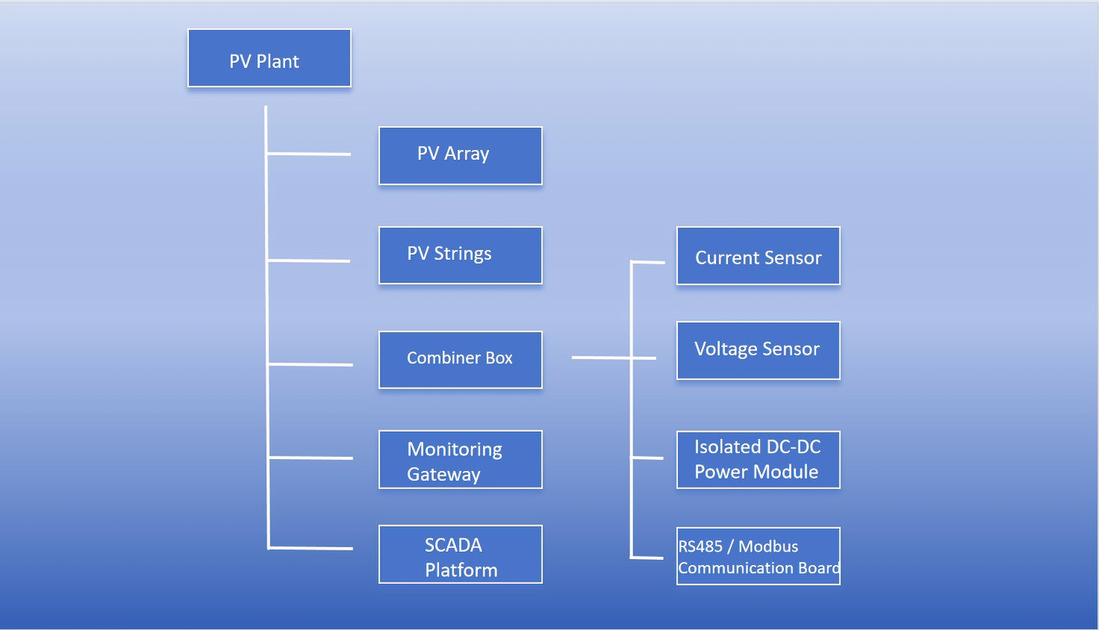
A typical PV String Monitoring System consists of several interconnected layers:
PV Strings
The system begins with photovoltaic strings that generate DC power from solar energy. Multiple strings are typically connected to a combiner box.
Combiner Box
The combiner box consolidates multiple string outputs into a common DC bus. It also provides protection functions such as:
- Fuse protection
- Surge protection devices (SPD)
- DC disconnect switches
Many modern combiner boxes integrate monitoring electronics directly into the enclosure.
Monitoring Sensors
Current sensors and voltage sampling circuits collect operational data from each PV string.
Common monitoring parameters include:
- String current
- String voltage
- Temperature
- Insulation status
- Fault alarms
Monitoring Controller
The monitoring controller processes sensor signals and converts them into usable digital information.
It serves as the central intelligence unit of the monitoring system.
Communication Interface
Collected data is transmitted through communication networks such as:
- RS485
- Modbus RTU
- Modbus TCP
- Ethernet
- Wireless communication systems
SCADA or EMS Platform
The final layer is the supervisory system, where operators can view real-time performance data, alarms, and historical trends.
SCADA and Energy Management Systems (EMS) provide centralized monitoring for large solar installations.
How Data Flows Through the Monitoring Architecture
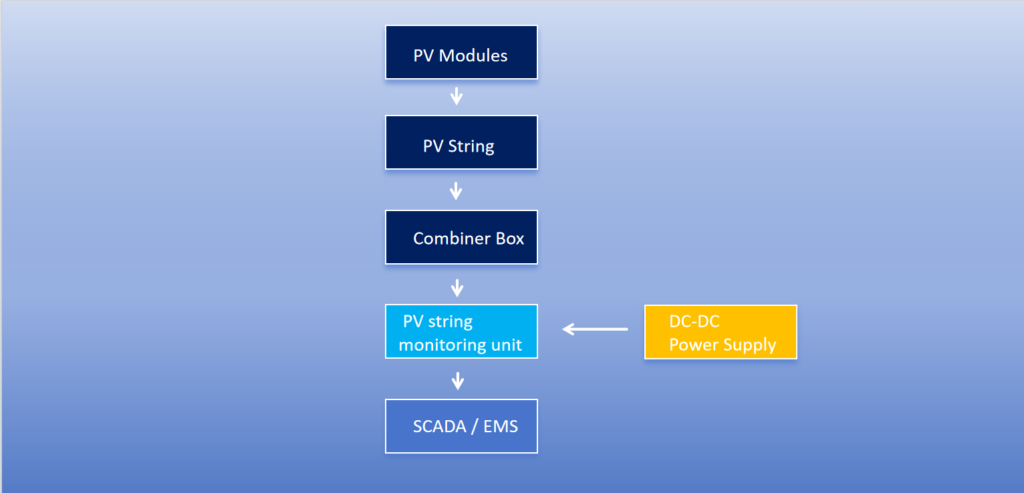
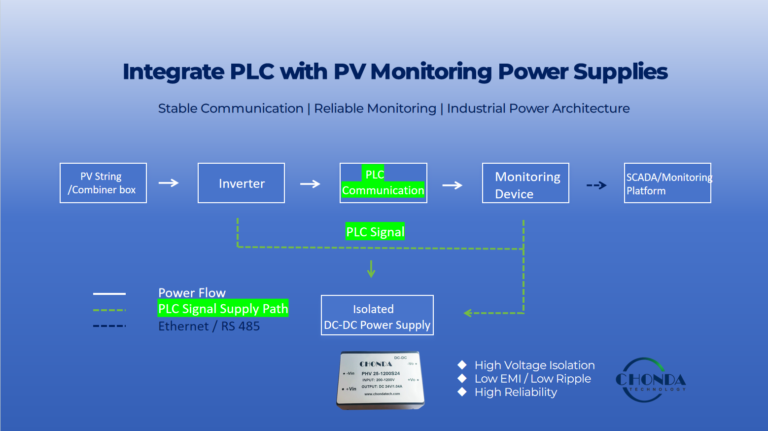
The monitoring process follows a simple sequence:
- Electrical data is collected from PV strings.
- Sensors measure current and voltage values.
- Monitoring controllers process the signals.
- Communication modules transmit the data.
- SCADA platforms analyze and display system performance.
This architecture enables continuous visibility into the operational condition of each PV string.
The Role of DC-DC Power Supplies in PV Monitoring Systems
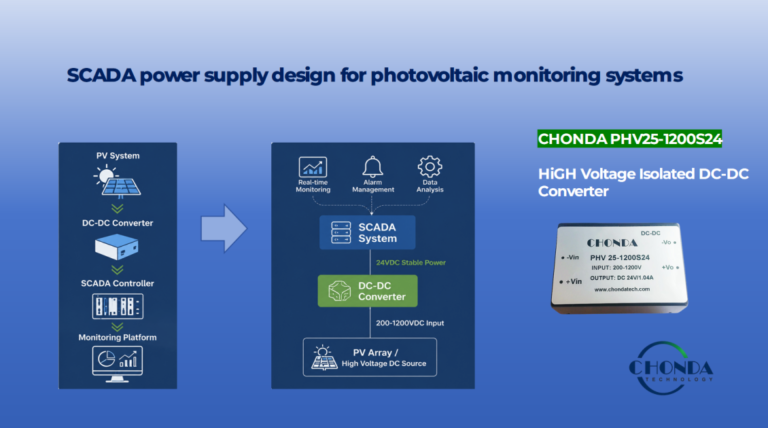
In many utility-scale photovoltaic projects, monitoring devices are installed inside combiner boxes or remote monitoring stations where stable auxiliary power is required.
A common architecture uses a high-voltage DC input from the solar field and converts it into a regulated low-voltage output for monitoring electronics.
For example, CHONDA’s isolated DC-DC converters can be used to provide stable 24VDC or 12VDC power for:
- PV string monitoring controllers
- Communication gateways
- RS485/Modbus modules
- SCADA interface equipment
This architecture improves system reliability while simplifying field installation.
Reliable power is critical for monitoring equipment operating in outdoor solar environments.
A dedicated isolated DC-DC power supply is commonly used to power:
- Monitoring controllers
- Communication modules
- Sensor circuits
- Data acquisition systems
.png)
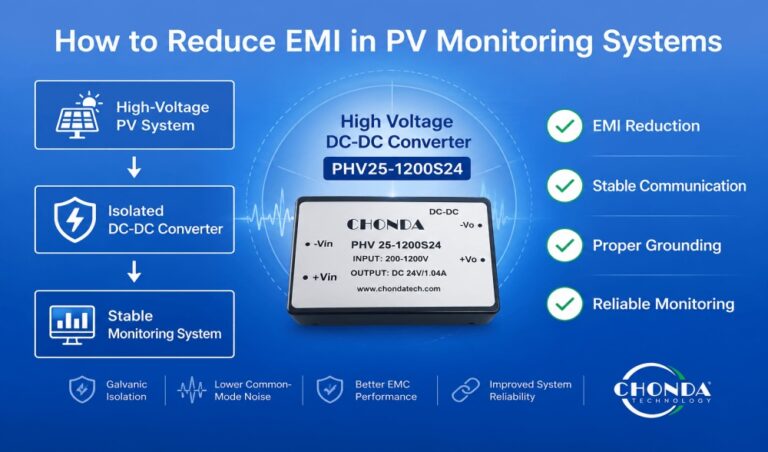
Benefits of isolated DC-DC converters include:
Electrical Isolation
Isolation protects sensitive electronics from high-voltage transients and ground potential differences.
Improved Reliability
Stable power delivery ensures uninterrupted monitoring performance.
Noise Immunity
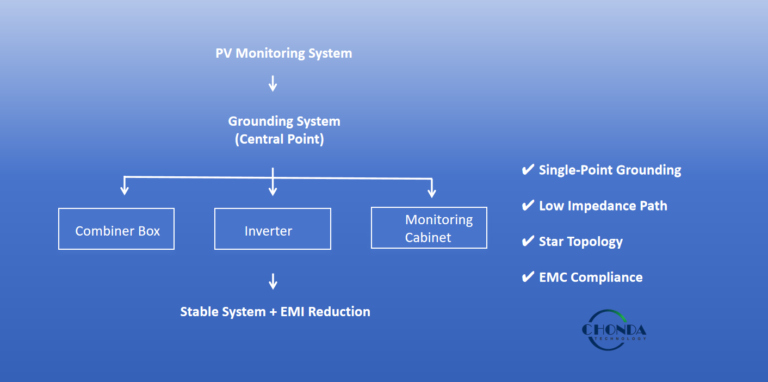
Isolation reduces electrical noise that may affect measurement accuracy.
Protection Against Harsh Environmental Conditions
Industrial-grade DC-DC converters are designed to withstand temperature fluctuations, electrical disturbances, and long-term field operation.
Combiner Box Monitoring Architecture
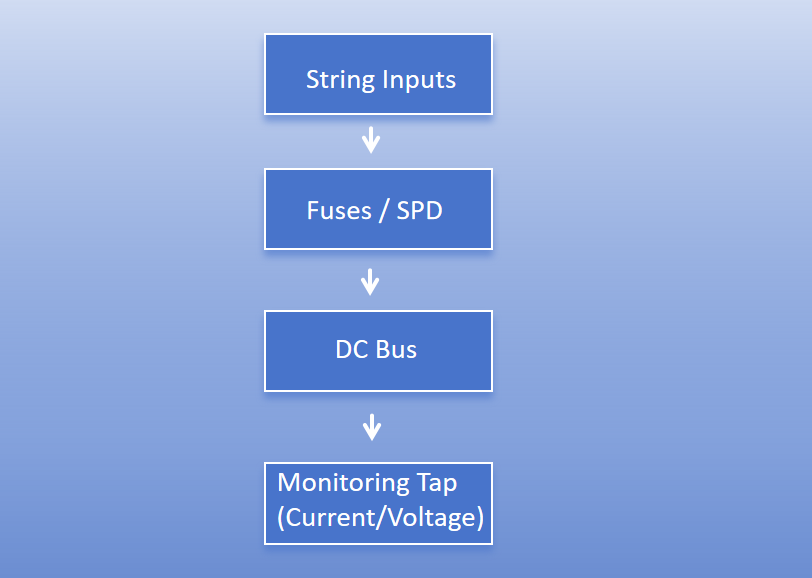
Inside a monitored combiner box, current and voltage measurements are typically collected before data is transmitted to the monitoring controller.
Key monitoring functions include:
• String current measurement
• DC voltage monitoring
• Fuse status monitoring
• Surge protection monitoring
• Fault detection and alarm reporting
Combiner box monitoring serves as the foundation of most utility-scale PV string monitoring systems.
Typical Power Architecture Inside a Smart Combiner Box
A modern smart combiner box typically contains not only protection devices and monitoring electronics, but also an isolated power subsystem.
The DC-DC converter provides the operating voltage required by:
• Current sensors
• Voltage sampling circuits
• Monitoring controllers
• Communication interfaces
Without a reliable power supply, monitoring data may become unstable or unavailable, especially in harsh outdoor environments.
Benefits of a Well-Designed Monitoring Architecture
A properly designed PV String Monitoring System offers several advantages:
- Faster fault detection
- Improved energy yield
- Reduced maintenance costs
- Better asset management
- Enhanced system reliability
- Improved plant availability
For large solar power plants, these benefits can significantly improve long-term return on investment.
Conclusion
A PV String Monitoring System combines sensors, monitoring controllers, communication networks, power supplies, and SCADA platforms into a unified architecture that provides real-time visibility into solar plant performance.
As photovoltaic installations continue to grow in scale, reliable monitoring infrastructure becomes increasingly important. Engineers must evaluate not only monitoring functions and communication capabilities but also the reliability of the supporting power architecture.
Selecting an isolated DC-DC converter with a wide input range, high isolation voltage, and industrial-grade protection can significantly improve long-term monitoring stability and system availability.
For utility-scale solar projects, reliable power solutions have become an essential part of modern PV monitoring architectures.
To learn more about power solutions for PV monitoring applications, explore our PV String Monitoring Power Supply Solutions page.
🔵 Explore System Design Layers
This architecture is part of a larger PV monitoring ecosystem:
👉 PV String Monitoring Basics
Understand how measurement data is collected at string level.
👉 Role of Isolated DC-DC Power Supply in PV Monitoring Systems
Learn how power supply ensures stable operation of monitoring electronics.
👉 Power Design for Smart Combiner Boxes
See how power architecture is implemented inside combiner boxes.
👉 Back to Overview
Return to the full system introduction.